
Standalone DJ systems do everything a laptop-and-controller rig does — analysis, effects, streaming, stems — without the laptop. We tested and compared the eight that matter, from a $699 first system to $3,199 club-grade flagships. Here’s what to buy, and exactly who each one is for.
The verdict in 30 seconds
The only standalone that genuinely feels like a CDJ-and-DJM club booth. rekordbox and Serato.
Four decks, onboard stems with no laptop, the deepest streaming, lighting — and ~$1,000 less than the flagships.
Most of the Prime 4+ feature set, built-in speakers, onboard stems — for well under $1,500.
Four channels, individual deck screens, statement looks. The booth centrepiece — if you can skip performance pads.
The world’s first standalone with motorised platters — real vinyl feel, Serato chops, no laptop.
A single-screen CDJ-3000-style setup for home. The training ground for club gear, full DJM FX.
Battery-powered, backpack-sized, Bluetooth in and out. Take the party to the beach.
Real standalone DJing — streaming, speakers, stems — for $699. The cheapest honest way in.
At a glance
| System | OS | Decks / ch. | Onboard stems (no laptop) | Streaming | Built-in speakers | Battery | Price (USD) |
|---|---|---|---|---|---|---|---|
| XDJ-AZ | rekordbox + Serato | 4 / 4 | No | 2 services | No | No | ~$3,199 |
| OPUS-QUAD | rekordbox + Serato | 4 / 4 | No | 2 services | No | No | ~$3,199 |
| Rane System One | Engine DJ + Serato | 2 / 2 | Yes* | Multiple | No | No | ~$2,499 |
| Prime 4+ | Engine DJ + Serato | 4 / 4 | Yes | 5+ services | No | No | ~$2,199 |
| XDJ-RX3 | rekordbox + Serato | 2 / 2 | No | 2 services | No | No | ~$1,999 |
| OMNIS-DUO | rekordbox-ready | 2 / 2 | No | Limited | Yes | Yes | ~$1,499 |
| SC Live 4 | Engine DJ + Serato | 4 / 4 | Yes | 6+ services | Yes | No | ~$1,299 |
| Mixstream Pro+ | Engine DJ + Serato | 2 / 2 | Yes | 6+ services | Yes | No | ~$699 |
* System One stems are played back standalone but pre-analysed in Engine DJ desktop first. Engine DJ stems playback needs a one-off $9.99 licence. Prices are current street figures and move with deals — check the live listing before buying.
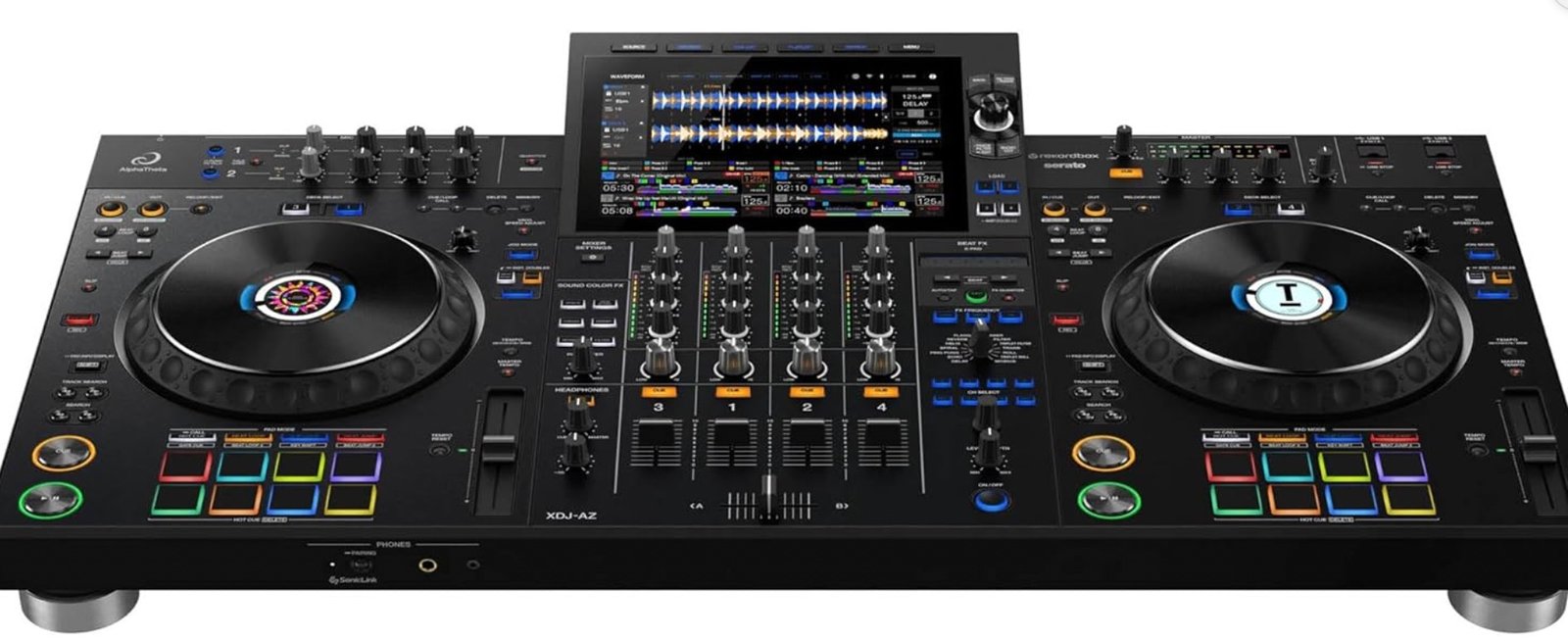
1. AlphaTheta XDJ-AZ
If your goal is to walk into any club, step up to the CDJ-3000s and DJM-A9 in the booth, and feel instantly at home, the XDJ-AZ is the standalone that gets you there. It’s the only all-in-one on the market that genuinely replicates the club workflow — full-size jogs, a proper four-channel mixer layout, Beat FX and Sound Color FX lifted straight from the flagship DJM, and PRO DJ LINK so it slots into a wider club setup. It runs both rekordbox and Serato, and its SonicLink wireless and built-in transmitter pair with AlphaTheta’s wireless headphones.
The catch is what it leaves out: only two streaming services, and no onboard stem separation without a laptop — a real gap in 2026 when cheaper Engine DJ units do stems standalone. You’re paying a premium for feel and club authenticity, not feature count. For aspiring and working club DJs, that trade is the entire point. For everyone else, the Prime 4+ below does more for a grand less.
- Closest thing to a real CDJ/DJM booth
- rekordbox and Serato
- PRO DJ LINK + SonicLink wireless
- Replaces the discontinued XDJ-XZ
- No standalone stems (laptop needed)
- Only two streaming services
- Most expensive on this list
We pit it head-to-head with the Prime 4+ in a dedicated comparison — read XDJ-AZ vs Prime 4+ if those two are your shortlist.
Check prices →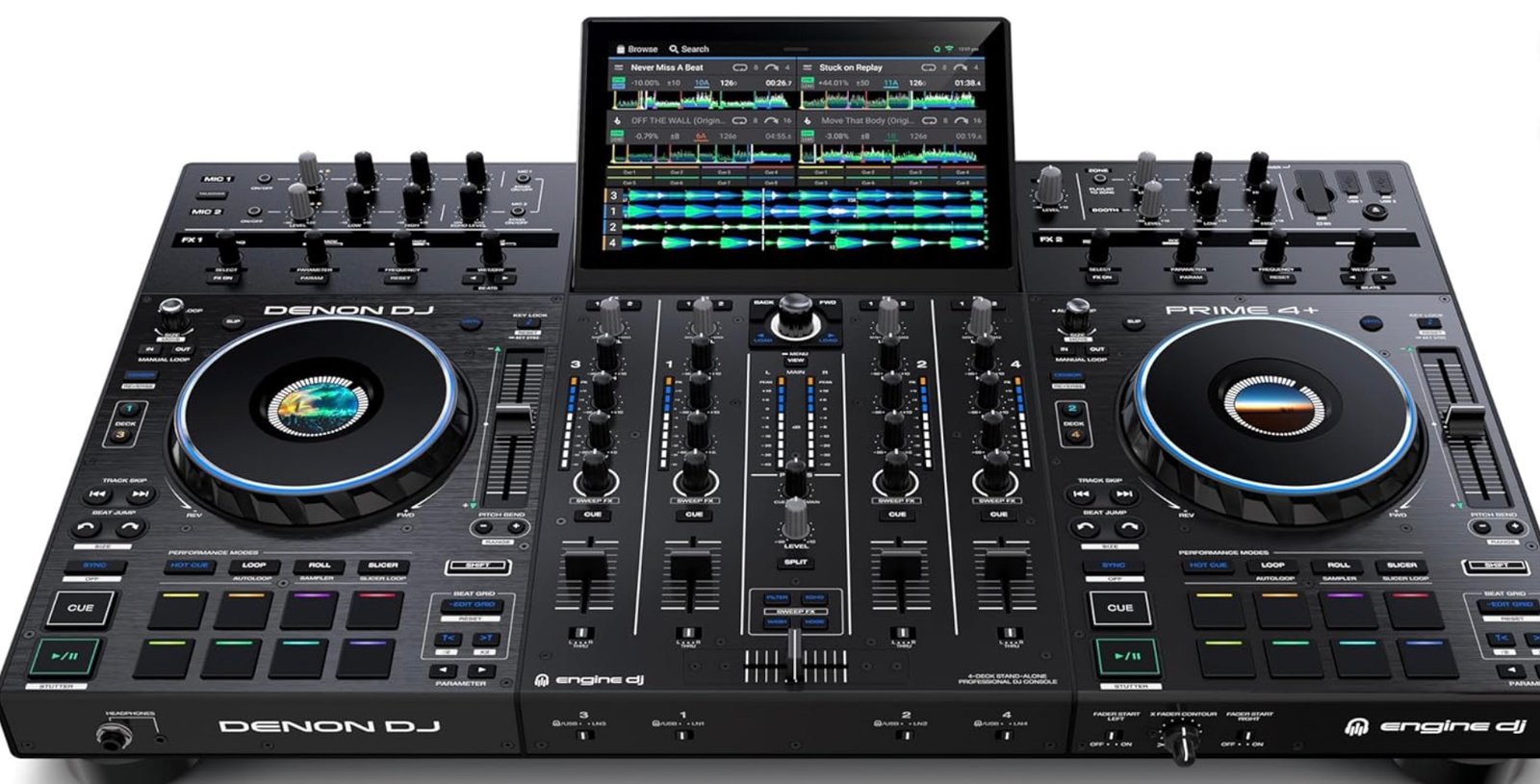
2. Denon DJ Prime 4+
If you’re not married to rekordbox, the Prime 4+ is the smartest money on this list. It’s a four-deck standalone with a huge tilting 10.1″ touchscreen, a built-in hard-drive bay, real-time stems with no laptop, the deepest streaming line-up here (Tidal, Beatport, SoundCloud Go+, Amazon Music and more), zone output for a second room, and SoundSwitch lighting control baked in. It even reads rekordbox-analysed USBs. For mobile and event DJs especially, it does more out of the box than anything else and costs around a thousand less than the rekordbox flagships.
It doesn’t have the big-jog, club-DJM feel of the XDJ-AZ or OPUS-QUAD, and it’s a heavy, semi-permanent lump. But on pure capability per dollar, nothing else comes close. This is the unit we recommend to most working DJs who want one box that does everything.
Standalone gear earns its money at paid work, where a laptop failure has an audience — it’s one piece of the wider setup a paid gig needs.
- Onboard stems, no laptop
- Deepest streaming + internal drive bay
- Zone out + built-in lighting control
- ~$1,000 less than the flagships
- Not the club-DJM feel of the AZ
- Big and heavy for transport
- Engine DJ, not rekordbox
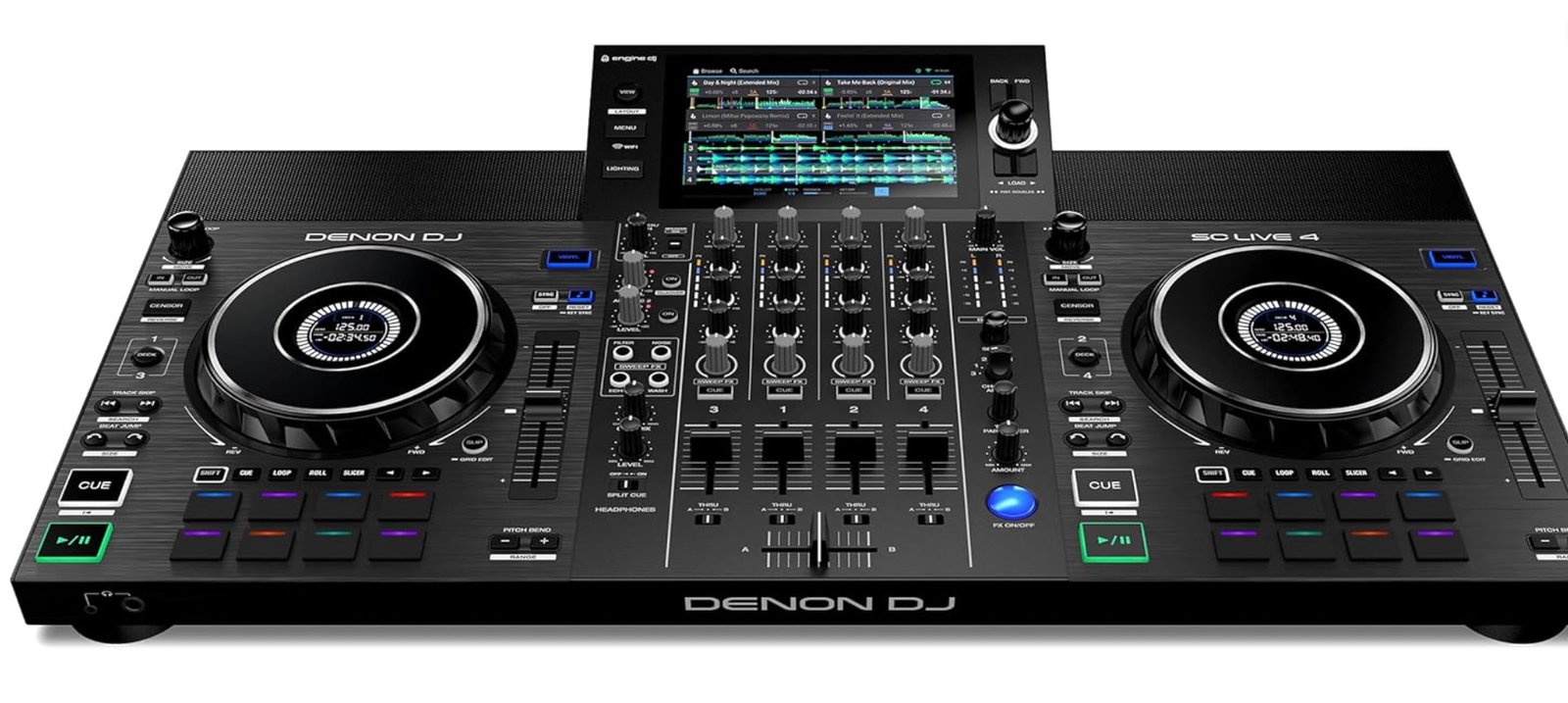
3. Denon DJ SC Live 4
The SC Live 4 is the value pick of the whole category. It borrows its layout and workflow from Denon’s flagship Prime gear, gives you four decks, onboard stems, six-plus streaming services and a 7″ touchscreen — then adds genuinely usable built-in speakers, all for under $1,500. For a bedroom DJ stepping up, a content creator, or anyone who wants to practise and stream without rigging up monitors, it’s almost unreasonable value.
The compromises are sensible ones: the screen is smaller and doesn’t tilt, the build is plastic rather than the Prime 4+’s metal, and there are no external inputs beyond a mic — so no plugging in turntables. If those don’t matter to you, this is the most system you can get for the money.
- Four decks + onboard stems under $1,500
- Built-in speakers — practise anywhere
- Six-plus streaming services
- Serato DJ Pro licence included
- No external inputs (mic only)
- Smaller, non-tilting screen
- Plastic build, Wi-Fi only (no Ethernet)
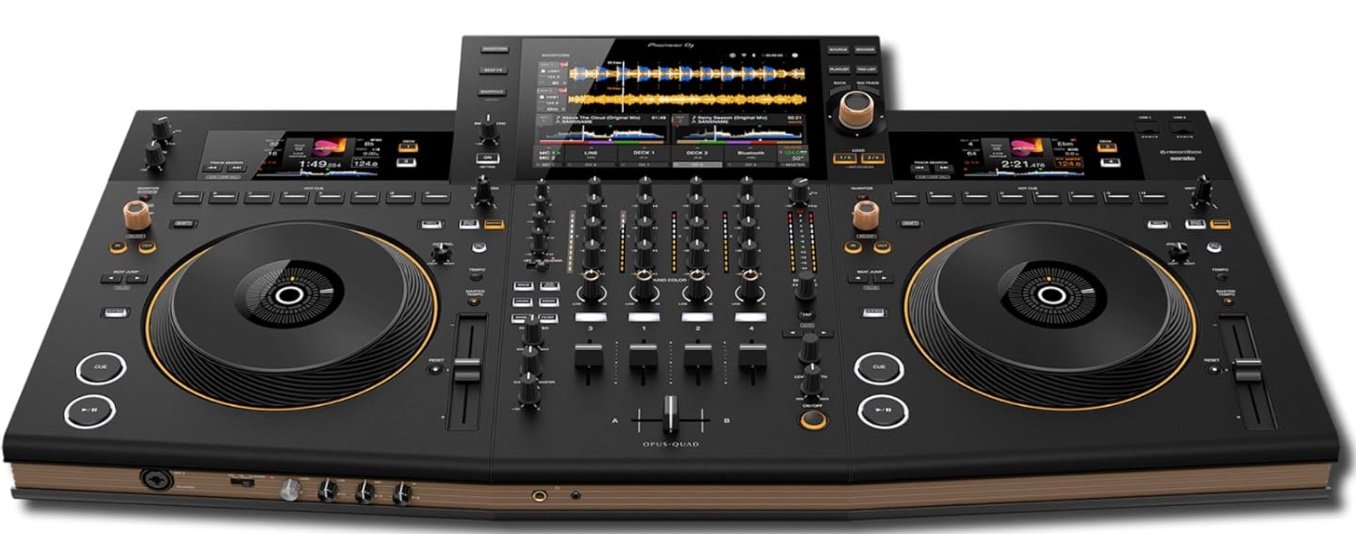
4. Pioneer DJ OPUS-QUAD
The OPUS-QUAD is Pioneer’s statement piece: a four-channel standalone with angular, bronze-accented looks, a big central touchscreen and individual screens above each deck for a CDJ-like read on every track. Sound quality and the full Pioneer FX suite are excellent, there’s a Smart Rotary Selector and a zone output, and it simply looks like nothing else in a fixed booth or high-end home setup.
It’s a polarising design, though, and the big omission is no performance pads — a genuine dealbreaker if hot cues and beat-juggling are core to your style. At the same ~$3,199 as the XDJ-AZ, the AZ is the more versatile club tool; the OPUS-QUAD is for DJs buying on aesthetics, deck-screen workflow and the conductor-style layout.
- Individual per-deck screens
- Statement design for installs
- Full Pioneer FX + zone out
- rekordbox and Serato
- No performance pads
- No standalone stems
- Priciest, and divisive looks
5. Rane System One
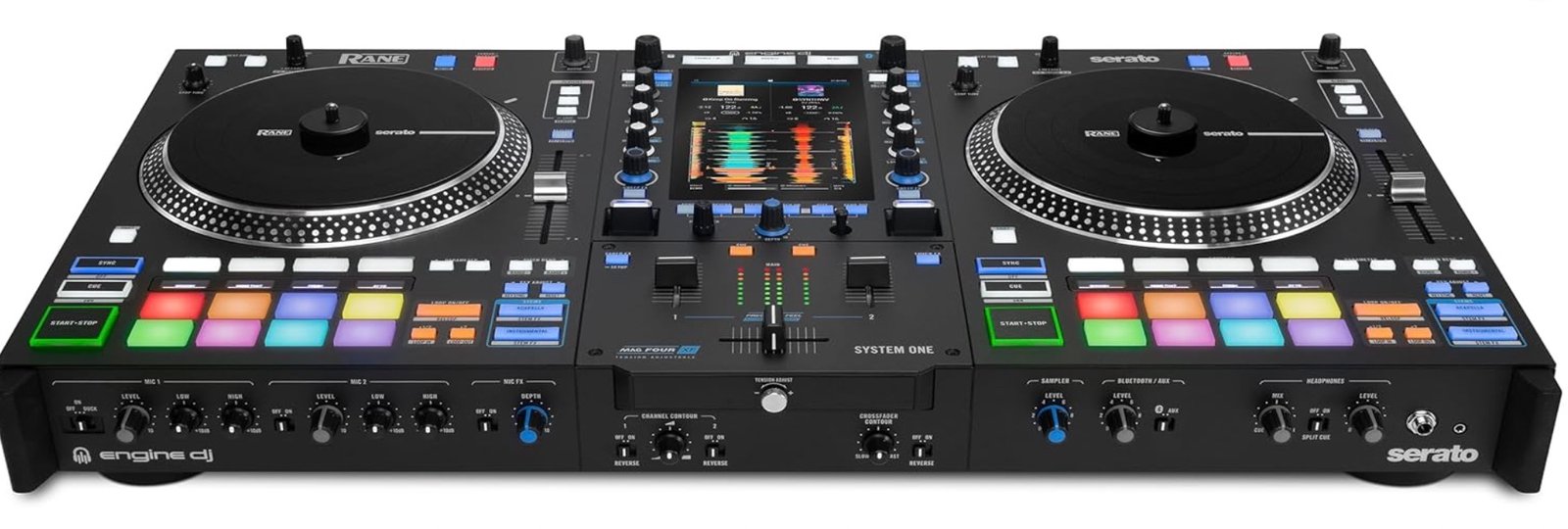
Released in January 2026, the System One is the world’s first standalone DJ system with motorised platters — the same high-torque 7.2″ platters as the Rane One. For scratch DJs and turntablists, that mechanical feel is the whole game, and Rane’s OmniSource tech means you can move between USB, streaming and Serato with no reboot. It comes with a high-end Mag Four crossfader (adjustable curve and tension), crisp OLED pads, and the build quality you’d expect from a Rane mixer running Serato — except it runs entirely on its own.
The limits are real and priced-in: it’s two channels only, there are no external inputs (so no real turntables despite the mixer pedigree), and at this price you’re paying squarely for the motorised feel. If you don’t scratch, you’re spending a premium on platters you won’t fully use — but if you do, nothing else on this list comes close.
- Only standalone with motorised platters
- Mag Four crossfader + OLED pads
- OmniSource: USB/streaming/Serato, no reboot
- Award-winning build
- Two channels only
- No external inputs
- Overkill if you don’t scratch
We put it through a full workout in our Rane System One review.
Check prices →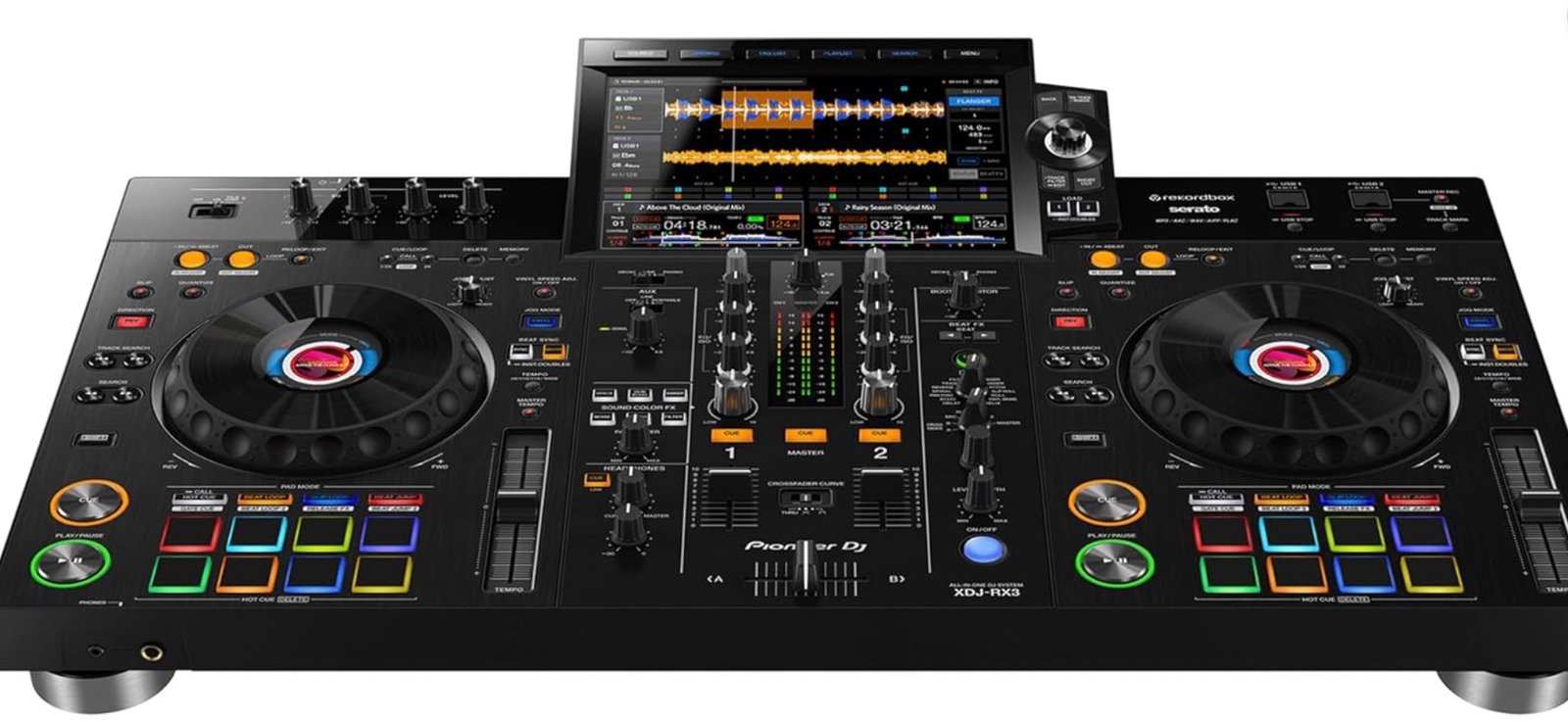
6. Pioneer DJ XDJ-RX3
The XDJ-RX3 has quietly become one of the most popular standalones around, and it’s easy to see why: it feels like a single-screen CDJ-3000 setup you can keep at home. You get the full bank of 14 Beat FX and 6 Sound Color FX from a DJM, a big bright touchscreen, full-size jogs, and both rekordbox and Serato support. As a training ground for the club rigs you’ll meet out in the wild, it’s hard to beat — at roughly a third of the cost of an actual CDJ-3000 pair plus mixer.
It’s strictly two channels, there are no onboard stems, and the OMNIS-DUO’s newer interface makes the RX3’s UI feel a touch last-generation. But for a home club-style setup that prepares you for real booths, it remains a benchmark.
- CDJ-3000-style feel at home
- Full DJM FX suite
- rekordbox and Serato
- Proven, hugely popular
- Two channels only
- No standalone stems
- UI starting to feel dated
7. AlphaTheta OMNIS-DUO
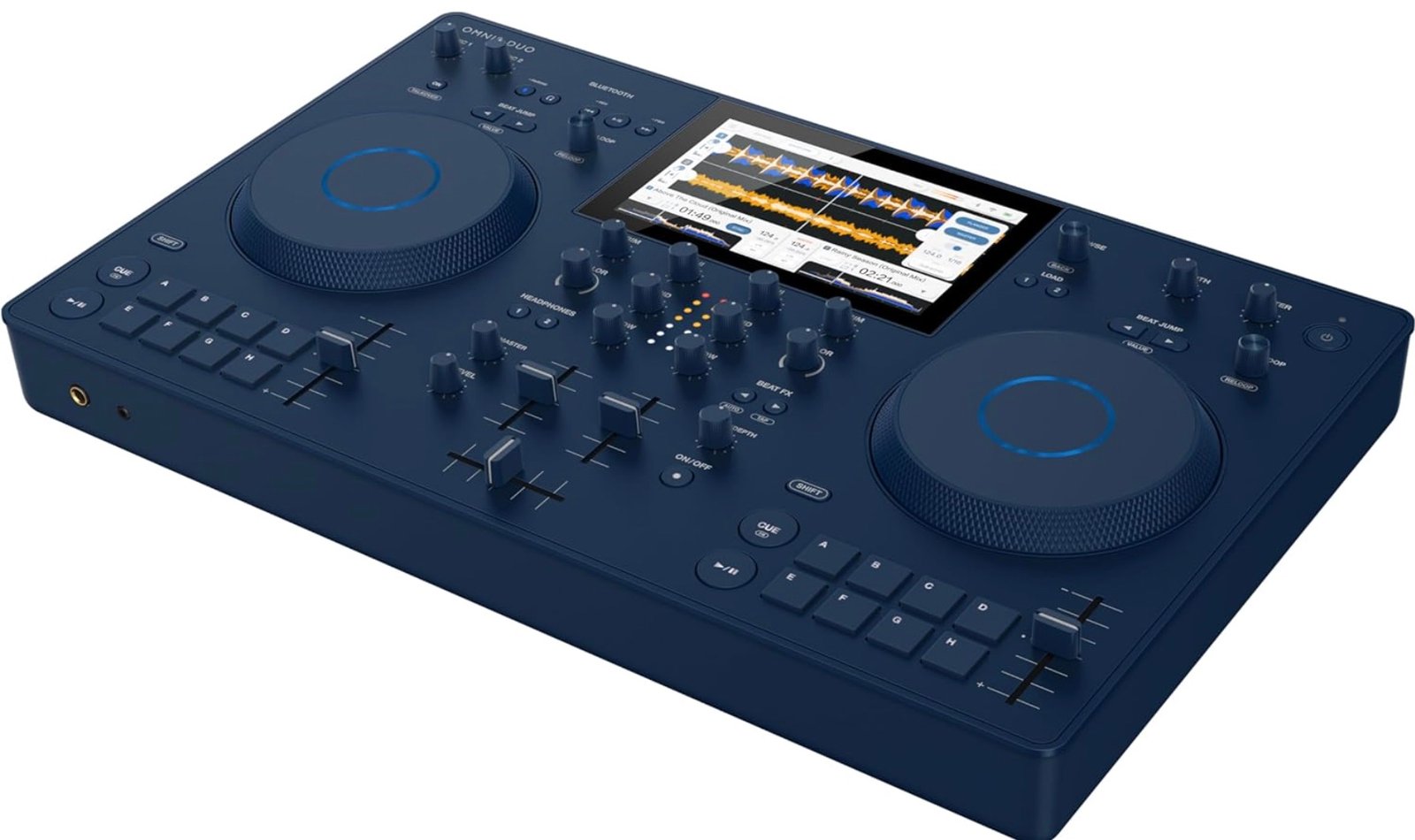
The OMNIS-DUO was the first product to carry the AlphaTheta name, and it’s the pick when portability comes first. Think of it as a shrunken OPUS-QUAD with a battery: a 2-deck-plus-mixer layout, a clean flat touchscreen with light and dark modes for outdoor visibility, around five hours of battery life, and — a standalone first — Bluetooth in and out. At about 10 lb it genuinely slides into a backpack. It’s the unit for rooftop sets, beach parties and the outdoor segments of complex bookings.
It’s a portable, so expect compromises: smaller controls, limited streaming, and it’s pricier than the budget portables from Denon and Numark. As a pro’s reliable take-anywhere second unit, though, it’s a joy.
- Genuinely backpack-portable
- ~5-hour battery
- Bluetooth in and out
- Modern AlphaTheta interface
- Smaller controls + screen
- Limited streaming integration
- Pricey vs other portables
8. Numark Mixstream Pro+
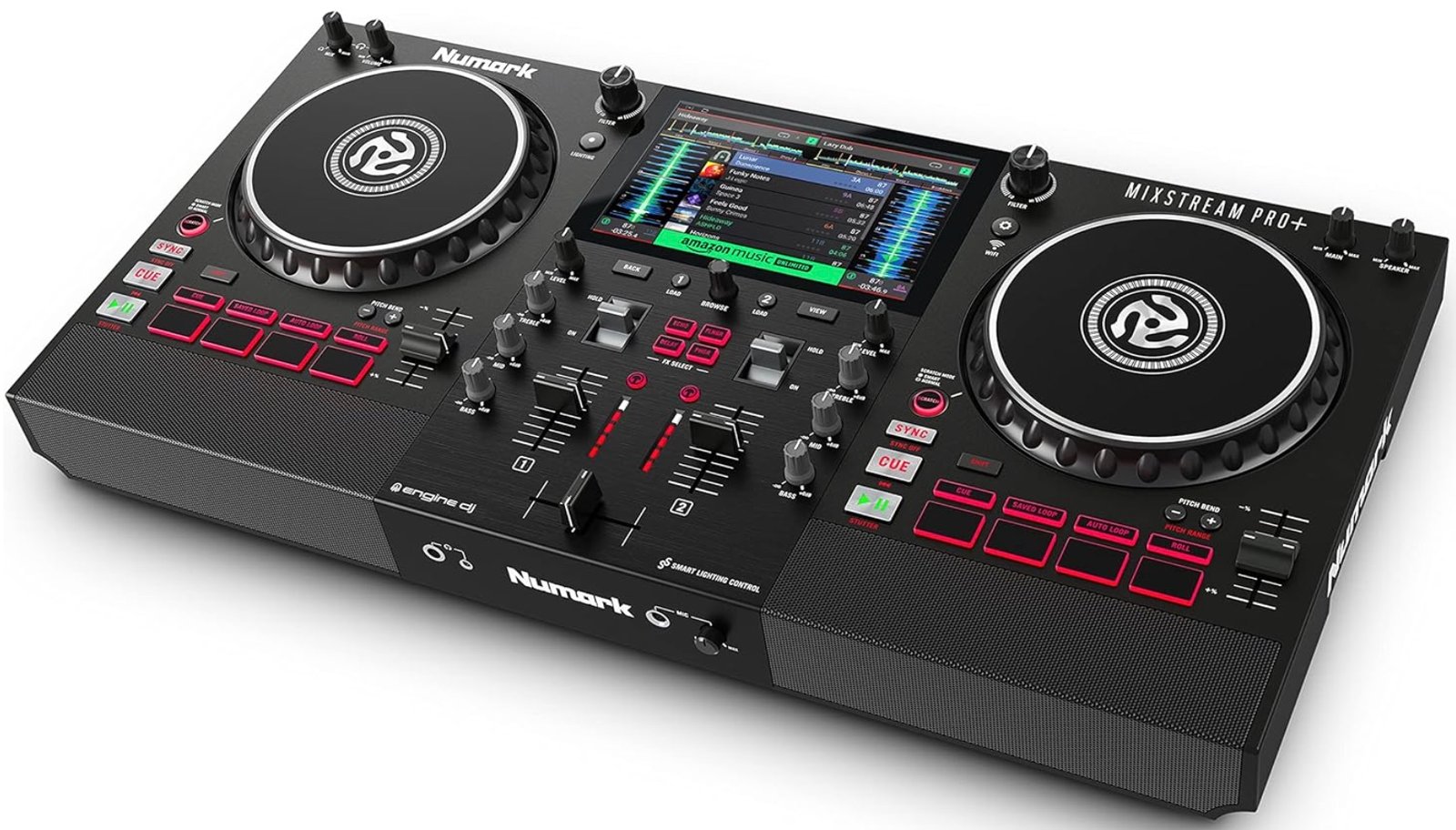
The Mixstream Pro+ is the cheapest honest way into real standalone DJing. At $699 you get the full Engine DJ ecosystem — the same operating system as the Prime 4+ — plus a 7″ touchscreen, six-plus streaming services, onboard stems, built-in speakers, a filter per deck and Philips Hue lighting control. For a complete beginner or anyone who wants laptop-free practice without spending four figures, this punches absurdly above its price.
It’s plastic, it’s two channels, and the jogs and faders feel their price point — but Numark isn’t pretending otherwise. As a first system or a casual second unit, it’s the standout budget choice. (Want the same unit with a battery for true portability? Look at the Mixstream Pro Go.)
- Full Engine DJ for $699
- Onboard stems + built-in speakers
- Six-plus streaming services
- Easiest entry to standalone
- Plastic build, budget feel
- Two channels
- Basic jogs and faders
First decision: rekordbox or Engine DJ
Before features or price, the real fork is the ecosystem — because it shapes how you prep and where you can play. The systems here split cleanly into two camps.
rekordbox (AlphaTheta / Pioneer DJ)
The XDJ-AZ, OPUS-QUAD and XDJ-RX3 run rekordbox. It’s the club standard — if you play venues with CDJs, keeping your library in rekordbox makes life seamless, and these units feel like the gear you’ll meet in the booth. The trade-off is shallower streaming and, on these models, no standalone stems.
Engine DJ (Denon / Numark / Rane)
The Prime 4+, SC Live 4, Mixstream Pro+ and Rane System One run Engine DJ. Its edge is flexibility: deeper Wi-Fi streaming, onboard stems on most units, and the handy ability to import rekordbox-analysed libraries. If you’re not tied to playing CDJ clubs, Engine DJ generally gives you more for your money.
If you also use software with a laptop, our DJ software comparison breaks down Serato, rekordbox, Traktor and VirtualDJ side by side.
How to choose
Club-bound DJ
You want to walk into any booth and feel at home. Get the XDJ-AZ, or the XDJ-RX3 on a tighter budget.
Mobile / event DJ
One box that does weddings, corporate and clubs. The Prime 4+ — zone out, lighting, the lot.
Beginner / bedroom
Real standalone without the spend. The Mixstream Pro+ at $699, or step up to the SC Live 4.
Scratch / turntablist
You need platters that fight back. The Rane System One — nothing else does motorised standalone.
Content creator
Built-in speakers and onboard stems for clips and streams. The SC Live 4 is purpose-built for it.
Travel / outdoor
Battery power and a backpack fit. The OMNIS-DUO takes the party anywhere.