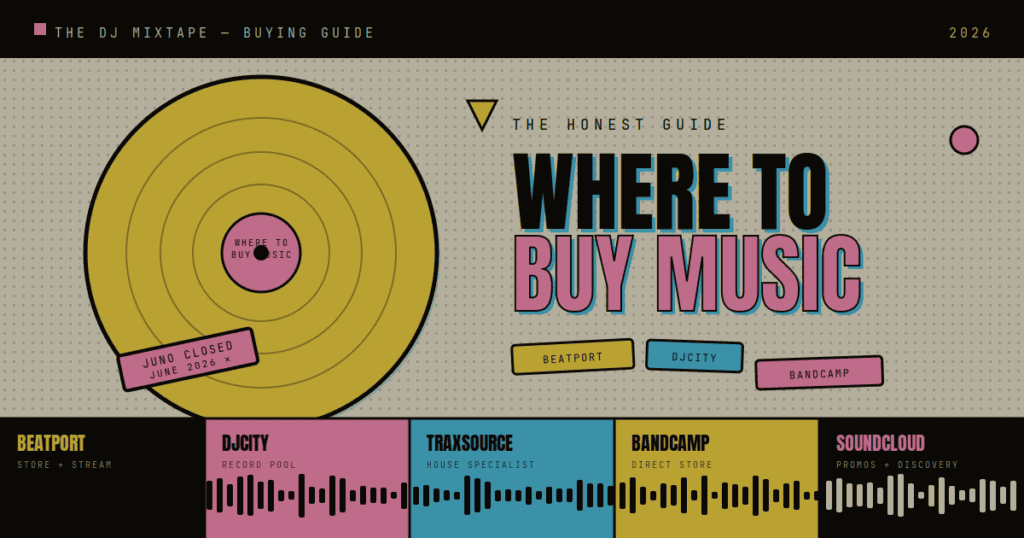
Start with the news: Juno Download closed in June 2026. If you were buying records there, you need a new plan. And even if you weren’t, the broader landscape for buying DJ music has shifted significantly — streaming is eating into à-la-carte downloads, Beatport has merged Beatsource into its platform, and AI stem tools are quietly changing how DJs get what they need from a track.
This guide covers where to spend your money in 2026 depending on how you DJ, what genres you play, and how much volume you need.
Some links in this post are affiliate links. If you buy or sign up through them we may earn a small commission at no extra cost to you — it helps fund the site.
Start here: what type of DJ are you?
Playing out multiple nights a week, open format or top 40? A record pool is better value than any download store. DJcity gives you unlimited 320kbps downloads plus radio edits, clean versions and exclusive remixes for a flat monthly fee. The cost per track drops to pennies if you’re downloading at scale.
Underground specialist — house, techno, drum and bass? Beatport for the main catalogue, Traxsource if you’re house-focused, Bandcamp for the labels that don’t bother with either. Buy what you need, own the files.
Just starting out or on a budget? Beatport’s streaming plan gives you access to 9m+ tracks for less than £10/month. It’s not ownership, but it’s a legitimate way to practise and build a set without spending a fortune on downloads you’re not sure about yet.
Beatport — the main store
Beatport is still the largest catalogue of electronic music available anywhere, with around 9–13m tracks depending on who’s counting. Strong across house, techno, drum and bass, trance and every club-oriented subgenre you can name. If you’re buying individual tracks rather than subscribing, this is the default starting point for most DJs.
The streaming side has become more interesting. Beatport absorbed Beatsource — the open-format, DJcity-powered streaming platform — into its own ecosystem from March 2026. The unified platform now covers both underground electronic and open-format catalogues under a single subscription, with the higher-tier plans giving you offline locker access directly inside rekordbox, Serato and Traktor. Check current pricing before committing; the tier structure has been shifting.
One caveat on streaming: tracks stored in an offline locker are tied to your active subscription. Cancel, and you lose access. If you want to own the files permanently, you’re buying downloads.
DJcity — best record pool
DJcity is a record pool, which means you pay a flat monthly subscription and download as much as you want. The catalogue is built around open-format — hip-hop, R&B, Latin, pop, club bangers — with a particular strength in radio edits, intro/outro versions and exclusive remixes you won’t find anywhere else. First month is discounted heavily; annual plans work out significantly cheaper per month.
The workflow is clean. Files come down as 320kbps MP3s with properly tagged metadata that imports sensibly into Serato and rekordbox. DJcity’s integration with Beatsource (now folding into Beatport’s platform) also means it’s increasingly plugged into the wider streaming ecosystem. We put the service through its paces in our full DJcity review — pricing tiers, catalogue depth, and how the downloads actually perform in the booth.
If you’re downloading dozens of tracks a week, record pools win on pure economics. At DJcity’s annual rate you’re spending less than £2 a track even if you download moderately. At Beatport’s à-la-carte prices that’s one track.
Traxsource — best for house
Traxsource is a boutique house store and it doesn’t pretend otherwise. Soulful house, deep house, afro house, tech house, jackin’ house, nu-disco — if that’s your world, Traxsource’s curation and chart system beats Beatport despite having a smaller overall catalogue. Genre specialists consistently rate it higher for discovering the right tracks in the right subgenre.
Pricing sits broadly in line with Beatport for recent releases, with a cheaper Classic tier for older catalogue. WAV and AIFF are available at slightly higher prices. No streaming or record pool — pure à-la-carte downloads.
Bandcamp — underground and independent labels
Bandcamp remains the best place to buy from underground and independent labels that either can’t be bothered with Beatport’s submission process or actively prefer to deal directly with their audience. A huge amount of house, techno, bass music and experimental club music lives here and nowhere else.
Downloads are DRM-free in your choice of format — MP3, FLAC, WAV, AAC. Bandcamp Friday (eight dates in 2026) waives the platform’s cut entirely, so every penny goes to the artist. If you care about supporting the labels and artists you actually play, Bandcamp Fridays are worth building a buying habit around.
No DJ software integration. Traditional download-and-import workflow. Which for a lot of DJs is exactly how they prefer to work.
On ownership: Bandcamp was sold to Songtradr in 2023 after Epic Games acquired it in 2022. The artist-first model and revenue share have been maintained under the new ownership. As of 2026 it remains independently operated and viable.
SoundCloud — promos, white labels and discovery
SoundCloud isn’t really a place to buy music, but it’s where a lot of working DJs find it. Promos, white labels, edits, unsigned artists posting early material — the discovery function is still unmatched. SoundCloud Go+ (around £10/month) gives you full catalogue access and offline playback. The DJ-specific plan (~$20/month) adds integration with rekordbox, Serato, VirtualDJ and others and unlimited offline storage in those apps.
The legal position is the same as Beatport Streaming: Go+ is technically for personal and private use, not public performance. In practice most DJs treat promos and white labels from SoundCloud as fair game for the booth, but it’s worth knowing the line.
What about Juno Download?
Juno Download closed in June 2026. It had been one of the better underground stores for house, techno and drum and bass, and its loss is felt particularly in those communities. If you had a Juno account, your purchased files are yours — the question is just where you go next. Beatport and Traxsource are the closest direct replacements depending on your genre.
The AI route: stems and acapellas from anything
Worth mentioning alongside the platforms: AI stem separation has become a legitimate part of how DJs get what they need from a track. Tools like Lalal.ai let you pull clean vocals, drum stems and basslines from any track you already own. In practice that means you need fewer official acapella releases and remixes — you can create what you need from the original.
This doesn’t replace buying music. It extends the usefulness of the music you already have. Read our full Lalal.ai review for the full breakdown.
FAQ
Is Juno Download still working?
No. Juno Download closed in June 2026. Beatport and Traxsource are the closest direct replacements for its catalogue of underground house, techno and drum and bass.
What’s the cheapest way to build a DJ music library?
A record pool subscription like DJcity at its annual rate gives you the lowest cost per track if you’re downloading regularly. For underground electronic music, Beatport’s streaming tier is the cheapest way to access a large catalogue, though you don’t own the files.
Beatport vs DJcity — which should I use?
Different tools for different DJs. Beatport is better for underground electronic specialists who buy carefully selected tracks in smaller volumes. DJcity is better for open-format or high-volume DJs who need large amounts of current, radio-ready content. Many working DJs use both.
Can I use Beatport Streaming tracks in my DJ sets?
Beatport’s streaming terms are written for personal and private use. In practice the offline locker integrations are widely used for DJ sets. Check Beatport’s current terms if this matters to your specific situation.
Is Bandcamp still worth using after the ownership change?
Yes. Bandcamp was sold to Songtradr in 2023 but the artist-first model has been maintained. It’s still the best place to buy from underground and independent labels, and Bandcamp Fridays continue to run in 2026.
What’s a record pool and is it worth it?
A record pool is a subscription service that gives you unlimited downloads of curated, DJ-ready content — usually including radio edits, clean versions and exclusive remixes. Worth it if you’re gigging regularly and downloading in volume. Not worth it if you’re a genre specialist who buys 10-15 carefully chosen tracks a month — à-la-carte is cheaper at that volume.