CDJ-3000X review
The club standard gets a bigger screen, built-in Wi-Fi, and a better DAC. Is it the upgrade — or is the CDJ-3000 still the smart-money buy?
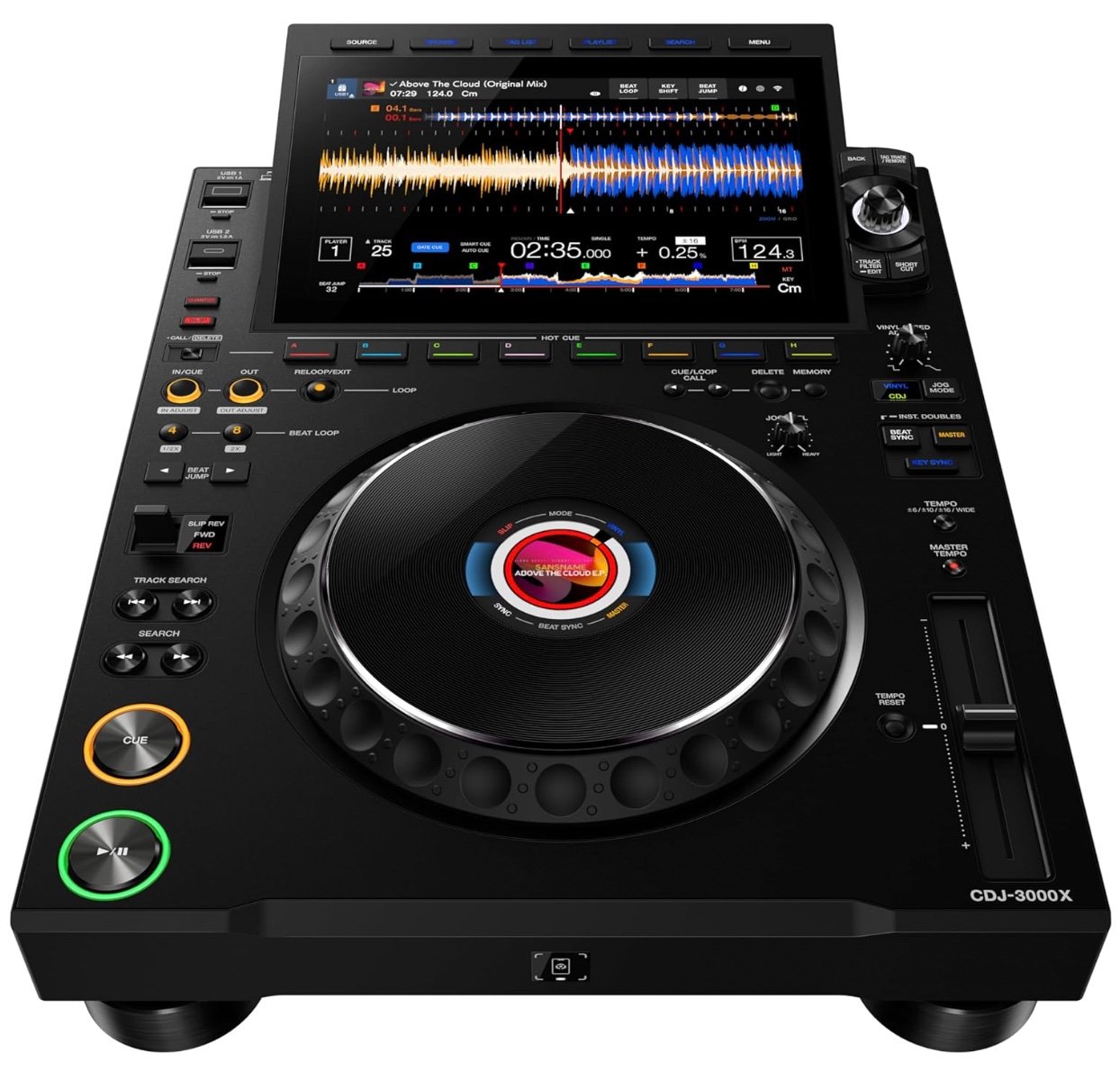
The CDJ-3000X: a 10.1″ glass touchscreen now dominates the top panel.
An exceptional player and the new booth flagship — but an evolution, not a revolution. Most working DJs don’t need to trade up from a CDJ-3000.
Skip if: you already own CDJ-3000s and don’t stream
Price: $2,999 each · ~$5,998 / pair
The short version
The CDJ-3000 has been the undisputed club standard since 2020 — the deck you’ll find in nearly every serious booth on earth. The CDJ-3000X is its successor, and it’s the first top-of-the-line CDJ to launch under the AlphaTheta name rather than Pioneer DJ (same company, same team — Pioneer DJ is now an AlphaTheta brand).
It’s a genuinely better player. But it’s an iterative upgrade, not a reinvention. The headline additions are a bigger 10.1″ screen, built-in Wi-Fi with NFC, an ESS-branded DAC, and modern USB-C. The things many DJs hoped for — onboard stems, a redesigned pad layout, deeper mixer integration — didn’t arrive. If you understand that going in, the X is excellent. If you were waiting for a leap, this isn’t it.
The screen
This is the change you’ll notice first. The touchscreen grows from 9″ to a 10.1″ high-resolution capacitive glass display — enough extra real estate to show up to 16 tracks at once, with crisper waveforms and a roomier library view. Browsing deep crates is faster and less cramped, and the streaming/cloud UI finally has space to breathe. It looks a little tablet-bolted-on from the side, but in use the extra inch genuinely improves the workflow.
Sound
Here’s the nuance worth understanding: on paper, the audio specs are identical to the CDJ-3000 — 4 Hz to 40 kHz frequency response, 115 dB signal-to-noise, 0.0018% THD. So if you only read the data sheet, you’d think nothing changed.
The difference is in the physical components. AlphaTheta swapped in a new 96 kHz / 32-bit ESS Technology DAC and a redeveloped custom power supply. The result isn’t a different number on the spec sheet — it’s a cleaner real-world performance: lower noise floor, better dynamic separation, and more detail when you push a big club system hard. Whether you’ll hear it on a bedroom setup is debatable; on a Funktion-One rig, it’s a real improvement.
Connectivity & media — the big trade-off
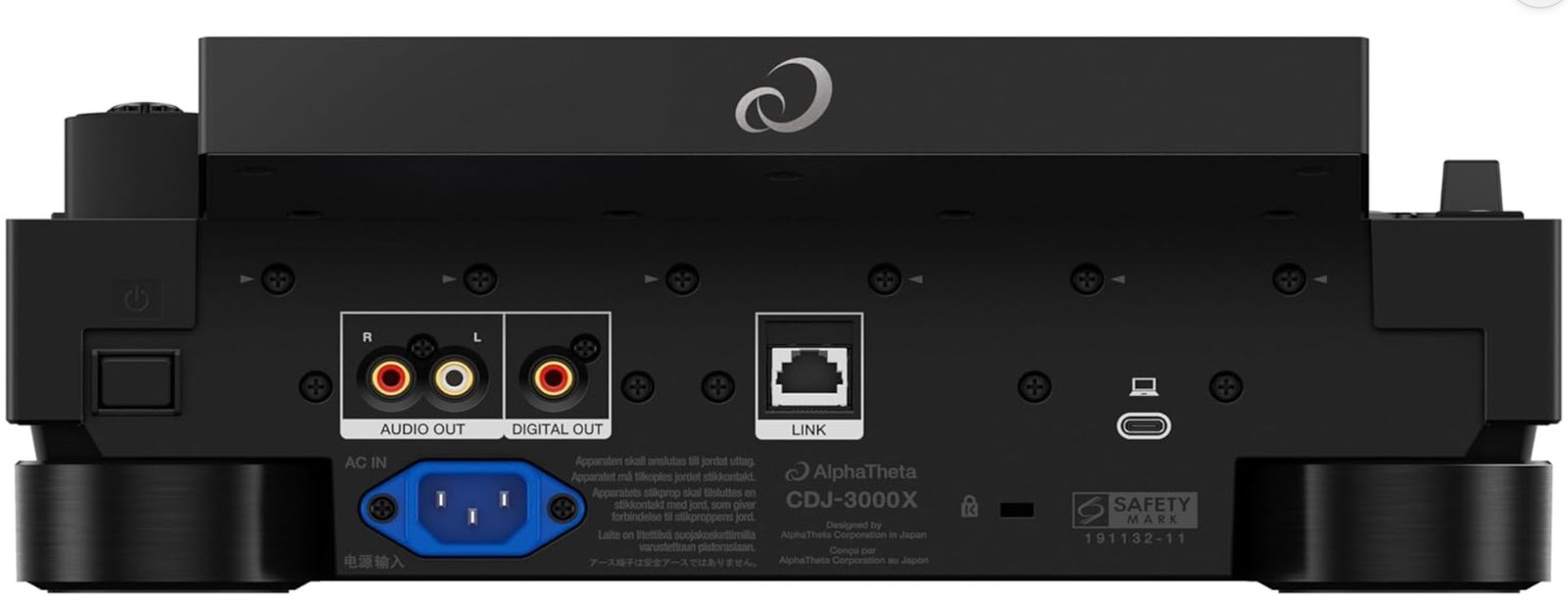
The rear panel: USB-C for PC, Gigabit LAN for Pro DJ Link, analog RCA and digital coaxial out.
Connectivity is where the X modernises hardest. You get built-in Wi-Fi (802.11 a/b/g/n/ac) and a front-panel NFC touchpoint for fast login — no LAN cable required just to reach cloud libraries. Storage moves to USB-C: one USB-A and one USB-C on top for media, plus a second USB-C on the rear for laptop connection. Pro DJ Link stays on Gigabit Ethernet, linking up to six players.
But there’s a real catch, and it’s the most important thing in this review for some DJs: the SD card slot is gone. The CDJ-3000 had one; the 3000X removes it entirely. If you’ve built your workflow around SD cards as a primary or backup media format, the X forces a hard pivot to USB-C drives and the cloud. That’s a deliberate push toward a modern, cloud-centric setup — and a genuine inconvenience if you’re not ready for it.
Supported formats are MP3, AAC, WAV, AIFF, FLAC and ALAC, across FAT16/32, exFAT and HFS+ file systems. Note: NTFS is not supported, so Windows users formatting big drives need to use exFAT.
Streaming & cloud
The X leans into streaming via rekordbox CloudDirectPlay. You can pull libraries from Dropbox and Google Drive, and stream from Beatport, TIDAL, and — as of January 2026 — Apple Music (added in firmware v1.31 alongside rekordbox 7.2.8). For a club deck, that’s a lot of music available without a USB stick.
The honest caveats: it’s rekordbox-centric (you set up and sign into each service in rekordbox first, then authenticate on the player via NFC, QR or an auth-USB), it requires a paid rekordbox plan, and playback is online-only — there’s no offline cached locker on the deck itself. At launch only Beatport and TIDAL worked, and even after Apple Music landed, reviewers reported a fussy setup. Streaming is powerful here, but it isn’t the plug-and-play experience you get on some all-in-one controllers. If a genuinely cloud-first workflow is your priority, a standalone all-in-one like the AlphaTheta XDJ-AN is built around streaming from the outset. Treat it as a bonus, not something to rely on for a critical set on shaky club Wi-Fi.
Build & feel
The jog wheel keeps the same low-latency platform as the 3000 but adds an expanded tension range, so you can dial in a lighter or heavier feel from the top-panel adjust knob. The Play/Cue buttons were rebuilt and are now officially rated for over 500,000 presses each — built for years of marathon sets. The 8 hot cues sit in the same horizontal row under the screen; there’s no controller-style pad bank, and no change to the fundamental layout DJs already know. Pick one up and you’ll feel at home instantly.
Full specifications
| Type | Professional DJ multi player (AlphaTheta) |
| Display | 10.1″ capacitive full-colour touchscreen |
| Hot cues | 8 (A–H) |
| DAC | 96 kHz / 32-bit ESS Technology + custom PSU |
| Audio | 4 Hz–40 kHz · S/N 115 dB · THD 0.0018% |
| Formats | MP3, AAC, WAV, AIFF, FLAC, ALAC |
| File systems | FAT16/32, exFAT, HFS+ (no NTFS) |
| USB | 1× USB-A + 2× USB-C (no SD card slot) |
| Network | Gigabit LAN (Pro DJ Link), Wi-Fi 802.11 a/b/g/n/ac, NFC |
| Outputs | Analog RCA + digital coaxial S/PDIF |
| Software | rekordbox; Serato DJ Pro & djay Pro via HID (licence/sub) |
| Released | September 2025 |
| Price | $2,999 each / ~$5,998 pair |
CDJ-3000 vs CDJ-3000X — do you need the upgrade?
This is the question most people land on this page to answer. The CDJ-3000 is not discontinued — Pioneer DJ still sells it, it’s still the global club standard, and it now sits around $2,500 a deck versus the X’s $2,999. That’s roughly a $500-per-deck premium for the X, or about $1,000 across a pair.
| CDJ-3000 | CDJ-3000X | |
|---|---|---|
| Screen | 9″ touchscreen | 10.1″ touchscreen |
| Wi-Fi / NFC | No | Yes |
| Storage | USB-A + USB-B + SD card | USB-A + 2× USB-C (no SD) |
| DAC / PSU | 96/32-bit (non-ESS) | ESS DAC + new PSU |
| Buttons | Standard | Rebuilt, 500k+ presses |
| Jog | Fixed tension | Expanded tension range |
| Stems | No | No |
| Hot cues / pads | 8, top row | 8, top row (unchanged) |
| Price (each) | ~$2,500 | $2,999 |
The verdict: buy the X if you specifically want the bigger screen, built-in Wi-Fi/NFC streaming, the ESS DAC, or you’re building a brand-new booth you’ll keep for a decade. Buy — or keep — the CDJ-3000 if you don’t stream, rely on SD cards, or already own a pair. The performance paradigm is the same on both; the X is a quality-of-life and future-proofing upgrade, not a new way of DJing.
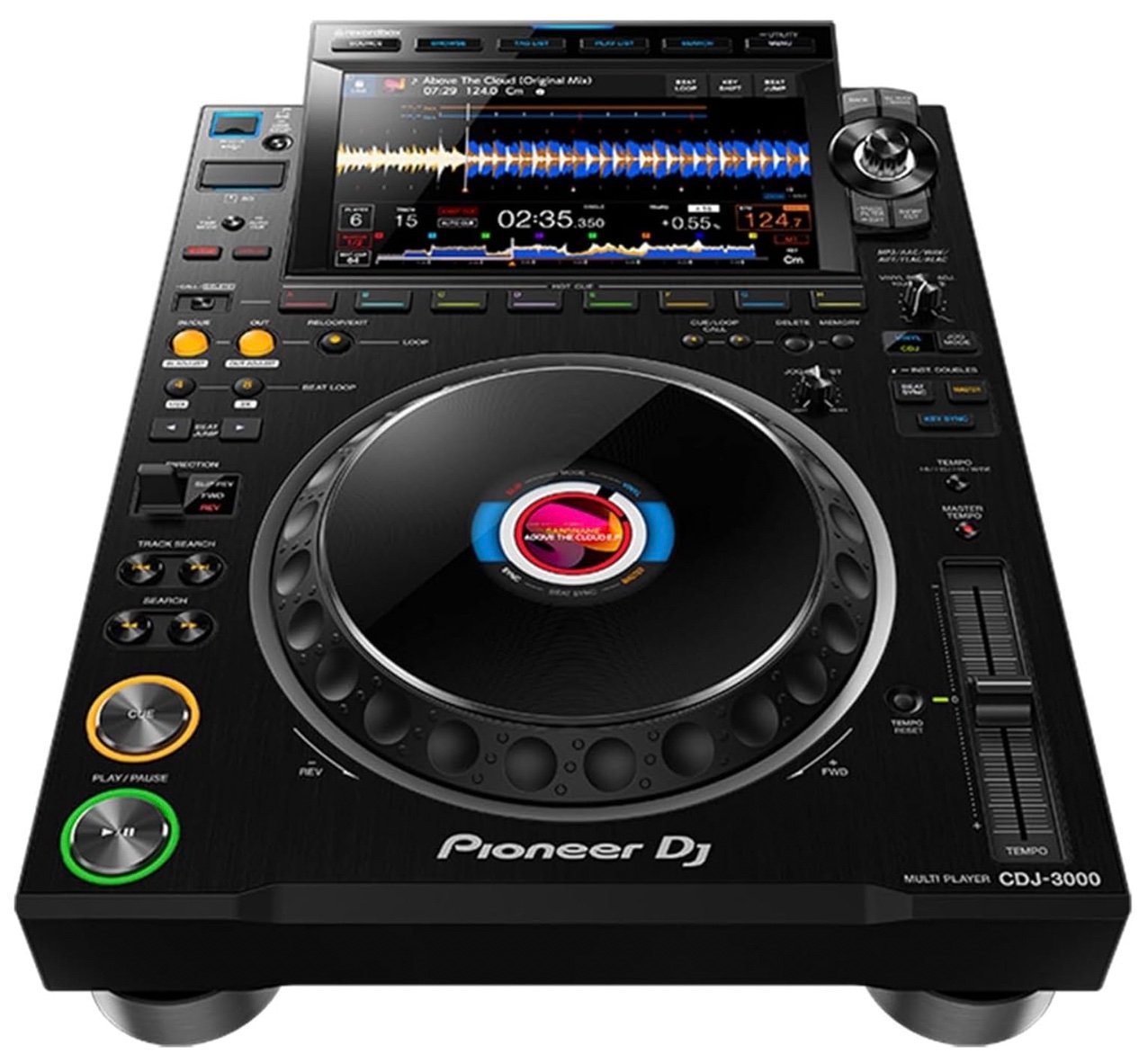
Still the club standard, still sold new, and about $500 cheaper per deck. For most working DJs who don’t stream, this is the smart-money buy.
Check CDJ-3000 price on Amazon →The verdict
The CDJ-3000X is the new flagship and it earns the title: better screen, cleaner sound, modern connectivity, and the bulletproof build the CDJ line is known for. It’s the deck top booths will standardise on over the next few years.
But it’s an evolution. No stems, the same pad layout, a streaming workflow that’s still fiddly, and a price that climbs while removing the SD slot. If you’re outfitting a new club or you’re a streaming-first DJ who wants the latest, buy it without hesitation — it’s a 9.0 for a reason. If you already run CDJ-3000s, there’s no urgent reason to switch. And if you’re a working DJ buying your first pro pair on a budget, the standard CDJ-3000 remains the value champion.
Pros
- Bigger, sharper 10.1″ screen
- Built-in Wi-Fi, NFC & cloud
- New ESS DAC — cleaner on big systems
- Modern USB-C, rebuilt 500k-press buttons
- Flawless build & familiar layout
Cons
- Very expensive ($500/deck over the 3000)
- Still no stems
- SD card slot removed
- Streaming fussy & online-only (paid rekordbox)
- Iterative — not a reinvention
Who should buy it
Still weighing the X against other decks? Our CDJ-1500X vs 3000X vs XDJ-1000MK2 comparison lines it up against the cheaper 1500X and the old-workhorse XDJ-1000MK2, so you can see which player actually earns a place in your rig.
If you’re new to all this, a $6,000 pair of media players plus a mixer is not where you start — see how to start DJing in 2026 for a realistic first setup. If you’re choosing the software that’ll run alongside these decks, our DJ software comparison covers rekordbox, Serato and the rest. And to complete the booth, pair the X with a club mixer from our best DJ mixers guide — the DJM-A9 is the natural partner.
Keep reading
- The best DJ mixers in 2026 — the other half of the booth
- DJ software compared — rekordbox vs Serato vs Traktor vs VirtualDJ
- How to start DJing in 2026 — the beginner’s roadmap
- The CDJ player line-up compared — the X against the 1500X and XDJ-1000MK2
- AlphaTheta XDJ-AN review — the cloud-first standalone alternative
- How Key Sync works on the CDJ-3000X — key & tempo matching explained