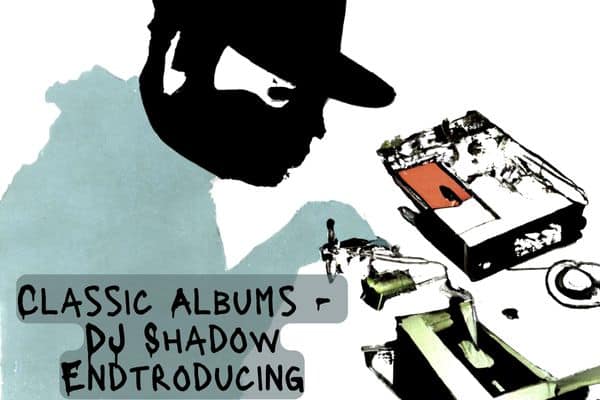
There are albums that do something new, and then there are albums that change what’s possible. DJ Shadow’s Endtroducing, released in 1996, sits firmly in the second category. Made entirely from samples — no live instruments, no session musicians, just records, a sampler and an obsessive ear — it remains one of the most creative and influential records ever made. Not just in hip hop. In music, full stop.

Shadow — born Josh Davis in California — made Endtroducing largely in the back room of a Sacramento record shop called Records, spending hours in the used vinyl bins pulling out sounds most people had never heard of and would never have thought to use. His tools were an Akai MPC60 sampler, Technics SL-1200 turntables, and an Alesis ADAT recorder. His approach was something else entirely.
What set the album apart wasn’t just the sources — jazz, funk, soul, rock, film dialogue, spoken word, world music — but what he did with them. His signature move was chopping samples into tiny fragments and rebuilding them into something unrecognisable from the original. A two-second drum hit becomes a texture. A film score string section becomes atmosphere. A piece of forgotten prog rock becomes the backbone of something completely new. The technique has a name now — micro-sampling — and Endtroducing is largely why.
There’s also a strong storytelling thread running through the album. Film dialogue, ambient sound and spoken word samples don’t just sit there as decoration — they give tracks a sense of place and mood, like scenes from a film you’ve never seen but somehow recognise. It’s that quality that makes Endtroducing feel less like an album and more like an experience.
Below we’ve gone track by track through the key samples on the album. It’s a rabbit hole worth going down.
Best Foot Forward
- Stanley Clarke – “Concerto For Jazz/Rock Orchestra Part II”: The album opens with a nod to Clarke’s fusion masterpiece — a statement of intent about where this record is going.
- Russel Rush & Jazzy Jay – “Cold Chillin’ In The Spot”: A tip of the hat to the hip hop crate-digging culture that gave birth to Shadow’s whole approach.
- Sparky Dee – “He’s My DJ”: A quiet acknowledgment of DJ culture as the foundation everything else is built on.
Best Foot Forward is Shadow setting the scene — introducing you to his world before the album really opens up.
Building Steam With A Grain Of Salt
- Jeremy Storch – “I Feel A New Shadow”: Shadow slips his own name into the fabric of the record — understated but deliberate.
- H.P. Riot – “I Need You”: A melancholic fragment that lifts the emotional temperature of the track considerably.
- Lexia – “I Worship You”: Adds another emotional layer to one of the album’s most introspective moments.
Building Steam is where the album starts to breathe. It’s slow, patient and hypnotic — and a good early sign of how much Shadow trusts the listener.
The Number Song
- Metallica – “Orion”: Yes, really. Shadow lifts from one of Metallica’s most cinematic instrumentals and makes it work in a completely different context.
- Tony Alvon & The Belairs – “Sexy Coffee Pot”: A funky groove that sits quietly in the rhythm bed and keeps things moving.
- Pearly Queen – “Quit Jivin”: Keeps the energy up without ever drawing attention to itself.
The Number Song is the most hip hop-facing track on the album — faster, more kinetic, and a reminder that for all his genre-blending, Shadow never forgot where this music came from.
Changeling
- Tangerine Dream – “Invisible Limits”: Ethereal and slow-moving — exactly what Changeling needs underneath it.
- The Meters – “Here Comes the Metermen”: A bit of New Orleans funk tucked into the rhythm. Shadow’s range of sources in a single moment.
- Kay Gardner – “Touching Souls”: Adds depth to a track that’s already sitting in a very specific emotional space.
Changeling is one of the album’s more elusive tracks — hard to pin down genre-wise, which is entirely the point.
Transmission 1
- “This is not a dream…”, from John Carpenter’s film “Prince of Darkness”: One line of dialogue that opens up a pit of unease. Carpenter couldn’t have planned it better.
Thirty seconds. Completely unsettling. A breather between the album’s bigger moments that somehow makes everything feel heavier.
What Does Your Soul Look Like (Part 4)
- Flying Island – “The Vision and the Voice Part 1 – The Vision”: Esoteric and strange — the kind of record only a serious digger would find.
- From the movie “Deep Calm”: Film dialogue that adds a surreal, half-dreaming quality to the track.
Part 4 is where the album drifts furthest from conventional structure — and it’s all the better for it.
Untitled (Track 6)
- Human Race – “Grey Boy”: A melancholy loop that gives this short, nameless track its particular emotional colour.
Brief and quietly affecting — the kind of moment that would be easy to skip past and impossible to forget once you’ve actually heard it.
Stem
- Nirvana – “Love Suite”: Haunting and unexpected — another moment where Shadow’s instinct for an unusual source pays off completely.
- The Mystic Number National Bank – “Blues So Bad”: A blues fragment that creates a striking contrast with the surrounding textures.
Stem moves between moods in a way that shouldn’t work but absolutely does. The transitions feel inevitable rather than forced.
Long Stem
- Giorgio – “Tears”: Dramatic and cinematic — Shadow uses it to push the track into more emotional territory.
- Murray Roman – “Freedom”: A spoken word fragment that adds another dimension to the track’s atmosphere.
Long Stem extends the emotional weight of Stem rather than releasing it. By the end you feel like you’ve been somewhere.
Transmission 2
- Pekka Pohjola – “The Madness Subsides”: An obscure Finnish progressive rock composer — exactly the kind of source most people would never think to dig for.
- David Axelrod – “The Human Abstract”: Axelrod’s orchestral jazz-rock is a recurring presence across the album. Shadow clearly loved what he found there.
- From the movie “Silent Running”: A single word of dialogue that somehow amplifies the whole thing.
The second Transmission pulls the album deeper into its own world. At this point you’ve stopped trying to categorise what you’re hearing and just let it happen.
Mutual Slump
- Bjork – “Possibly Maybe”: A recognisable source, used in a way that makes it feel completely unfamiliar.
- Motherlode – “Soft Shell”: Soulful and warm — a grounding presence amid the more abstract elements.
- Roger Waters and Ron Geesin – “Seven Dwarves In Penis Land”: An unexpected choice that somehow fits perfectly. Shadow’s sense of humour is very much present.
Mutual Slump is probably the most emotionally open track on the album — vulnerable in a way that a lot of hip hop production never allows itself to be.
Organ Donor
- Samson And Delilah – “There’s A D.J. In Your Town”: A direct nod to DJ culture, fitting for one of the album’s more up-front tracks.
- Giorgio – “Tears”: Shadow returns to this source, getting something different out of it in a new context.
- Bill & Tim – “PM Or Later”: An obscure fragment that adds intrigue without drawing attention to itself.
Organ Donor is tighter and more rhythmically driven than much of the album — Shadow showing he can do focused and energetic just as well as expansive and atmospheric.
Midnight In A Perfect World
- Organized Konfusion – “Releasing Hypnotic Gases”: A hip hop sample that gives the track its sense of forward motion.
- Rotary Connection – “Life Could”: Psychedelic soul that adds warmth and colour.
- Meredith Monk – “Dolmen Music”: An experimental vocal piece used to create an otherworldly quality that sits at the heart of the track.
Midnight In A Perfect World is the album’s emotional peak for a lot of listeners. It’s the track that tends to stay with people longest — melancholic, beautiful and strangely comforting all at once.
Napalm Brain/Scatter Brain
- From the movie “The Aurora Encounter”: Film dialogue that drops you into the middle of something strange before the music even starts.
- Joann Garrett – “Walk On By”: A soulful presence that gives the track emotional grounding.
- Fantastic Epics – “Fun & Funk Part 2”: A funky fragment that injects energy exactly when the track needs it.
Napalm Brain/Scatter Brain is one of the more chaotic moments on the album — intentionally destabilising before the closing stretch brings everything back together.
What Does Your Soul Look Like (Part 1 – Blue Sky Revisit)
- Alan Parsons Project – “Nucleus”: Grand and sweeping — a fitting source for one of the album’s most expansive moments.
- Heath Bros. – “The Voice Of The Saxophone”: A warm jazz presence that lifts the track at exactly the right moment.
- David Young – “Joe Spilivigates”: A drum sample that forms the rhythmic foundation without ever dominating.
Part 1 revisits themes from earlier in the album and brings them to a satisfying resolution — Shadow the composer as much as Shadow the DJ.
Transmission 3
- From John Carpenter’s film “Prince of Darkness”: The Carpenter sample returns one last time — bookending the album’s sense of dread and wonder.
- “It is happening again…”, episode 15 of “Twin Peaks”: A closing line that leaves the door open rather than shutting it. Deliberately unresolved.
Transmission 3 doesn’t close the album so much as let it fade out into something unfinished. Which feels exactly right.
Midnight In A Perfect World (Extended Version)
- Funkadelic – “Wars of Armageddon”: A psychedelic, dissonant choice that adds a final dimension of strangeness.
- “What happened.. what happened that night?”, from the movie “Jacob’s Ladder”: A haunting final line that lingers long after the record stops.

Final Thoughts
Endtroducing is one of those records that rewards repeat listening in a way most albums don’t. The first time through you’re trying to figure out what you’re hearing. By the fifth listen you’re noticing details you missed completely before — a fragment buried in the background of a track, a piece of dialogue that only makes sense once you know what comes next. Shadow built something genuinely deep here, and nearly thirty years later it still holds up completely.
If you’ve never sat down and listened to it front to back in one go, do that. It’s worth the hour.
Go check out DJ Shadow Endtroducing in full here:
We’ve put together a table featuring the samples in the DJ Shadow Endtroducing album. Happy spotting!
| Track | Samples |
| Best Foot Forward | – Stanley Clarke – “Concerto For Jazz/Rock Orchestra Part II” |
| – Russel Rush & Jazzy Jay – “Cold Chillin’ In The Spot” | |
| – Sparky Dee – “He’s My DJ” | |
| – Jeru The Damaja – “You Can’t Stop The Prophet” | |
| – JVC Force – “?” | |
| – Kool G Rap & DJ Polo – “Poison” | |
| – Masters of Ceremony – “Dynamite” | |
| – Stezo – “It’s My Turn” | |
| – Lifer’s Group – “Real Deal” | |
| – Divine Sounds – “Do Or Die Bed-Stuy” | |
| – Beastie Boys – “The Party’s Getting Rough” | |
| Building Steam With A Grain Of Salt | – Jeremy Storch – “I Feel A New Shadow” |
| – H.P. Riot – “I Need You” | |
| – Lexia – “I Worship You” | |
| – “from listening to records I just knew what to do..” from “Music Makers – Percussion” | |
| – Signs Of The Zodiac: Cancer – “Planetary Motivations” | |
| The Number Song | – Metallica – “Orion” |
| – Tony Alvon & The Belairs – “Sexy Coffee Pot” | |
| – Pearly Queen – “Quit Jivin” | |
| – Pink Floyd – “On The Run” (movie version from at Pompeii) | |
| – Jimmy Smith – “8 Counts For Rita” (drums) | |
| – New Fast Automatic Daffodils – “?” | |
| – T La Rock – “Breakdown” | |
| – A Tribe Called Quest – “Can I Kick It? (Spirit Mix)” | |
| – Grandmaster Flash – “Flash It To The Beat” | |
| – Pigmeat Markham/B.Y. and the Turnettes – “Who Got The Number” | |
| – Grandmaster Flash – “Freelance” | |
| – Countdown from the movie “Wild Style” – Fantastic Freaks @ The Dixie | |
| – The Troubleneck Brothers – “Back To The Hip Hop” | |
| Changeling | – Tangerine Dream – “Invisible Limits” |
| – The Meters – “Here Comes the Metermen” | |
| – Kay Gardner – “Touching Souls” | |
| – Kay Gardner – “Inner Mood I” | |
| – Motherlode – “Hard Life” | |
| – Embryo – “Klondyke Netti” (bassline) | |
| – Loudon Wainwright III – “The Man Who Couldn’t Cry” | |
| Transmission 1 | – “This is not a dream…”, from John Carpenter’s film, “Prince of Darkness” |
| What Does Your Soul Look Like (Part 4) | – Flying Island – “The Vision and the Voice Part 1 – The Vision” |
| – “Talk to me.. c’mon old boy.. lose that!..”, from the movie “Deep Calm” | |
| Untitled (Track 6) | – Human Race – “Grey Boy” |
| Stem | – Nirvana – “Love Suite” |
| – “..I tell ya children I could lay right down..”, The Mystic Number National Bank – “Blues So Bad” | |
| Long Stem | – Giorgio – “Tears” |
| – Mother Mallard’s Portable Masterpiece Co. – “Oleo Strut” | |
| – “Parking tickets, you’re crazy.. so they take me in on a chain to long beach.. I am scared”, Murray Roman – “Freedom” | |
| Transmission 2 | – Pekka Pohjola – “The Madness Subsides” |
| – David Axelrod – “The Human Abstract” | |
| – “..latitude..”, from the movie “Silent Running” | |
| – “This is not a dream…”, from John Carpenter’s film, “Prince of Darkness” | |
| Mutual Slump | – Bjork – “Possibly Maybe” |
| – Motherlode – “Soft Shell” | |
| – Pugh – “Love, Love, Love” | |
| – Roger Waters and Ron Geesin – “Seven Dwarves In Penis Land” | |
| Organ Donor | – “..playing a funky solo”, Samson And Delilah – “There’s A D.J. In Your Town” |
| – Giorgio – “Tears” | |
| – Bill & Tim – “PM Or Later” | |
| Midnight In A Perfect World | – “Insight, forsight, more sight…”, Organized Konfusion – “Releasing Hypnotic Gases” |
| – Rotary Connection – “Life Could” | |
| – Meredith Monk – “Dolmen Music” | |
| – David Axelrod – “The Human Abstract” | |
| – Pekka Pohjola – “The Madness Subsides” | |
| – Baraka – “Sower Of Seads” (bass line) | |
| – “The midnight rush”, Akinyele – “Outta State” | |
| Napalm Brain/Scatter Brain | – “Well hello there little buddy. come on in. what ya got there with ya? is that your dog?” from the movie “The Aurora Encounter” |
| – Joann Garrett – “Walk On By” | |
| – Fantastic Epics – “Fun & Funk Part 2” | |
| – Charles Bernstein – “Moment of Truth” | |
| – Tyrannosaurus Rex – “Pon A Hill” | |
| – Daly-Wilson Bigband – “My Goodness” (guitar) | |
| – Billy Cobham – “Funky Kind Of Thing” (drum roll) | |
| – “Testify”, The Original Soul Senders – “Soul Brothers Testify” | |
| – “Napalm, when the bombs activated…”, BQ In Full Effect – “Let the Homicides Begin” | |
| What Does Your Soul Look Like (Part 1 – Blue Sky Revisit) | – Alan Parsons Project – “Nucleus” |
| – Heath Bros. – “The Voice Of The Saxophone” | |
| – Shawn Philips – “All Our Love” | |
| – David Young – “Joe Spilivigates” (drums) | |
| Transmission 3 | – “This is not a dream…”, from John Carpenter’s film, “Prince of Darkness” |
| – “It is happening again…”, episode 15 of “Twin Peaks” | |
| Midnight In A Perfect World (Extended Version) | – Meredith Monk – “Dolmen Music (Overture)” |
| – Rotary Connection – “Life Could” | |
| – Meredith Monk – “Dolmen Music” | |
| – David Axelrod – “The Human Abstract” | |
| – Pekka Pohjola – “The Madness Subsides” | |
| – Funkadelic – “Wars of Armageddon” | |
| – Baraka – “Sower Of Seads” (bass line) | |
| – “The midnight rush”, Akinyele – “Outta State” | |
| – “What happened.. what happened that night?”, from the movie “Jacob’s Ladder” |
FAQ’s
What is DJ Shadow’s Endtroducing album known for?
Endtroducing is widely recognised as the first album ever made entirely from samples. Released in 1996, it holds a Guinness World Record for that distinction. Every sound on the record — drums, melody, texture, atmosphere, spoken word — comes from another source, chopped up and rebuilt into something completely new.
How many samples are used in the Endtroducing album?
Hundreds, spread across the full album. Each track layers multiple samples from different genres, eras and sources — jazz, funk, soul, rock, film soundtracks, spoken word recordings, obscure library music and more. The full sample list (which we’ve included above) runs to well over a hundred individual sources.
What equipment did DJ Shadow use on Endtroducing?
The core setup was an Akai MPC60 sampler, Technics SL-1200 turntables and an Alesis ADAT recorder. Shadow has also spoken about using an E-MU SP-1200 in his production work more broadly. The MPC60 in particular was central to how he chopped, layered and arranged samples on the album.
Where does DJ Shadow source his samples?
Primarily from vinyl — specifically from deep crate digging in used record stores. Much of Endtroducing was built from records found in the bins at a Sacramento shop called Records. Shadow has always been known for seeking out obscure and overlooked pressings rather than obvious sources, which is a big part of why the album sounds so singular.
What makes DJ Shadow’s sampling technique unique?
Shadow’s approach — often called micro-sampling — involves chopping samples into tiny fragments and rebuilding them into entirely new compositions. Rather than lifting a recognisable loop and dropping it into a track, he deconstructs his sources so thoroughly that the original recording becomes raw material rather than a reference point. Combined with his instinct for atmosphere and narrative, it produces music that feels completely original even though every element comes from somewhere else.
If you liked our post on the DJ Shadow Endtroducing album, check out our classic albums review on The Avalanches Since I Left You here:

If you’re interested in learning how to put a DJ mix together in Ableton then check out our Youtube video here: