Updated August 2026 · Originally published 2021
Rotary mixers are still one of the most misunderstood pieces of DJ equipment. To some people they look like boutique toys for house DJs with expensive record collections. To others they’re the most musical way to mix, full stop. The truth sits somewhere in between — and if you’re thinking about buying one, it’s worth understanding exactly what you’re paying for before you drop serious money on a box full of knobs.
This is the complete guide: what a rotary mixer actually is, how it changes the way you play, which features genuinely matter, and every mixer worth considering right now — from a first rotary under $400 to handbuilt machines that cost more than a small car.
The market has moved a long way since we first published this. MasterSounds has stopped building DJ mixers. AlphaTheta released the euphonia. Union Audio’s Orbit.6 redefined what a handbuilt mixer can be. And at the budget end, the Omnitronic TRM-202MK3 still gives people a way in without spending four figures.
Some of the buying links in this guide are affiliate links. If you buy through one, we earn a small commission at no extra cost to you. Every link that points to a manufacturer’s own website is not an affiliate link and earns us nothing — those mixers are here because they belong in this guide, not because anyone pays us. Nobody in this guide was consulted on their placement or paid to appear.
The quick verdict
| Category | Pick | Price | Status |
|---|---|---|---|
| Best budget | Omnitronic TRM-202MK3 | ~$260–360 | Current |
| Best mid-range | Ecler WARM2 | ~$740 | Current |
| Best boutique | Condesa Carmen V | ~$3,030 | Made to order |
| Best luxury | AlphaTheta euphonia | ~$3,799 | Current |
| Best sound | Union Audio Orbit.6 | ~$6,166 | Made to order |
| Best independent | SOA BEM OLHO-2R | ~$1,620 | Made to order |
| Best used classic | MasterSounds Radius 4 | Varies | Discontinued |
Prices are approximate street prices. Several of these mixers are priced by their makers in euros, pounds or Australian dollars, so the US figure moves with the exchange rate and with import duty depending on where you are.
Who are rotary mixers for — and who should avoid them?
- House, disco, techno, balearic
- Lounge and hi-fi bar sets
- Vinyl-first DJs
- DJs who value sound and flow over tricks
- Scratch and battle DJs
- Wedding and open-format DJs
- MC-heavy setups
- Controllerists and pad performers
- Anyone needing built-in effects or a USB interface
If you land firmly in the right-hand column, a rotary mixer is probably the wrong purchase — and there’s no shame in that. A conventional four-channel will serve you better and cost less. Our guide to the best DJ mixers covers that side of the market.
So what actually makes a mixer “rotary”?
The obvious answer is that channel levels are controlled by rotary knobs instead of vertical faders. But that undersells it. A proper rotary mixer isn’t just a normal mixer with the faders swapped out. The best ones are designed around a different mixing philosophy: longer blends, finer control over gain staging, and a layout that encourages patience instead of performance theatrics.
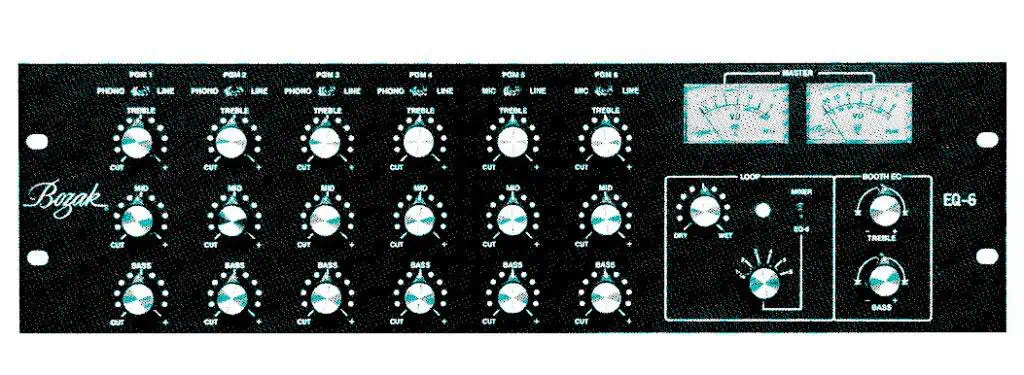
That’s why rotary mixers have such a strong connection to disco, loft parties, audiophile bars and deep house culture. The style goes right back to the classic Bozak and UREI mixers, where DJs weren’t chopping between cue points — they were building a room gradually, record by record, with long transitions and a real focus on sound quality.
The short version: a rotary mixer won’t automatically make your mixes sound better. What it does is encourage a more deliberate, more fluid kind of mixing. If that’s already how you like to play, you’ll probably get on with one. If not, the charm wears off fast.
How rotary mixers change the feel of DJing
The biggest difference is physical. A channel fader is great for quick moves. A rotary pot is better for long arcs. You tend to creep tracks in, hold them together for longer, then bleed one out rather than snapping between them. That makes a real difference to how you think about phrasing and tension.
Once you spend a bit of time on a good rotary, you also start to rely less on obvious tricks. Instead of masking a transition with echo, reverb or a dramatic sweep, you focus more on track selection, EQ balance and timing. That’s part of why rotary culture carries this aura of refinement — sometimes deserved, sometimes overplayed, but it comes from somewhere real.
| Rotary mixer | Club mixer | |
|---|---|---|
| Blending style | Slowly ride levels, shape transitions with isolator and filter moves | Line faders, EQ, filter and often built-in effects |
| What matters most | Flow, tone, headroom, musicality and tactile control | Versatility, speed, performance tools and familiarity |
| Built for | Selectors, vinyl DJs, long-form mixers, audiophile spaces | General club use, open format, digital performance, events |
| What you might miss | Crossfader, onboard FX, pads, USB interface, mic power | The smoother, more “played” feel of a rotary blend |
What to look for before buying one
This is where a lot of rotary content online falls short. People get carried away talking about warmth and soundstage and forget that practical features still matter. Not all rotary mixers are built for the same type of DJ.
1. Channel count
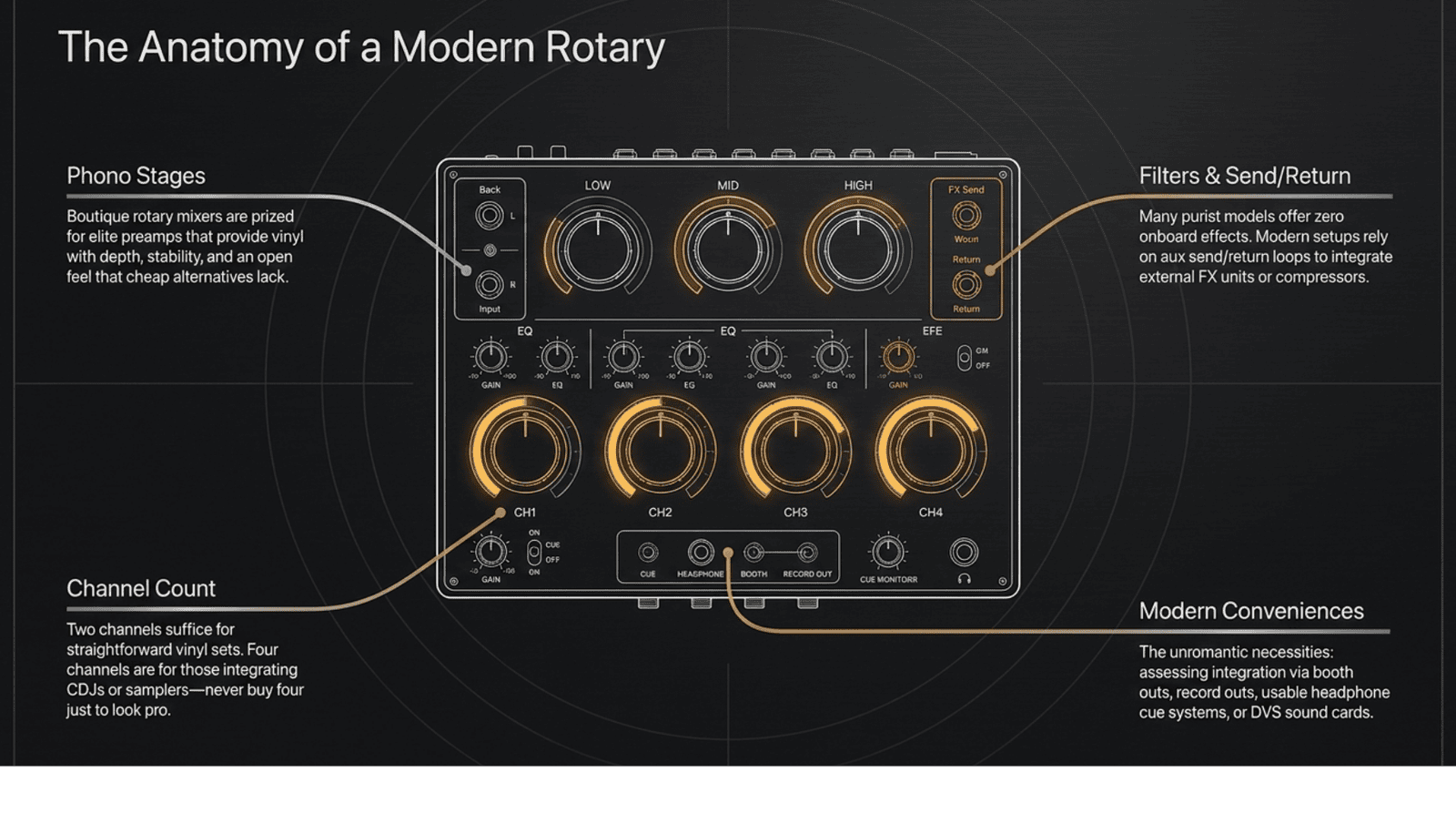
Two channels is enough for a lot of vinyl DJs, especially if your sets are straightforward and you don’t run external gear. Four channels makes more sense if you want CDJs, samplers, drum machines, multiple turntables or just more flexibility. Don’t buy four channels because it feels more “pro” — buy them if you’ll genuinely use them.
2. Phono stages
If you play vinyl, the quality of the phono preamps matters enormously. This is one of the reasons boutique rotary mixers get so much love in the first place. Cheap rotary mixers can look the part but fall short here. A great phono stage gives records more depth, more stability, and more of that “open” feel people talk about. It’s also worth pairing a good phono stage with a deck that deserves it — see our turntable guide if that side of your setup is still up for grabs.
3. Isolator vs standard EQ
A lot of rotary mixers use a master isolator rather than regular per-channel three-band EQs. That’s a big deal.
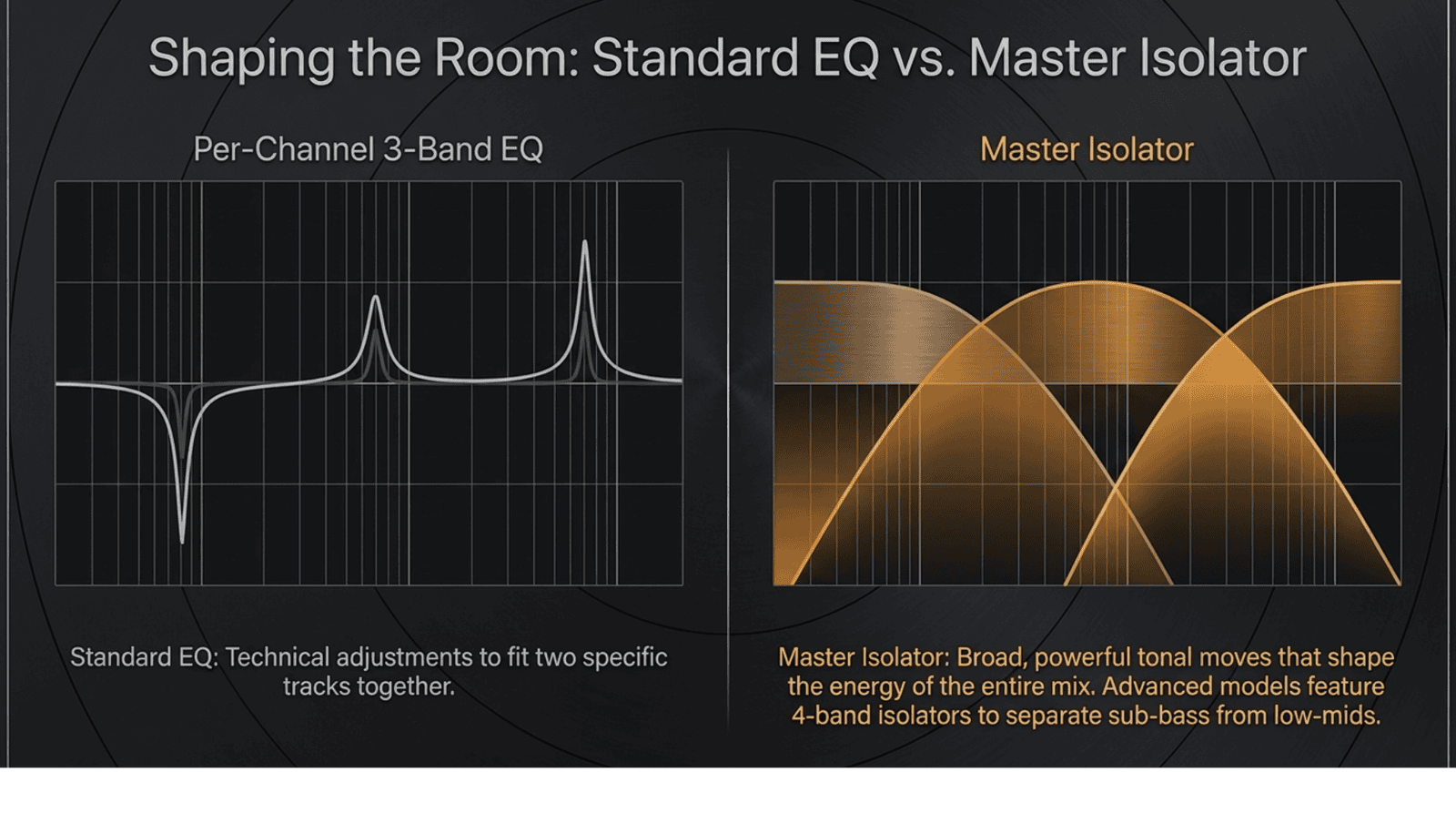
A good isolator lets you make broad, powerful tonal moves across the whole mix. Some mixers go further with four-band isolators, letting you treat subs separately from low mids. If you’re coming from Pioneer land this takes adjustment — but once it clicks, it becomes one of the format’s best features. If you’re not confident with tonal moves yet, our guide to using EQ in a DJ set is the foundation this builds on.
4. Filters and send/return
Some rotary mixers are ultra-pure and offer almost nothing beyond level and isolator control. Others include per-channel filters, high-pass sweeps, master inserts or proper aux send/return loops. This matters more than it used to, because one of the easiest ways to make a rotary practical is to pair it with an external FX unit, isolator or compressor.
5. Modern conveniences
This is the unromantic part, but it’s important. Do you need a microphone input? A record out? Booth out? Headphone cue features that actually feel usable in a dark booth? A built-in sound card for DVS or recording? Plenty of boutique rotary mixers are beautiful right up until you try to integrate them into a real-world setup.
The practical test
If you mostly play at home with turntables and love long blends, a pure rotary makes sense. If you’re bouncing between bars, clubs, events and content-creation setups, ask yourself whether you’re buying a tool or buying a fantasy version of your DJ life.
What the rotary market actually looks like now
The market is healthier than it was a decade ago, but also more fragmented. There are now clear tiers: affordable entry points, mid-tier mixers for serious home setups, and ultra-boutique machines that cost as much as a proper club rig. At the same time, some of the most beloved recent models have become harder to buy new.
| Tier | What it means | Examples |
|---|---|---|
| Budget / first rotary | Enough to learn the format without boutique pricing | Omnitronic TRM-202MK3 |
| Mid-range enthusiast | Better phono stages, stronger build, more confidence in the layout | Ecler WARM2 |
| Boutique / forever mixer | Sound, finish, feel — ownership that borders on obsession | euphonia, Orbit.6, Condesa, E&S |
| Independent builders | Small workshops making made-to-order units at real prices | SOA BEM OLHO-2R |
| Discontinued modern classics | Still desirable, but a used-market hunt rather than retail | MasterSounds Radius 4 |
The MasterSounds situation
For a while the MasterSounds Radius 4 was the easiest modern example of boutique rotary done well: compact footprint, fully analogue layout, musical filters, master isolator, strong sound quality, and a direct link back to Andy Rigby-Jones’s design pedigree. It felt modern without losing that stripped-back rotary identity.
But in 2024 MasterSounds announced they were building their final batches of DJ mixers and would not continue production, which moved the Radius line into “modern classic” territory. It doesn’t make the Radius 4 any less desirable — it just means you can’t walk into a shop and order one.
What it doesn’t mean is that MasterSounds have walked away from the mixers they built. Legacy units still come back through the company and are resold through MasterSounds Approved, their own section for returned and refurbished stock. Availability is intermittent and you’re at the mercy of whatever has come in, but it’s the closest thing to a proper retail route that still exists for a Radius — and it beats gambling on a private sale.
So there are two honest answers here, depending on how set you are on the Radius specifically. If you want that mixer, watch Approved and be patient. If what you actually love is the concept — compact, analogue, elegant, no wasted features — then the more useful question is which current-production mixer delivers that balance without putting you on a waiting list at all. The rest of this guide answers the second one.
Full comparison
| Mixer | Ch. | Best for | Price band | Status |
|---|---|---|---|---|
| Omnitronic TRM-202MK3 | 2 | First rotary, learning the format | Budget | Current |
| Ecler WARM2 | 2 | Serious home DJ, mid-budget | Mid-range | Current |
| SOA BEM OLHO-2R | 2 | Handmade analogue, fully customisable | Boutique | Made to order |
| Condesa Carmen V | 4 | Boutique vinyl setup, hi-fi bar | Boutique | Made to order |
| AlphaTheta euphonia | 4 | Flagship digital + analogue hybrid | Luxury | Current |
| Union Audio Orbit.6 | 6 | Ultimate sound, no compromise | Ultra-boutique | Made to order |
| MasterSounds Radius 4 | 4 | Compact analogue classic | Used market | Discontinued |
| Rane MP2015 | 4 | Legacy rotary with modern features | Used market | Discontinued |
| E&S DJR-400 | 4 | Pure analogue, specialist | Used / waitlist | Limited |
Rotary mixers you can buy new
1. Omnitronic TRM-202MK3 — best budget rotary
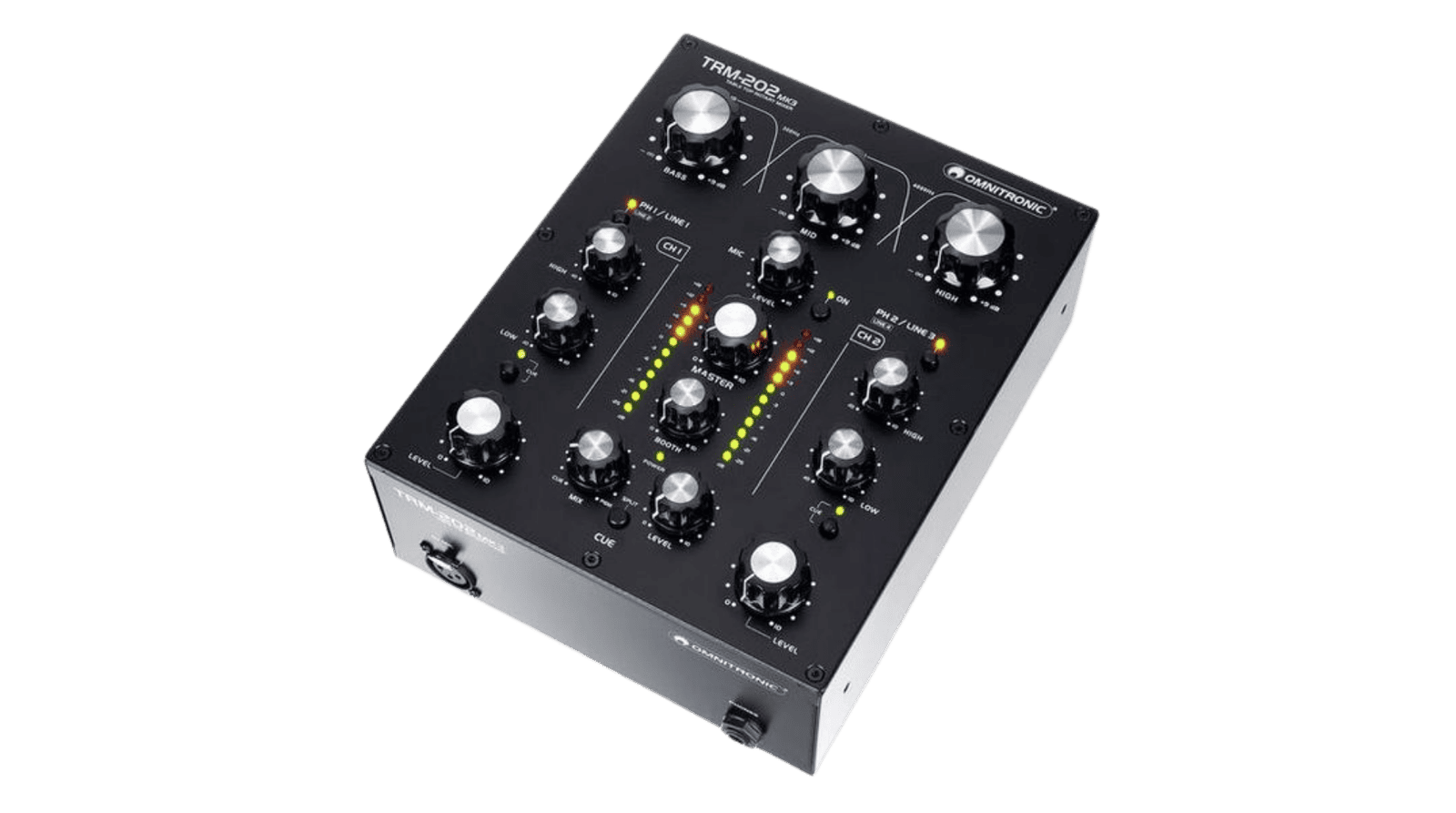
If you want to know whether the rotary format suits you without spending boutique money, this is the one. The TRM-202MK3 is a two-channel rotary with a three-band isolator, phono/line inputs, and build quality that’s more than adequate for home use and small bar gigs.
Nobody’s going to confuse this with a handbuilt Union Audio or a Condesa. The phono stages are decent rather than exceptional, the knob feel is functional rather than silky, and the isolator doesn’t have the surgical precision of a high-end unit. But that’s not the point. The point is that for somewhere around $260–360, you get a genuine rotary mixing experience that teaches you the workflow before you commit serious money.
For a first rotary, or a second mixer for home practice, this is an easy recommendation.
★★★★☆ 8.2 · ~$260–360 · Current production
Check the price →2. Ecler WARM2 — best mid-range rotary
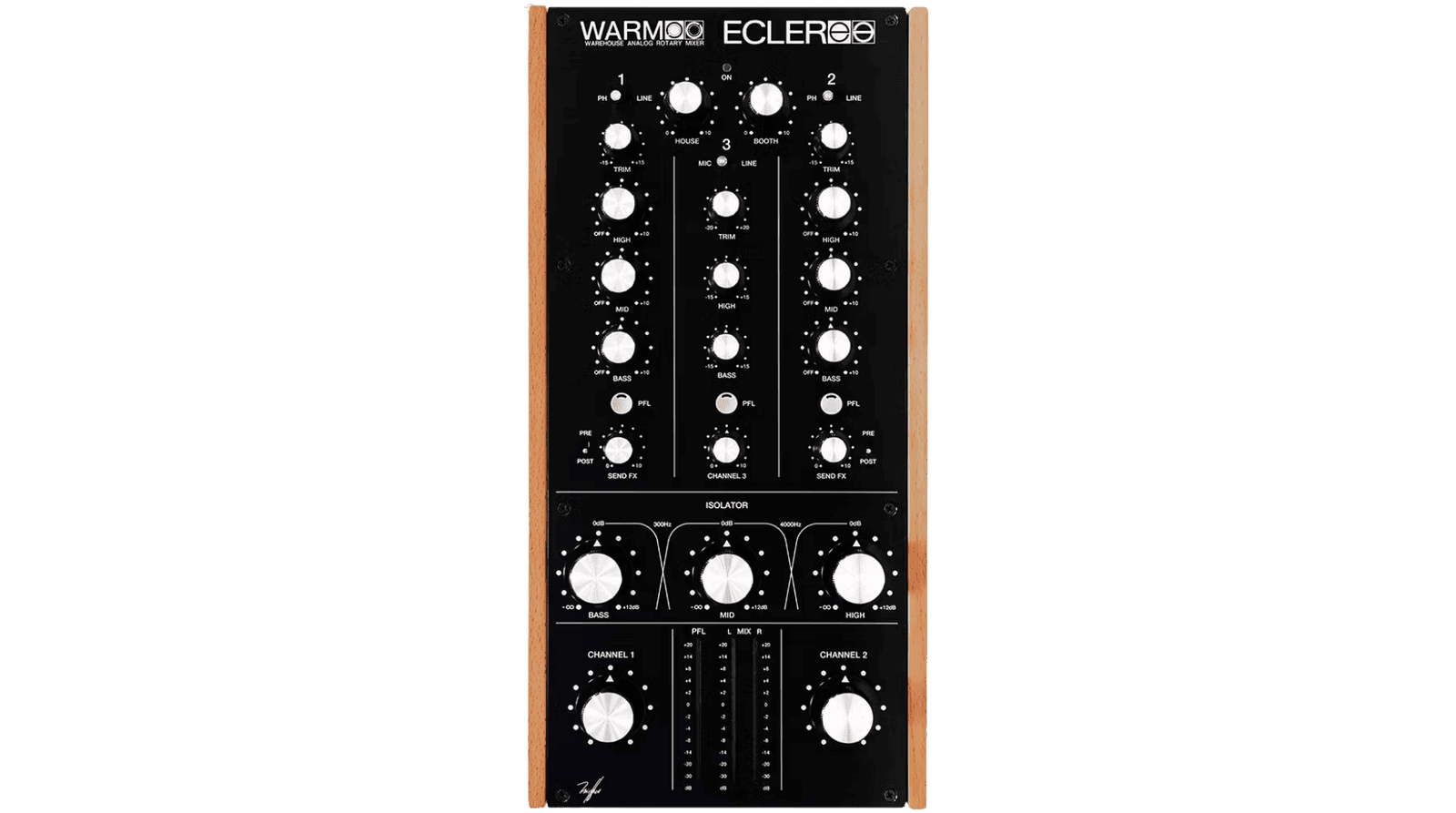
The Ecler WARM2 fills a gap in the rotary market that barely existed until recently: a properly engineered two-channel rotary at a mid-range price. At around $740 it sits comfortably above the budget tier without crossing into boutique territory — though that figure is a European retail price including VAT, and US availability is thinner, so expect to pay more if you’re buying stateside.
What you get for the money is genuinely impressive. The phono stages are a clear step up from the Omnitronic. The three-band isolator has proper weight to it. The filter section adds high-pass and low-pass sweeps that give you real creative options during blends. And the build quality feels like something made by people who understand that mixers get used hard.
Ecler have been making mixers for decades, and the WARM2 is the most convincing proof that mid-range rotary doesn’t have to mean compromise. For DJs who play regularly at home or in small venues and want something that sounds noticeably better than budget gear, this is the sweet spot.
★★★★★ 8.9 · ~$740 (EU retail, inc. VAT) · Current production
Check the price →3. SOA BEM OLHO-2R — the independent curveball
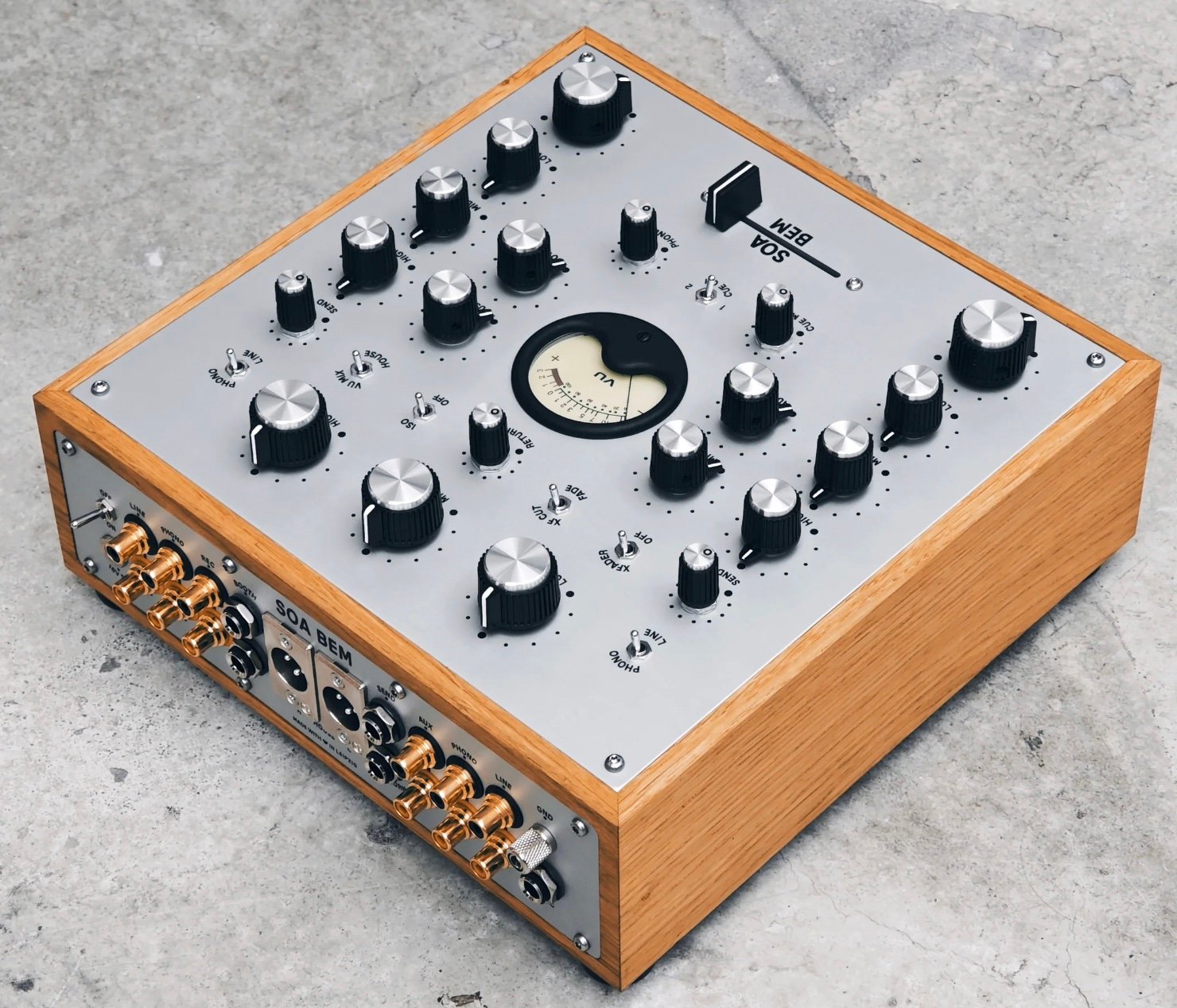
Not every great rotary mixer comes from a name you already know. The OLHO-2R is built by Dennis at SOA BEM, a one-man workshop in Leipzig, Germany — exactly the kind of small-batch, obsessively engineered mixer that rotary culture exists to celebrate. We’re including it as the wildcard: a genuinely independent builder making something that competes on sound with units costing several times more.
It’s a two-channel, fully analogue rotary with a signal path engineered for extremely low noise and distortion — the spec sheet quotes THD+N below 0.0008%, which is serious territory. The parts list reads like a boutique wishlist: oak housing, anodised aluminium front panels, ALPS potentiometers, an optional Innofader crossfader, and Neutrik connectors throughout. This is not a mixer built to a price. It’s built to a standard.
What sets SOA BEM apart from most of this list is how far the customisation goes. Every OLHO-2R is made to order and configured to you: front-panel colour, wood finish, whether you want a crossfader at all, the EQ characteristics, centre detents on the pots, even logo engraving. You’re not picking from two or three variants — you’re specifying a mixer. For a certain kind of DJ, that’s the whole appeal.
It’s been available since 2023 and has shipped to customers in over 20 countries, so this isn’t a prototype or a crowdfunding promise. Pricing starts around $1,620 plus taxes, which slots it between the mid-range Ecler and the established boutique names — a genuinely competitive position for a handbuilt, fully custom analogue mixer.
As with any made-to-order boutique unit, you order direct and wait while it’s built. If you want a rotary that’s truly yours, and you like the idea of supporting an independent builder over a big brand, the OLHO-2R deserves a serious look. We’re planning a full hands-on review, so treat this as an early flag rather than the final word.
Rating pending — full hands-on review to come · from ~$1,620 + taxes
Visit SOA BEM →4. Condesa Carmen V — best boutique rotary
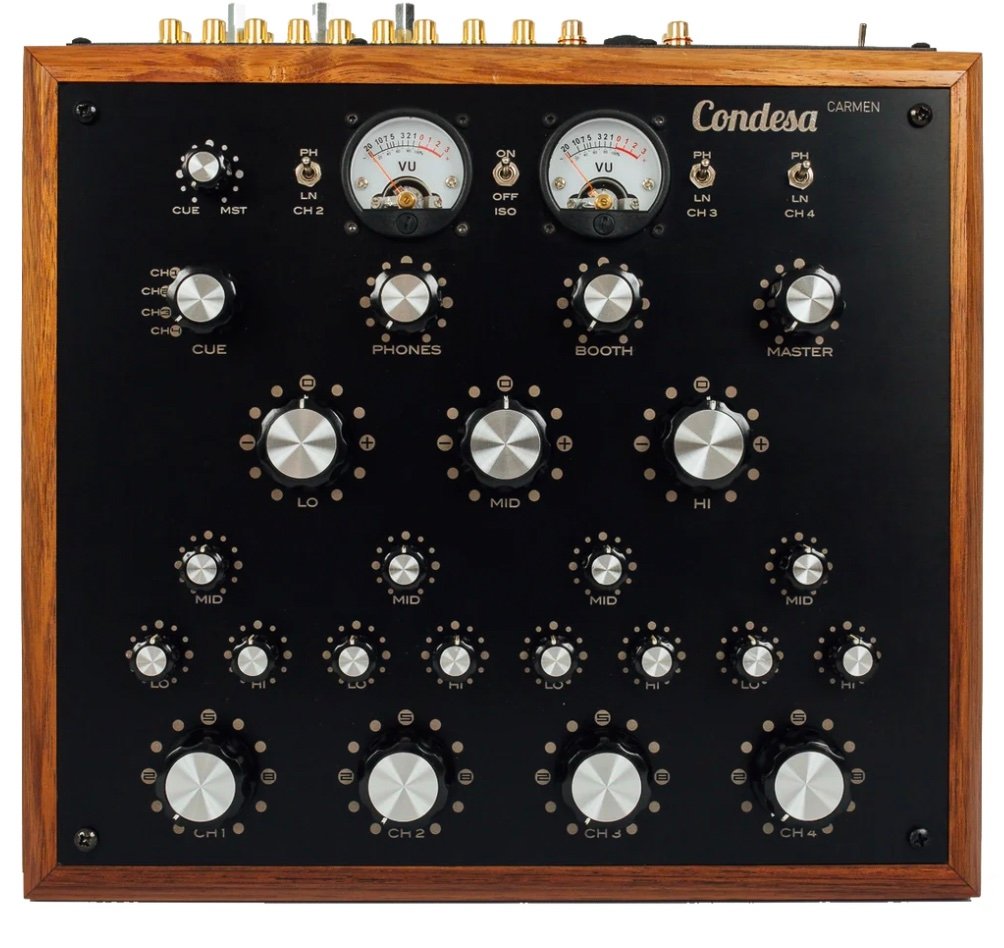
Condesa mixers are hand-built in Adelaide, South Australia, by Mehdi El-Aquil and his team, to a standard that makes most mass-produced gear feel disposable. The Carmen V is the four-channel “do it all” model: a three-band EQ on every channel, three discrete phono pre-amps across channels two to four, and a discrete Class-A four-pole master isolator with a true bypass for when you just want the shortest possible signal path.
The build is tank-solid, the pots are smooth, and the isolator is musical without being surgical. The aesthetic — brushed panels, hardwood framing, no unnecessary features — tells you exactly what kind of mixer this is. You buy one for the analogue signal path and the feel of something built by hand to last decades.
It’s more flexible than the stripped-back look suggests. There’s a pre-master stereo FX loop as standard, and an optional per-channel send with the return coming back into the mix — so you can run a good pedal or an outboard unit and keep the mixer’s own path entirely analogue. The one thing you genuinely don’t get is USB, and that’s a design decision rather than an oversight.
Everything is made to order, with a build time of roughly 20 to 22 weeks on a 50% deposit. Condesa ship worldwide with a two-year warranty and keep service agents in a number of countries, which is more reassuring than it sounds when you’re buying handbuilt from the other side of the world. The Carmen V is listed at A$4,300 — around $3,030 at the time of writing, before shipping and duty — and the design has been revised steadily through production, so a mixer built this year isn’t the one built at launch. If four channels is more than you need, the two-channel Lucia is the way in.
★★★★★ 9.4 · A$4,300 (~$3,030) · Made to order · 20–22 week build
Specifications confirmed directly with Condesa Electronics, August 2026.
Visit Condesa Electronics →5. AlphaTheta euphonia — best luxury rotary
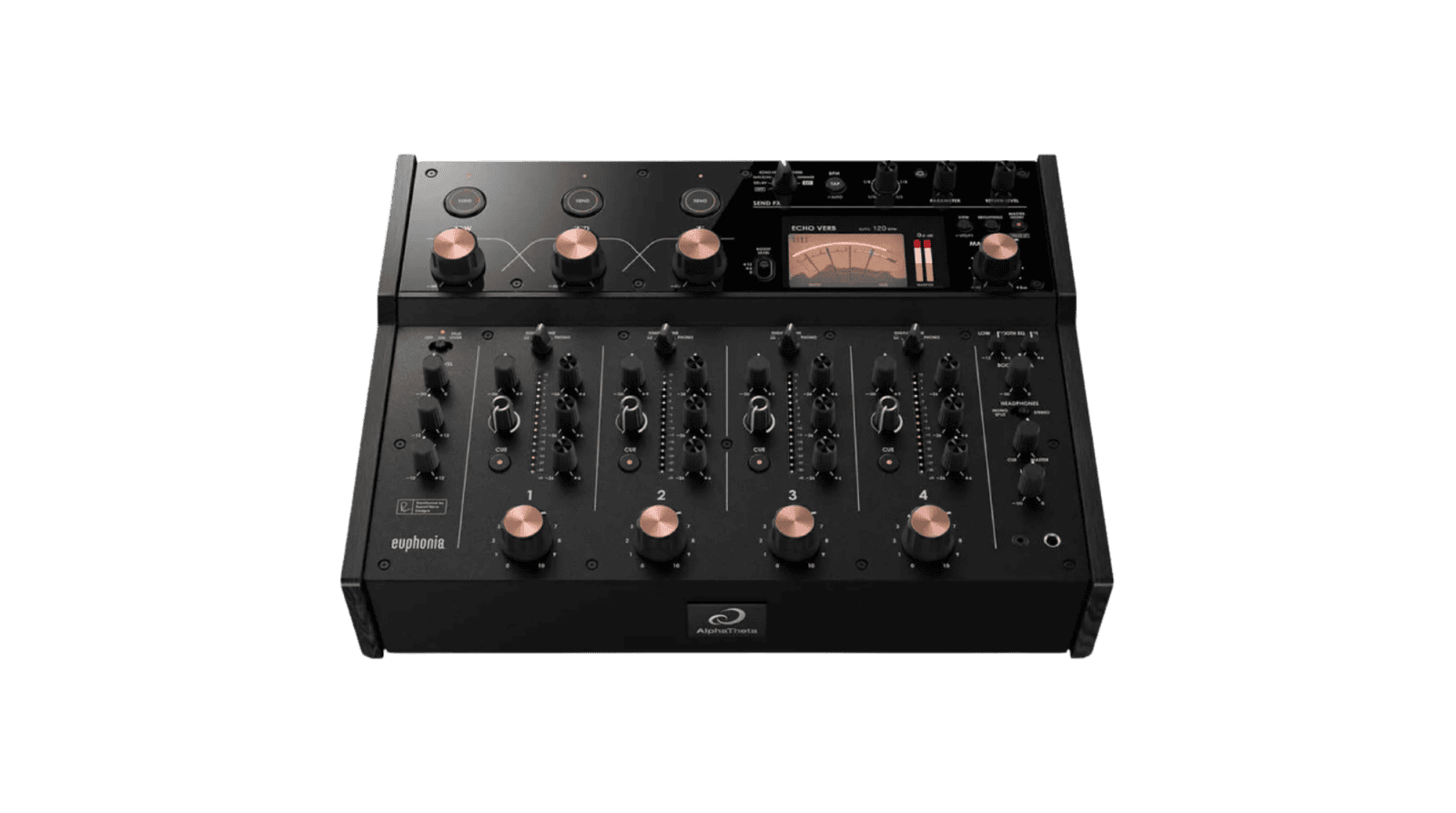
The euphonia is what happens when Pioneer DJ’s parent company decides to build a premium rotary mixer with no budget ceiling. Four channels, a hybrid analogue/digital signal path, Smooth Echo and other onboard effects, a built-in USB audio interface, and sound quality that has genuinely impressed even the most cynical rotary purists.
What makes the euphonia interesting rather than just expensive is that it bridges traditional rotary philosophy and modern DJ requirements. You get the smooth, musical blending rotary is famous for, but also effects, digital connectivity and a workflow that doesn’t force you to abandon the conveniences you’re used to. That’s a first for the category at this level.
At around $3,799 it’s expensive by any standard — but compared to boutique handbuilt alternatives that offer fewer features and longer wait times, it’s positioned as the practical luxury option. If you want the best rotary mixer you can walk into a shop and buy tomorrow, this is it. We’ve covered it in depth in our full euphonia review.
★★★★★ 9.5 · ~$3,799 · Current production
Check the price →6. Union Audio Orbit.6 — best sound, no compromise
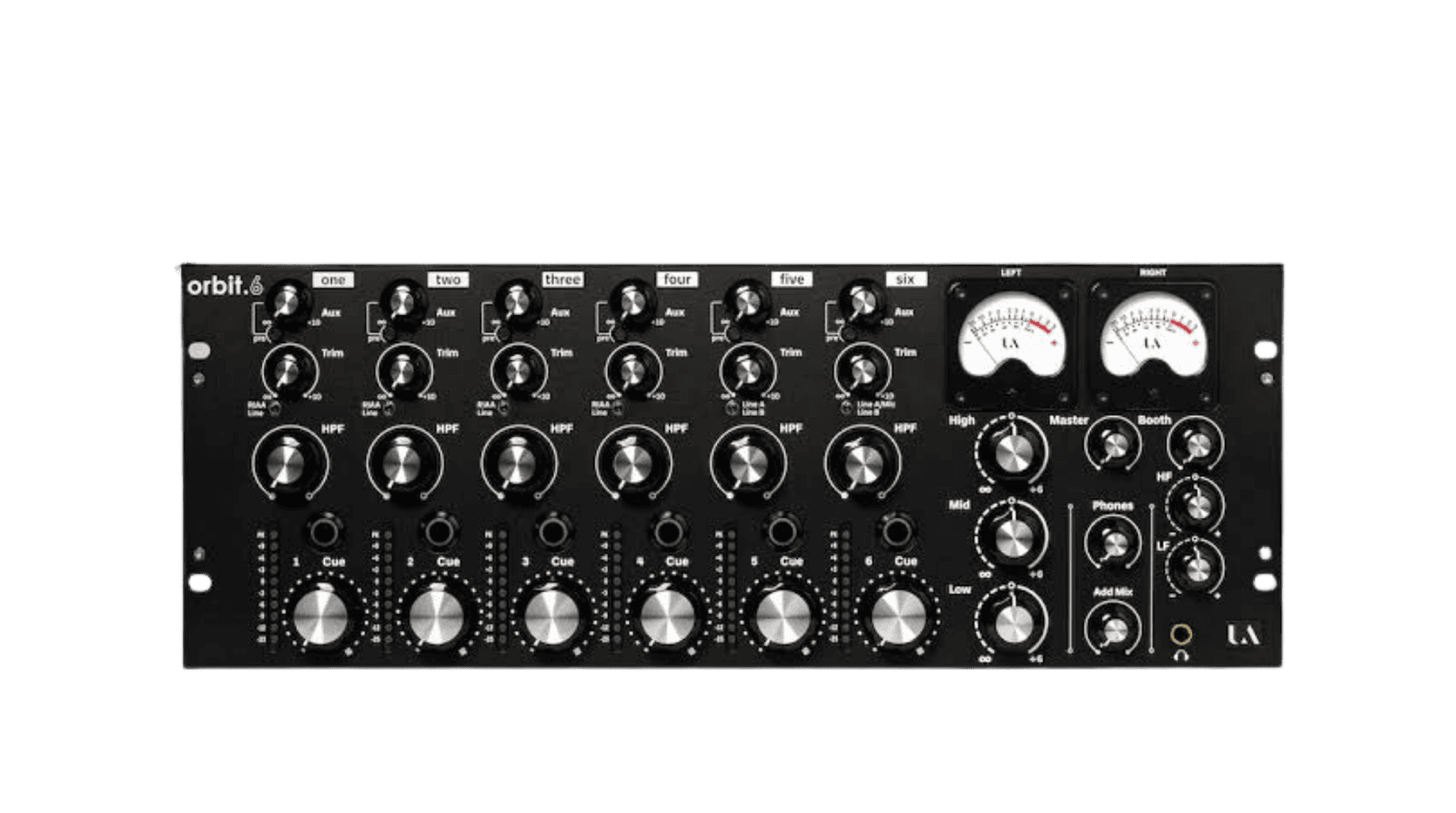
If the euphonia is the practical luxury option, the Union Audio Orbit.6 is the uncompromising one. This is a six-channel, fully analogue, handbuilt rotary designed for people who consider their mixer the most important piece of equipment they own. The sound quality is, by most accounts, extraordinary.
Union Audio build in small batches in the UK. The Orbit.6 is not a mass-market product. You buy direct, you may wait, and you pay accordingly — starting around $6,166. What you get is a mixer that some of the most respected selectors in the world choose as their permanent home unit or venue centrepiece.
Six channels is overkill for most DJs. But if you run turntables, CDJs, a drum machine and maybe an external FX unit or sampler, six channels lets you leave everything plugged in and ready. That’s the workflow the Orbit.6 is designed for — not switching cables between sets, but having your entire rig live.
This is not a recommendation for most people. It’s a recommendation for the people who already know they want it.
★★★★★ 9.7 · ~$6,166 · Made to order
Visit Union Audio →Used-market classics — discontinued but still worth finding
These mixers are no longer in production but remain highly relevant. If you’re comfortable buying used and doing your due diligence on condition, they’re some of the best rotary mixers ever made.
MasterSounds Radius 4
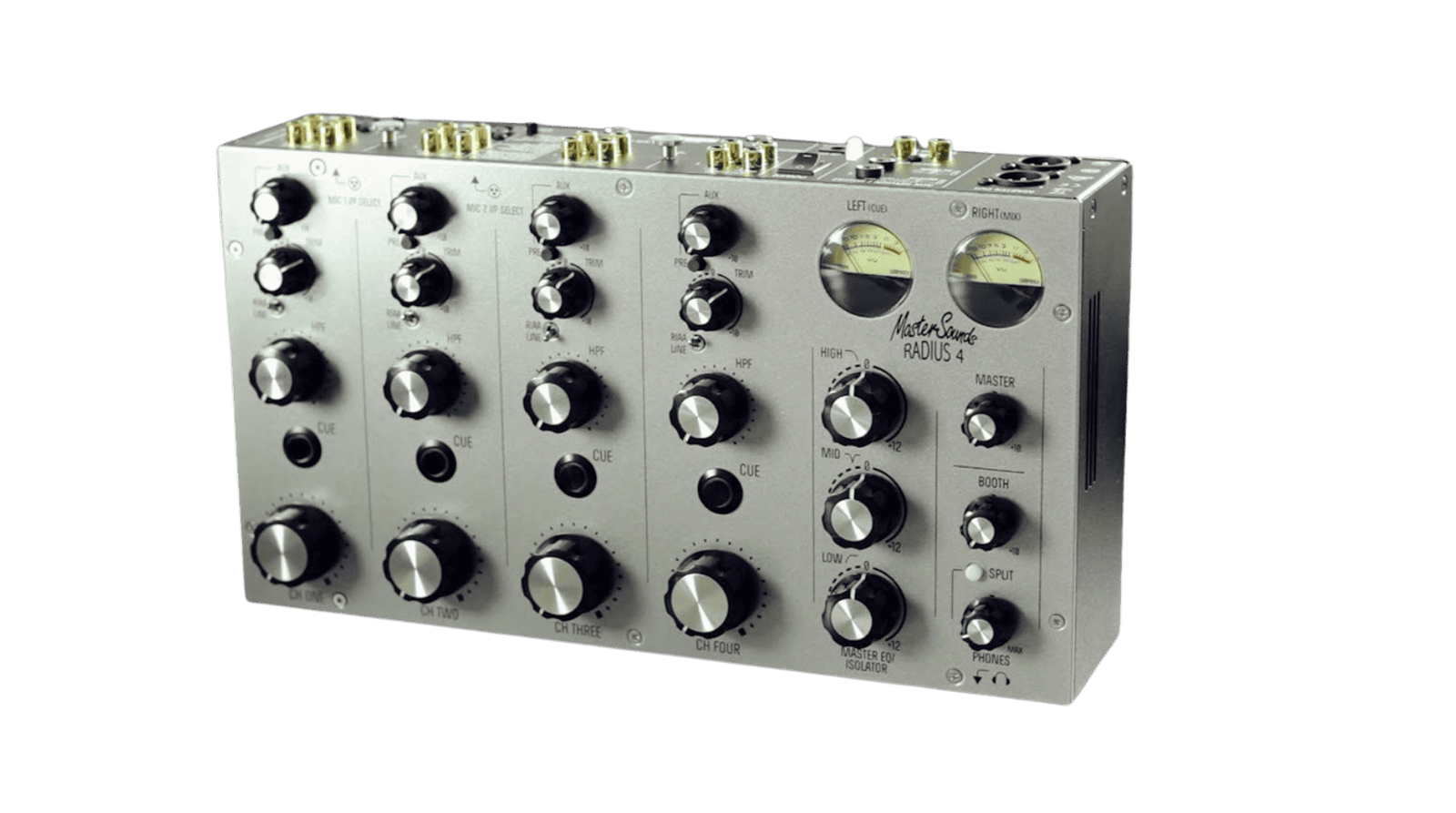
The Radius 4 was the most accessible modern boutique rotary for years — compact, fully analogue, beautifully built, with musical filters, a master isolator, and the Andy Rigby-Jones design pedigree behind it. MasterSounds announced in 2024 that they would stop building DJ mixers, which makes the Radius 4 a used-market proposition only.
The obvious question is where to actually find one. Beyond the usual classifieds, MasterSounds themselves list returned and refurbished legacy stock through their MasterSounds Approved section — units do surface there from time to time, and buying that way means the mixer has been through the people who built it rather than an unknown seller. Stock is intermittent, so it’s worth checking periodically rather than once.
If you find one in good condition at a fair price, it’s still an excellent mixer. But don’t overpay for nostalgia — the Ecler WARM2 (new, with warranty) or a Condesa Lucia may be better value depending on what you need.
★★★★★ 9.3 · Used market only
See MasterSounds Approved stock →Rane MP2015
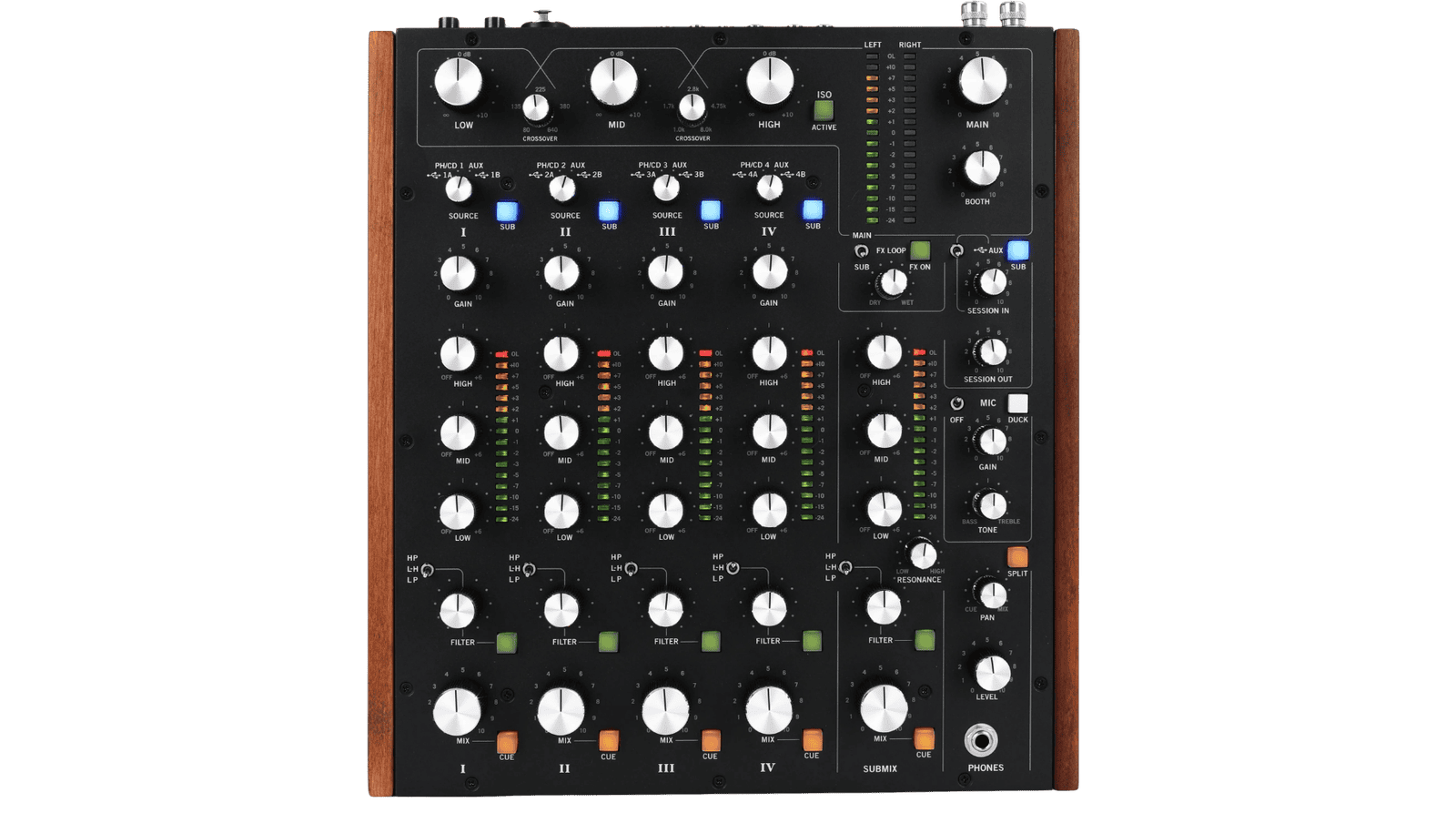
The MP2015 was Rane’s premium four-channel rotary, built with an internal USB interface, Serato-ready connectivity, and the kind of robust engineering Rane was known for. It bridged traditional rotary sound and digital DJ workflows in a way very few mixers managed.
Rane no longer produces it, but it remains popular used. The USB interface and Serato integration make it particularly appealing for DJs who want rotary feel without giving up digital conveniences entirely. Build quality is excellent — these are built to survive.
★★★★★ 9.0 · Used market only
View on Rane →E&S DJR-400
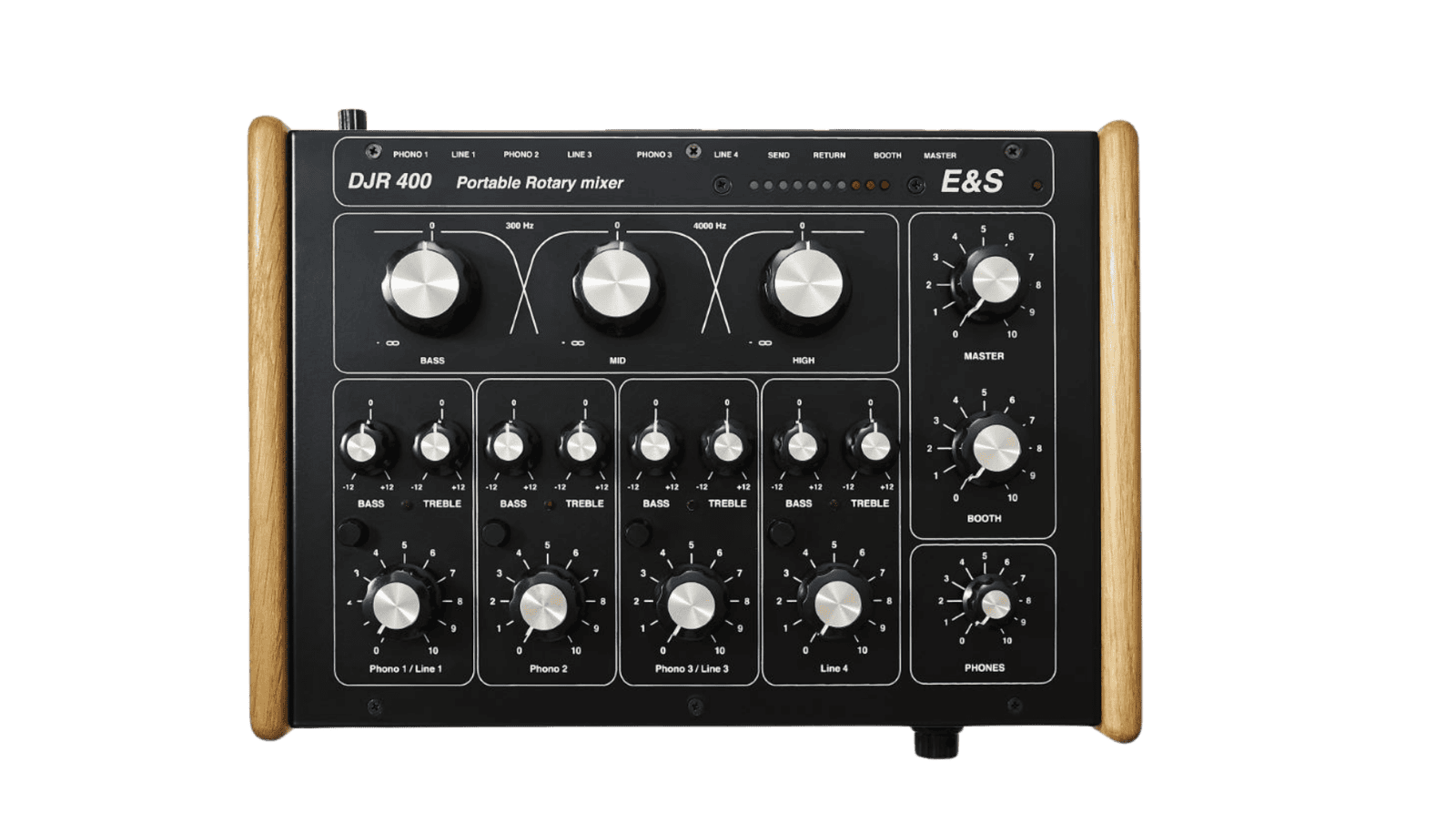
E&S are a small French manufacturer who build some of the most respected rotary mixers in the world. The DJR-400 is a four-channel, fully analogue design with superb phono stages and a sound that dedicated collectors consistently rate among the best available. Production is extremely limited — these are handmade in small numbers.
Finding one requires patience, connections or luck. But if you’re deep enough into rotary culture to know the E&S name, you already know what this mixer represents.
★★★★★ 9.6 · Limited / used / waitlist
View E&S DJR-400 →Should you buy new or used?
If you’re rotary-curious, buying used can be smart — but only if you know what you’re looking at. Boutique mixers tend to be owned by careful people, but they also live in hi-fi setups, bars, dusty booths and touring cases. Check pot feel, channel balance, PSU condition, crackle, headphone section behaviour, and whether any servicing history exists.
The advantage of buying new is obvious: warranty, support, predictable condition, and a much lower chance of spending premium money on somebody else’s problem. The downside is that current-production boutique mixers can be extremely expensive, and some of the most talked-about units are limited, made in small batches, or simply gone.
Where a discontinued mixer is still supported by the people who built it, that middle ground is worth taking seriously. A refurbished unit from the manufacturer’s own channel sits somewhere between a private sale and a new purchase — you lose the full warranty, but you also lose most of the risk.
How to choose
You want to try rotary for the first time: Omnitronic TRM-202MK3. Learn the format without risking serious money.
You’re a serious home DJ on a mid-range budget: Ecler WARM2. The best value-to-quality ratio in the category right now.
You want a fully custom mixer from an independent builder: SOA BEM OLHO-2R. Made to order, competitively priced, yours down to the last detail.
You want boutique handcrafted quality: Condesa Carmen V or Lucia. Built by hand in South Australia, made to order, exceptional sound.
You want the best rotary you can buy in a shop tomorrow: AlphaTheta euphonia. Premium, feature-rich, widely available.
You want the absolute best sound and don’t care about the price: Union Audio Orbit.6. End of conversation.
You’re happy buying used and want a proven classic: MasterSounds Radius 4 or Rane MP2015. Both excellent if you find one in good condition.
Who should actually own one?
Buy a rotary mixer if you care deeply about long blends, mostly play house, disco, techno or soul- and jazz-adjacent music, and want the mixer to feel like an instrument rather than a utility box.
Probably don’t buy one yet if you’re still learning the fundamentals and mainly want something versatile. A strong standard mixer will teach you more, faster, for less money.
Definitely think twice if your gigs rely on microphones, quick cuts, frequent requests, wedding-style flexibility or controller-heavy workflows.
The honest truth
Rotary mixers are not automatically better mixers. They are better for a very specific kind of DJing. The trick is working out whether you’re genuinely drawn to that way of playing, or whether you’ve just fallen in love with the idea of a rotary because the gear looks beautiful and the culture around it feels cool.
Both are understandable. Only one is expensive for the right reasons.