AlphaTheta
euphonia
Review (2026)
If you’ve spent any time in serious DJ booths, you’ll know the rotary mixer conversation well. Someone’s always making the case for warm, musical, boutique-crafted hardware over the clinical efficiency of a DJM. The MasterSounds crowd. The Condesa faithful. The Union Audio obsessives who insist nothing else will do.
For years, Pioneer DJ — now AlphaTheta — sat outside that conversation entirely. Their mixers were for everyone else: the residency DJs, the festival stages, the touring artists who needed reliability and familiarity above all else.
The euphonia is AlphaTheta’s answer to the rotary faithful. And it’s a genuinely interesting one.
Announced in March 2024, the euphonia is the first rotary mixer the company has ever made — and the first mixer to carry the new AlphaTheta brand name. It doesn’t try to out-boutique the boutiques. Instead, it does something more ambitious: it takes everything that makes a rotary mixer desirable and bolts it onto a full-fat digital brain, with a Rupert Neve Designs transformer stage on the output. The result sits in a category all of its own.
Check price on AmazonWhat is a rotary mixer, and why does it matter?

Before getting into the euphonia specifically, it’s worth anchoring why rotary mixers command the prices and devotion they do.
A rotary mixer replaces the vertical channel faders found on standard DJ mixers with large rotary pots — knobs that control channel volume. It sounds like a subtle difference. It isn’t.
Rotary pots change the feel of mixing entirely. They’re smoother, more tactile, and more musical for long blends and slow transitions. They reward patience. They’re closely associated with the deep house, techno, disco, and afrobeat scenes — styles where mixes breathe and evolve rather than cut hard.
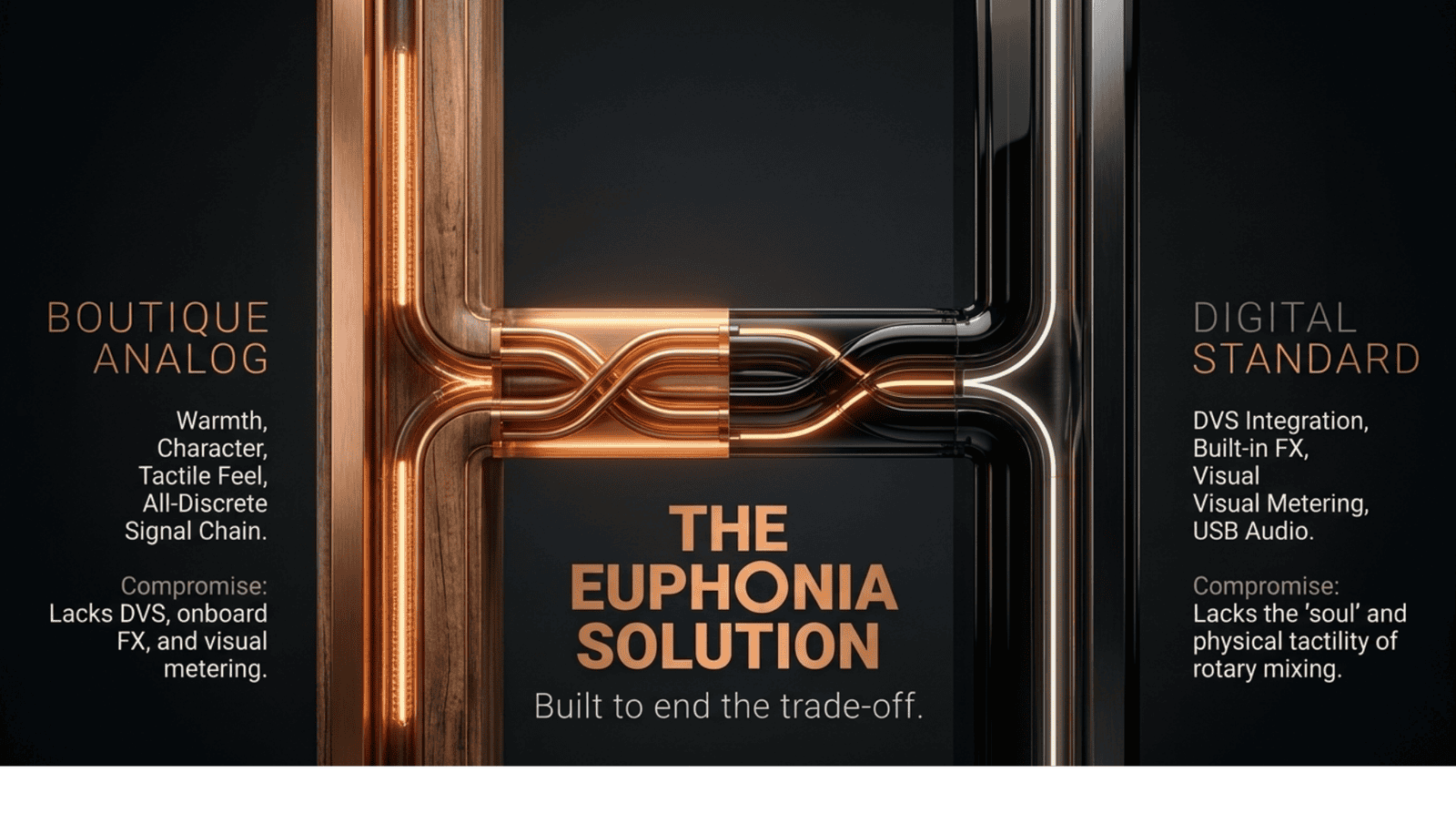
The analogue signal paths in most boutique rotaries (think Condesa, Union Audio, MasterSounds) also tend to impart a warmth and character that digital mixers don’t. That’s the appeal. That’s what DJs are paying for.
The trade-off has always been features. Most boutique rotaries lack DVS integration, built-in effects, visual metering, and the kind of USB audio interface functionality that modern digital DJs rely on. You chose between soul and convenience. The euphonia was built to end that trade-off.
Design and build: what it actually looks like in the booth
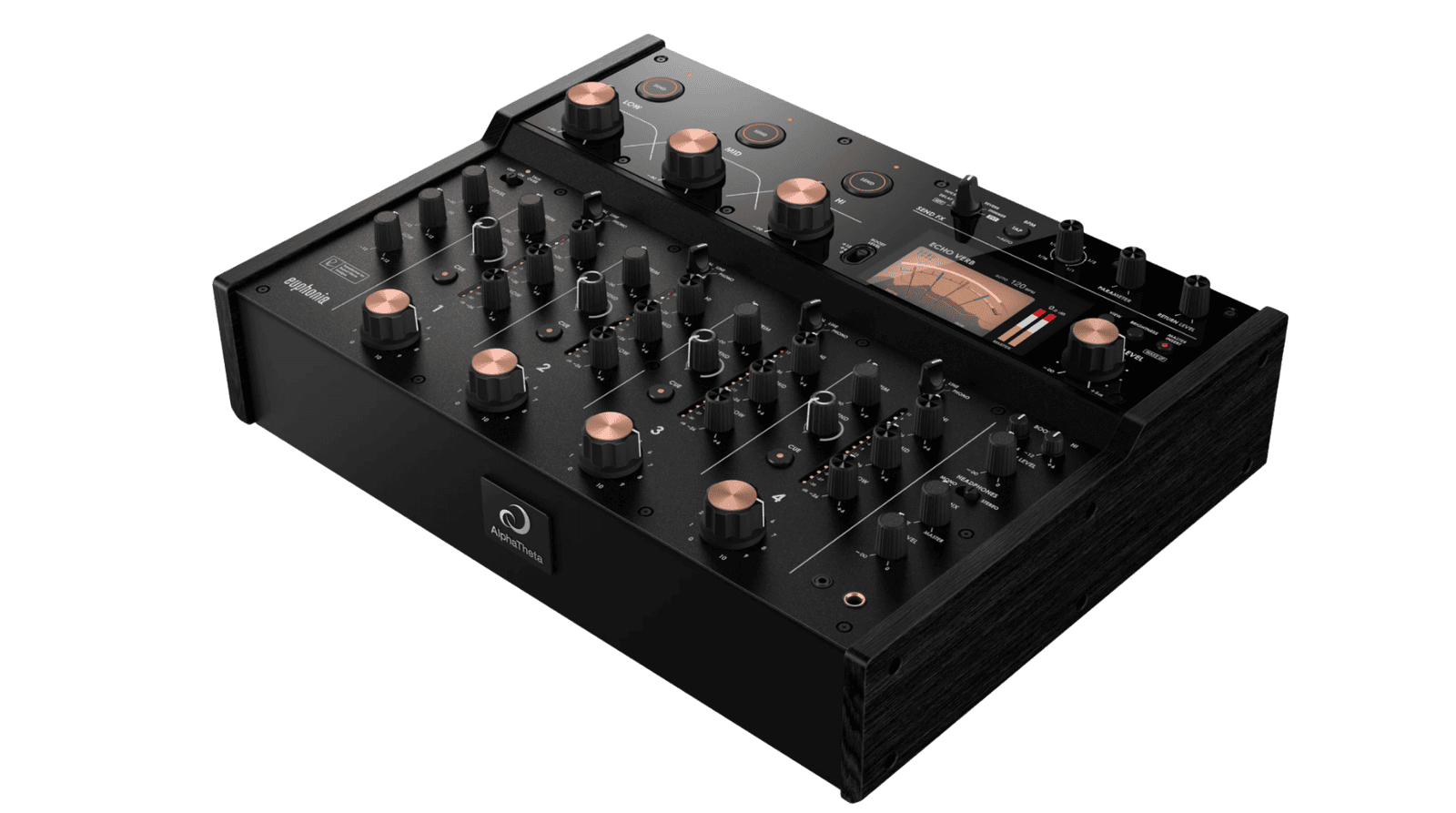
The euphonia is a substantial piece of kit. At roughly 430 × 331 × 120mm and 9.5kg, it’s a standard club-footprint four-channel mixer — not a compact boutique unit. It won’t disappear into a record bag.
The aesthetic leans into the AlphaTheta brand’s premium positioning: dark finish, wood-grain detailing, large smooth rotary pots on each channel, and a central display panel — the Energy Visualizer — that provides per-channel VU metering, master levels, and a spectrum analyser.
What most people agree on: it looks and feels expensive in person. Reviewers consistently describe it as elegantly designed and carefully crafted. The main criticism is the use of glossy plastic on some sections of the chassis — a peculiar oversight at this price point, and something that draws comment from people who’ve handled it.
The rotary pots themselves are the star of the physical design. Smooth, weighted, and large enough to make precise volume control genuinely pleasurable. If you’ve mixed on a MasterSounds or a Condesa before, you’ll know what this feels like. If you haven’t, it’s one of those things that’s difficult to describe in writing but immediately obvious in practice.
The signal path: honest about what it is
Here’s where the euphonia diverges from boutique rotary tradition — and where you need to go in with clear expectations.
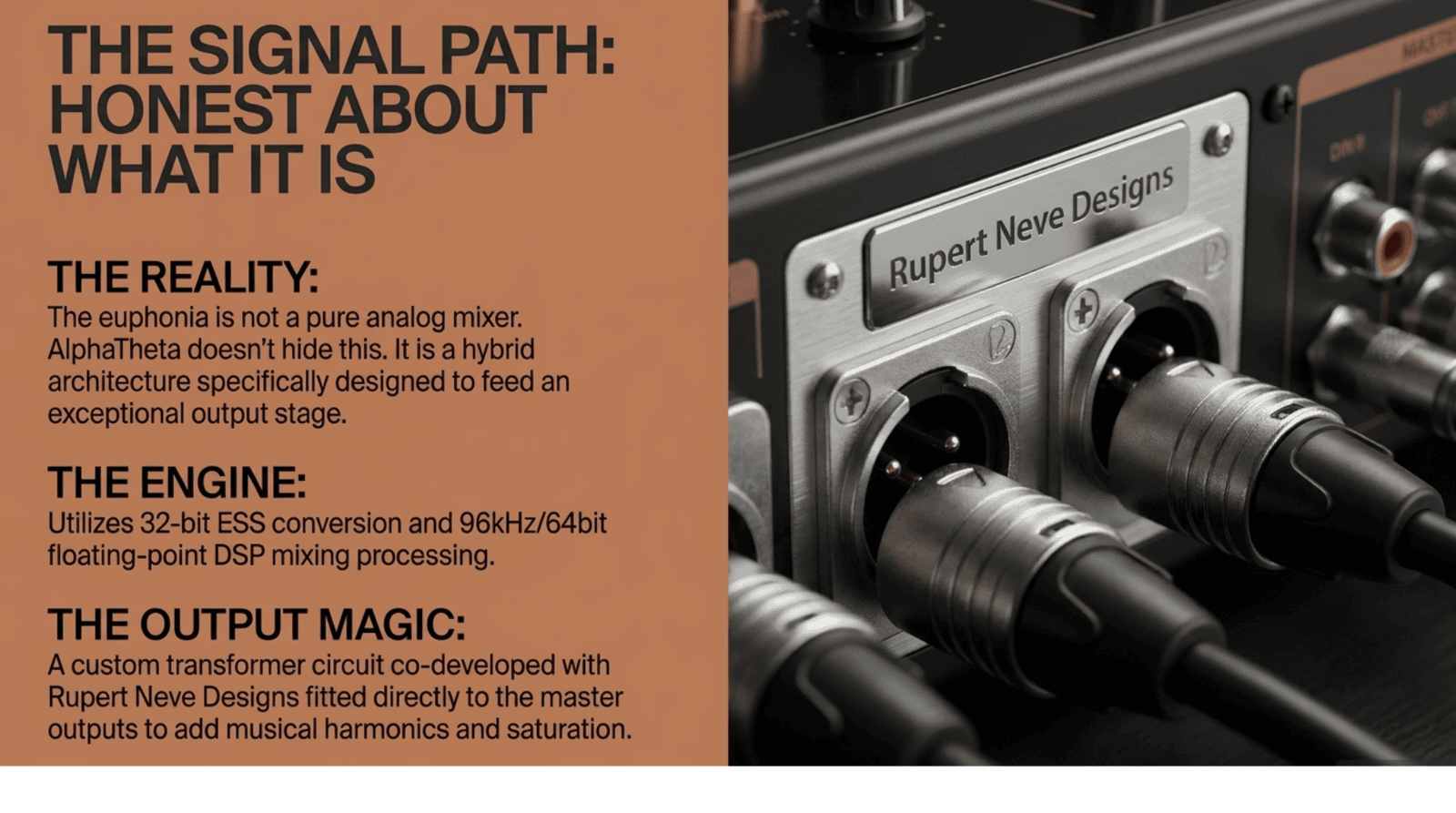
The euphonia is not a pure analogue mixer.
Line and phono inputs are converted via ADC, processed digitally, then passed through a DAC before reaching the output stage. This is a hybrid architecture, not a fully analogue signal chain. Forum teardowns of the block diagram confirm it. AlphaTheta doesn’t hide it.
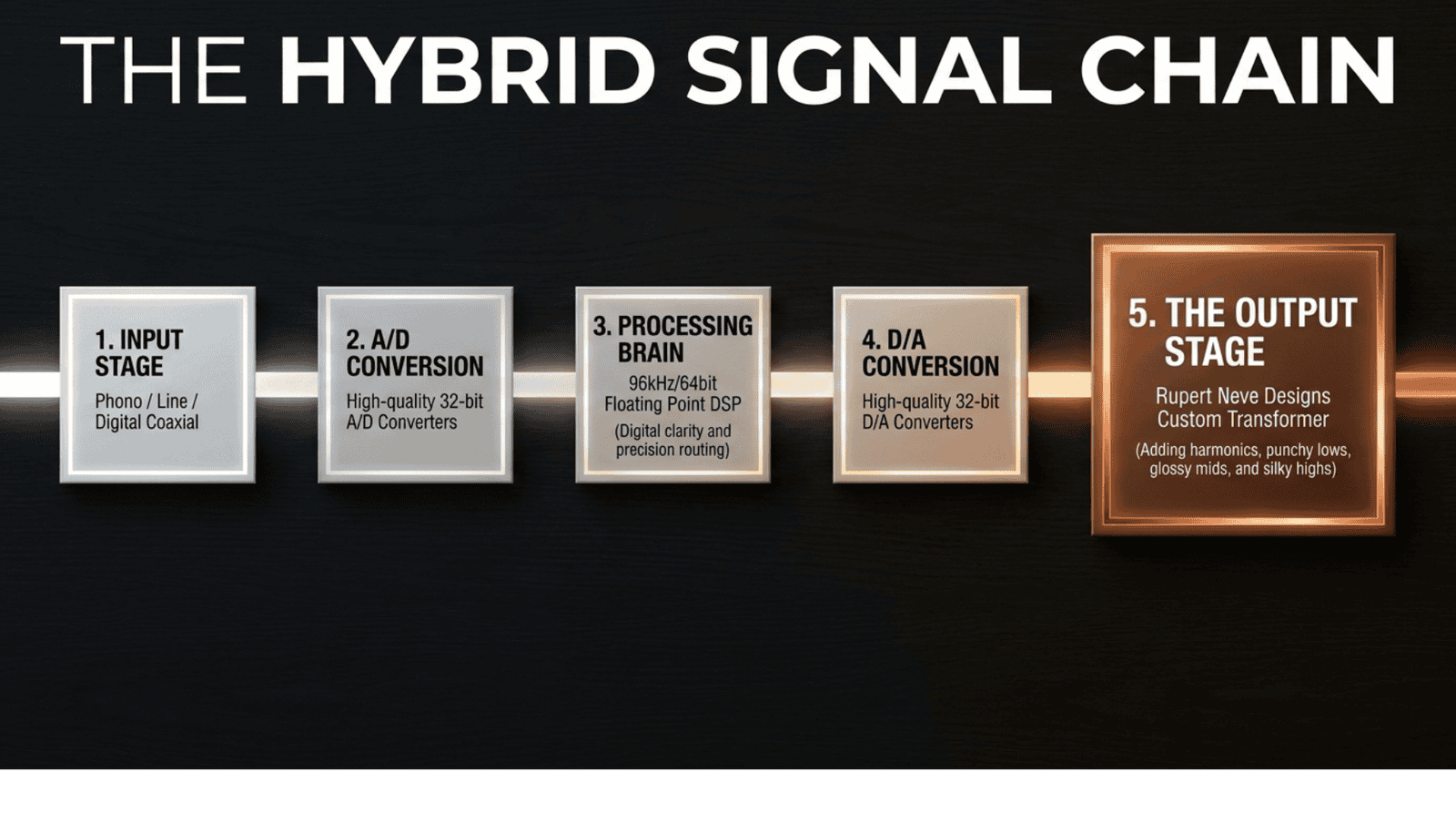
Why does this matter? Because a significant portion of the rotary mixer market cares deeply about keeping the signal path analogue from input to output. If that’s you — if you’re specifically after the transformerless, all-discrete signal chain that something like a Union Audio ELRA.4 or a Condesa Carmen provides — the euphonia isn’t that.
What it is, though, is a very good-sounding digital mixer with a genuinely exceptional output stage. That output stage is the headline: a custom transformer circuit co-developed with Rupert Neve Designs, fitted to the master outputs. The conversion runs 32-bit ESS chips with 96kHz/64-bit floating-point DSP, a frequency response of 20Hz–40kHz, and a signal-to-noise ratio of 107dB on USB/digital inputs.
“If the MasterSounds/Condesa/Union Audio gear is about pure analogue romance, the euphonia is about taking that rotary vibe and bolting it onto a full-fat, DJM-style digital brain with a Neve transformer on the output.”
Early hands-on reviews describe a “finished record” quality to the output that distinguishes it from a standard DJM. The honest framing: you’re not buying analogue purity. You’re buying 32-bit conversion, top-tier Neve-flavoured output staging, and an integrated digital toolkit — with rotary pots on top.
Features: where the euphonia goes well beyond boutique
This is where the euphonia’s case gets genuinely compelling, particularly for DJs who work across vinyl and digital.
Channel inputs
Each of the four channels offers phono, line, and digital coaxial input selection, plus assignment from rekordbox or Serato DJ Pro. That flexibility alone sets it apart from most rotary alternatives.
DVS integration
Full support for both rekordbox and Serato DJ Pro (the latter requiring the DVS expansion pack for vinyl/CD control). This is plug-and-play in a way that boutique rotaries simply aren’t.
Energy Visualizer
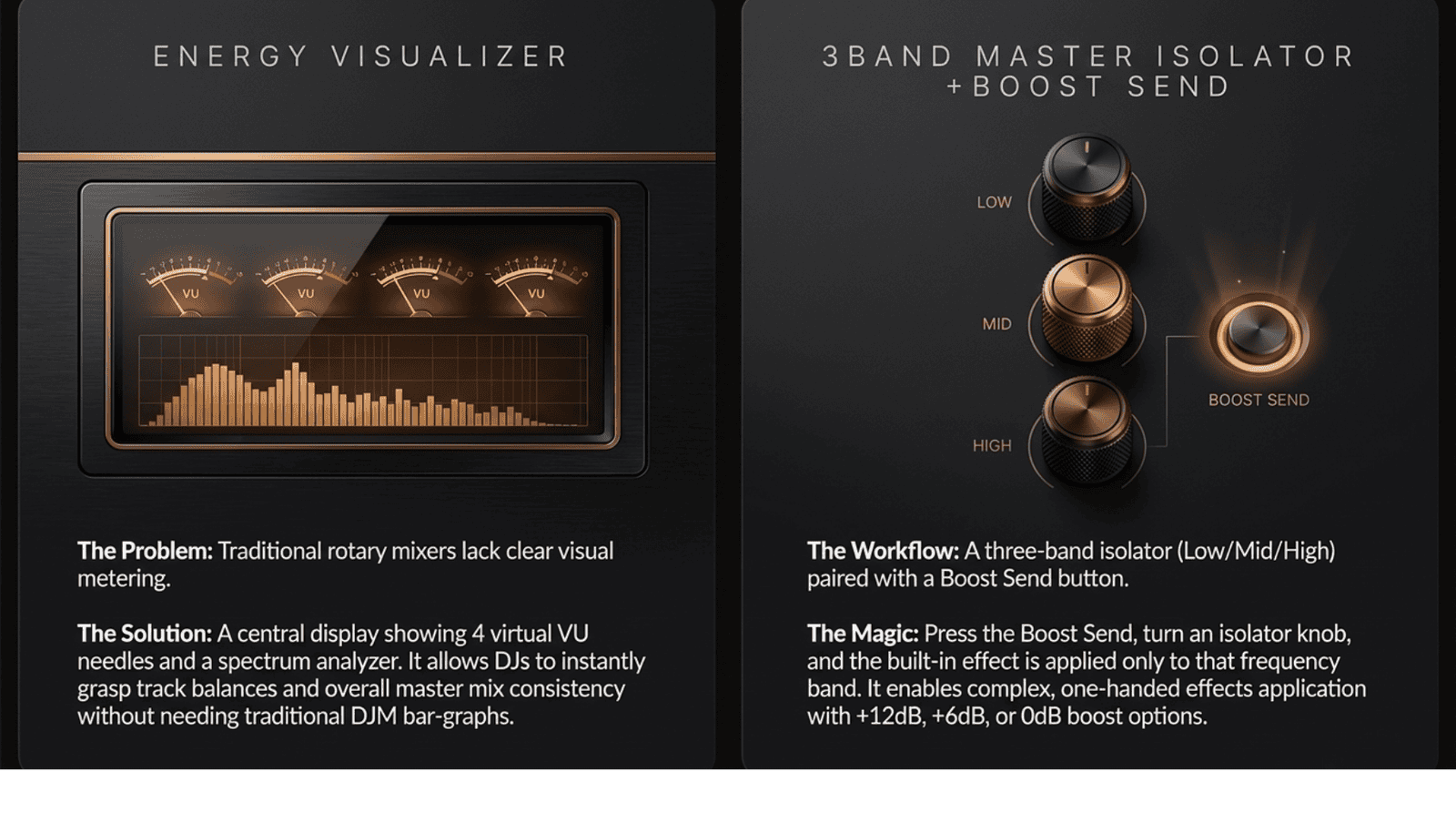
The central display shows four virtual VU needles, master metering, and a spectrum analyser. Whether you want it or not, it’s genuinely useful for rotary DJs who’ve lost the traditional DJM bar-graph metering they’re used to.
Master isolator + Boost Level
A three-band isolator (Low/Mid/High) with a “Boost Level” switch offering 0/+6/+12dB options. At +12dB, this becomes a dramatic performance tool — press Boost Send, turn an isolator knob, and the built-in effect is applied only to that frequency band. At 0dB, you can use it as a tone control without overall gain lift, useful for reverb tails and subtle tonal shaping.
Send/return routing
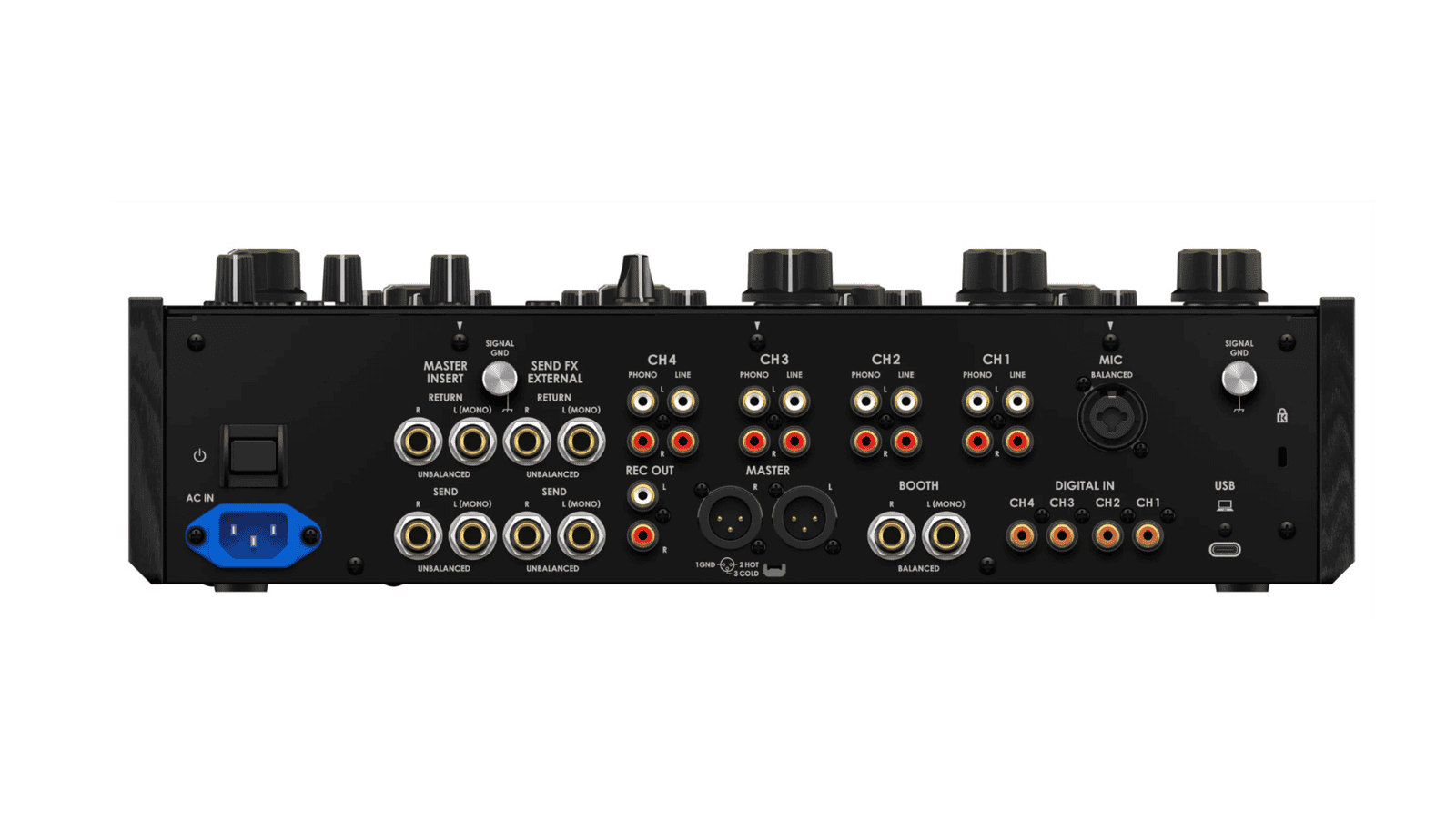
Two send (¼-inch TS) and two return (¼-inch TS) jacks, plus a dedicated master insert path for external processors. This is serious routing infrastructure for DJs who want to run outboard compressors, isolators, or effects units.
Built-in effects
High-pass filter, delay, tape echo, echo verb, reverb, and shimmer — all accessible via the send controls and combinable with external stereo FX via send/return.
How it compares to the competition
Against boutique analogue rotaries
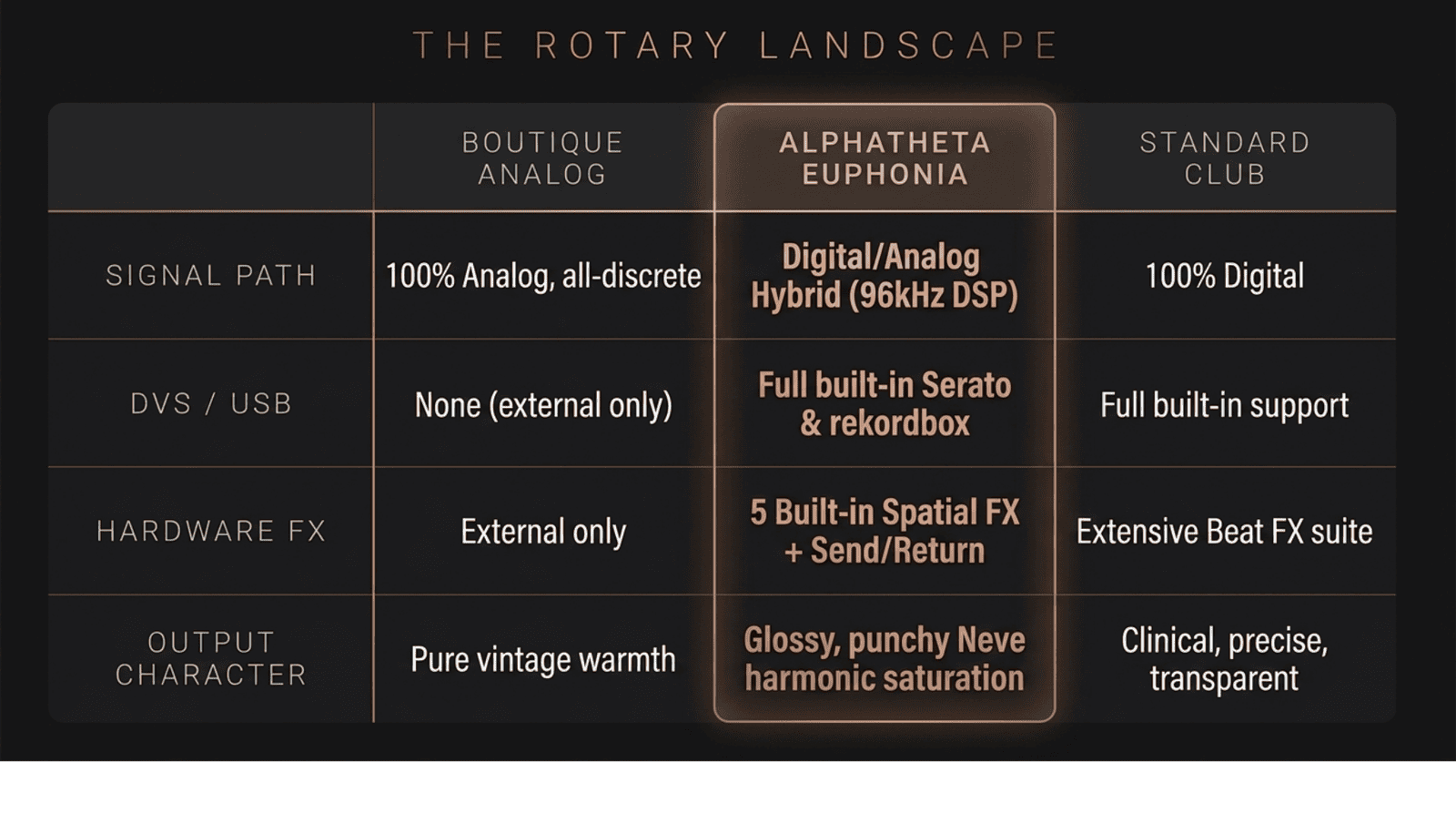
If the boutique analogue options are about pure romantic signal path — every component chosen for sonic character, no digital conversion anywhere — the euphonia is consciously not that. Analogue purists will always prefer a Condesa Carmen or a Union Audio orbit.6 for the signal path alone. But those mixers don’t have DVS, built-in FX, or a USB audio interface. The euphonia’s pitch: you get the rotary workflow and a genuinely great-sounding output, without the compromises.
Against AlphaTheta’s own DJM-A9 and DJM-V10
These sit in a similar price bracket and offer more conventional club workflows — traditional faders, comprehensive effects, industry-standard layouts. If you’re a working DJ who plays a wide range of venues, the DJM-A9 is probably a more practical choice. The euphonia is for DJs who specifically want rotary pots and the Neve output stage.
Who should actually buy the euphonia?
- You want rotary feel without giving up DVS, built-in FX, or metering
- You play a mix of vinyl and digital via CDJs, laptops, or both
- You’re comfortable with a hybrid signal path and want the Neve output
- You’re installing into a home studio or premium venue
- You want a single mixer that handles everything without compromise
- You’re an analogue purist — look at Union Audio, Condesa, or Bozak-style units
- You’re a scratch or battle DJ (there is no crossfader)
- You play rough touring festival stages where build durability is critical
- You exclusively play pure vinyl and will never use DVS or digital FX
Specifications at a glance
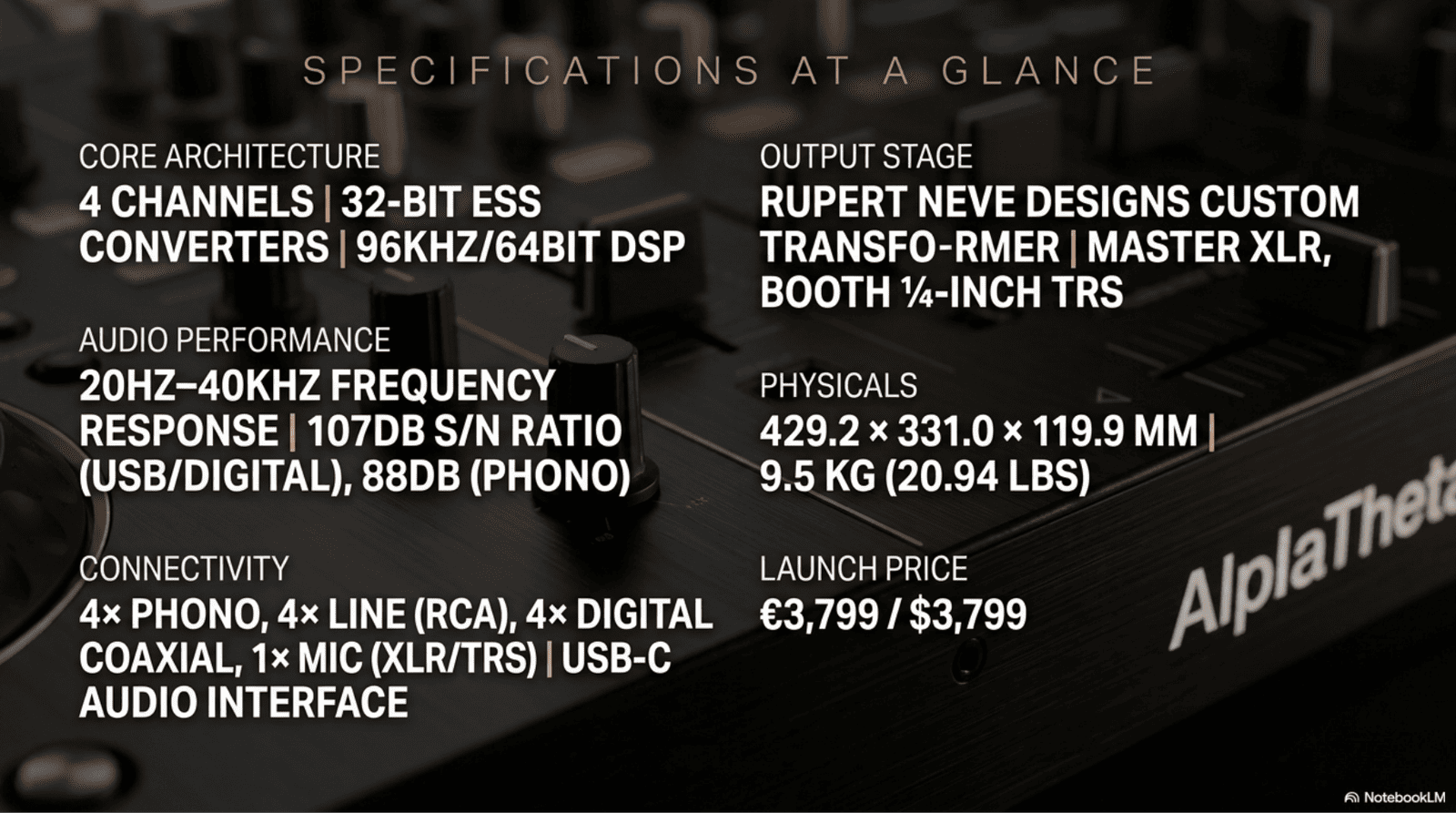
| Channels | 4 |
| Channel controls | Rotary pots |
| Inputs | 4× phono, 4× line (RCA), 4× digital coaxial, 1× mic (XLR/TRS combo) |
| Outputs | Master XLR, booth ¼-inch TRS, record RCA, 2× headphone (¼-inch + 3.5mm) |
| Send/Return | 2× send, 2× return (¼-inch TS), master insert |
| Interface | USB-C audio interface |
| Software | rekordbox, Serato DJ Pro (DVS expansion required) |
| Output stage | Rupert Neve Designs custom transformer |
| Converters | 32-bit ESS, 96kHz/64-bit DSP |
| Frequency response | 20Hz – 40kHz |
| S/N ratio | 107dB (USB/digital) · 88dB (phono) |
| Display | Energy Visualizer (4× VU + spectrum analyser) |
| Dimensions | 429.2 × 331.0 × 119.9mm · 9.5kg |
| Launch price | €3,799 / $3,799 |
Verdict
The euphonia is a genuinely original piece of kit. AlphaTheta didn’t build a boutique rotary — they built something new: a luxury hybrid that takes the rotary workflow seriously, pairs it with genuinely excellent conversion and a Rupert Neve output stage, and wraps it in a complete professional feature set that no boutique manufacturer comes close to matching.
It won’t satisfy the analogue purists. It was never trying to. But for the growing number of DJs who want rotary pots and a great-sounding mixer without sacrificing the modern digital toolkit they rely on, there isn’t another option at this level.
Dream kit? Absolutely. Overpriced hype? No. It knows what it is, does it exceptionally well, and occupies a space that didn’t exist before it arrived.
The most feature-complete rotary mixer ever made. Not a pure analogue purist’s tool — but a luxury hybrid that earns its price with Rupert Neve output staging, full DVS integration, and a workflow no boutique manufacturer can match. The rotary mixer Pioneer should have built years ago.
The Amazon link above is an affiliate link. If you buy through it, we earn a small commission at no extra cost to you. It doesn’t influence what we write — see our full affiliate disclosure for details. The DJ Mixtape is reader-supported and independent.