Review · Controllers & Decks · Jul 2026
A 10.1-inch touchscreen and cloud stack borrowed from the flagship, squeezed into a body built for bars, small rooms and home rigs. It’s the first properly affordable CDJ since 2016 — but the tradeoffs are real.
The verdict
On paper the CDJ-1500X is the player a lot of DJs have wanted for a decade: the CDJ-3000X’s screen and cloud features in a compact, half-price body. The catch is what AlphaTheta stripped out to get there — no key sync, no digital output, and a smaller jog. For bars, home setups and producers who want a real CDJ workflow without club-money outlay, it looks like an easy recommendation. We’ll drop a final score once we’ve had it in the booth.
Around $1,599 (international) / $1,699 US · launched July 2026
Check prices →What we like
- Flagship 10.1-inch touchscreen in a compact body
- Built-in Wi-Fi, cloud and streaming playback
- Roughly half the price of a CDJ-3000X
- Official Serato DJ Pro accessory over USB-C
- CoBeat crowd requests are genuinely new
What gives us pause
- No Key Sync or Key Shift at all — the real loss
- RCA analogue out only, no digital output
- Smaller jog than a full club CDJ
- USB-C power instead of a locking IEC cable
- Serato and djay Pro both need paid subs
What the CDJ-1500X actually is
Let’s be clear up front, because AlphaTheta is: this is not a CDJ-3000 or 3000X replacement. It sits a full tier below the club flagship. What it really replaces is the XDJ-1000MK2 — the “screen XDJ” that launched all the way back in September 2016 and has quietly been the only affordable single player in the range ever since. Nearly ten years on, the 1500X is the compact, cloud-connected successor that slot has been waiting for.
The pitch is simple. Take the 3000X’s 10.1-inch capacitive touchscreen and its whole cloud-and-streaming stack, drop them into a body that weighs about 60% as much (3.6 kg, 252 × 375 × 117 mm), strip out the big-club hardware that pushes the flagship’s price up, and land at roughly half the cost. It’s aimed squarely at bars, lounges, small clubs, mobile rigs and the growing number of home DJs who want separates without a club-sized footprint or budget.
The screen and waveforms
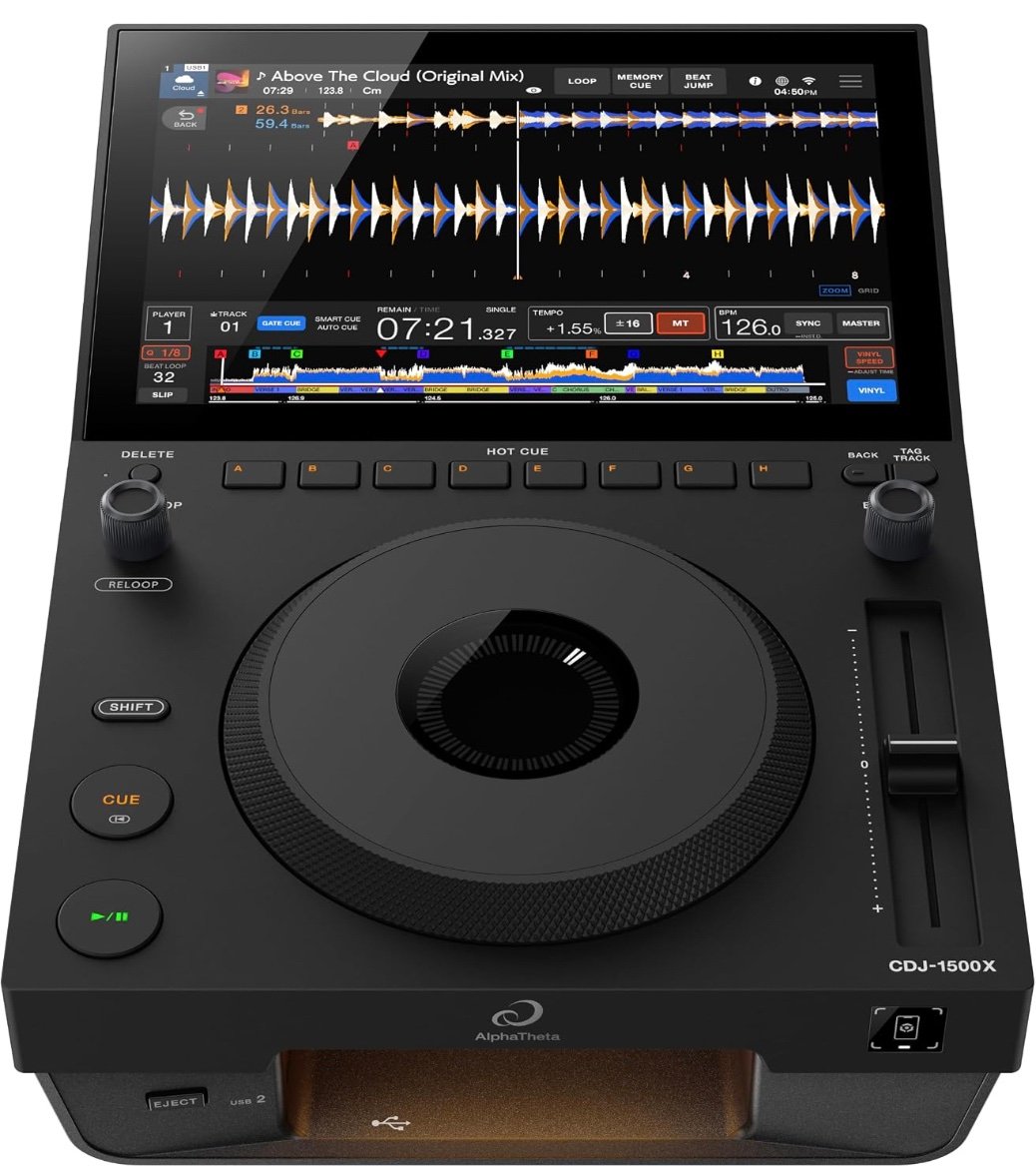
The screen is the headline, and it’s the same 10.1-inch panel as the far larger 3000X — here it dominates almost the entire top surface. The browse view shows up to 15 tracks at a glance, and the main waveform now marks up vocal positions, BPM change points and phrase structures directly on screen, so you can read a track’s arrangement without knowing it inside out. There’s Playlist Edit for rearranging tracks on the unit itself, plus dark and light display modes for different booth lighting.
Next to the XDJ-1000MK2’s little 7-inch display, this looks like it arrived from a different decade. For anyone moving up from an older screen player, the jump in usable information is the single biggest day-to-day upgrade.
Controls, jog and the missing key tools
This is where the compromises live. You get eight dedicated Hot Cue buttons (A–H, the same as the CDJ-3000) and a Beat Loop knob that sets a loop on a push and resizes it on a turn. Beyond that, the front panel is deliberately sparse: a lot of controls that get a physical button on the 3000X — master tempo, beat sync, quantise, slip and vinyl mode among them — are still on the unit, but moved into the touchscreen rather than dedicated buttons. Whether that’s a frustration or a welcome clean-up depends on how often you reach for them. The jog is mid-size — smaller than a full club CDJ, with a rotation indicator and non-slip surface. Scratch DJs will notice; most others won’t.
The one feature genuinely gone, not just relocated, is Key Sync and Key Shift — the tools that transpose a track’s musical key up or down to match the other deck on the fly. That’s a real step backwards, since AlphaTheta had put key shift on all its recent players and all-in-ones. Master Tempo (key lock) stays — you can still lock a track’s key while you move the pitch fader, just via the on-screen menu — so this isn’t the loss of harmonic mixing itself, only of on-the-fly key matching. Still, if that’s central to how you play, it’s the single biggest reason to pause before buying. Our guide to harmonic mixing explains where it matters most.
Don’t conflate these: Master Tempo (key lock) is still here — on-screen — so you can keep a track in its own key while you shift tempo. What’s actually removed is Key Sync and Key Shift, the deck-to-deck key-matching tools. Two different things that both have “key” in the name.
Connectivity, power and outputs
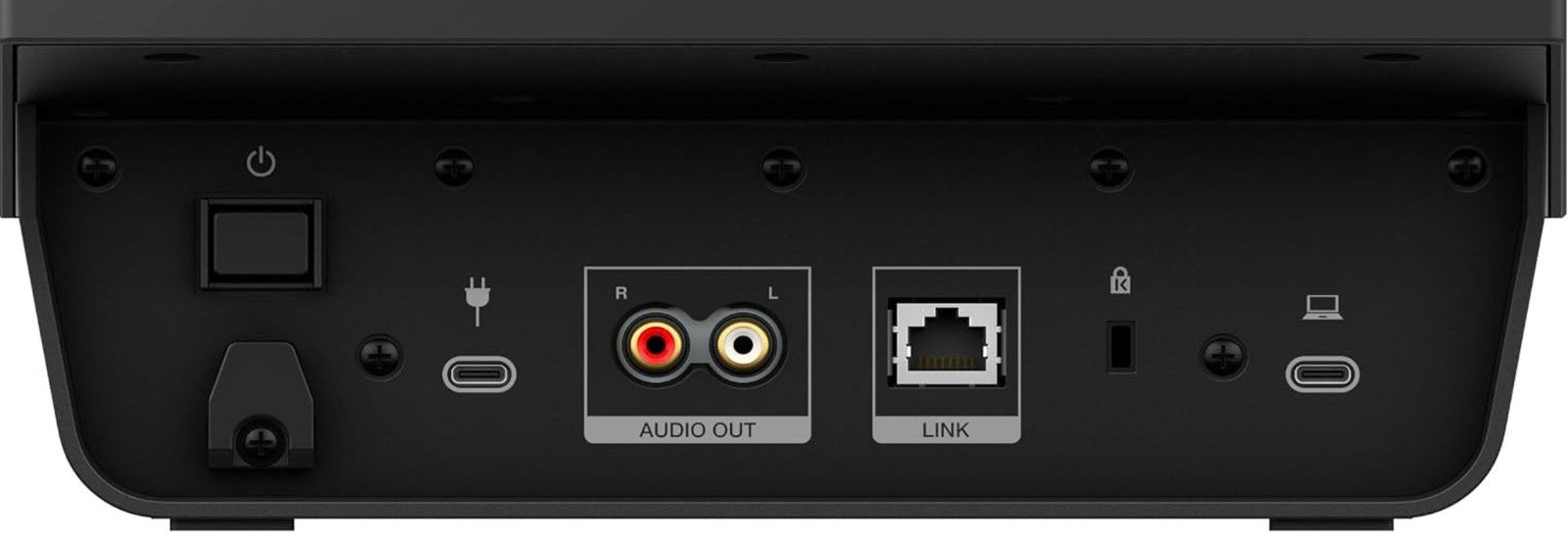
Two things on the rear will divide opinion. First, power: the 1500X ditches the locking IEC AC cable from the 3000X and runs off an external AC adapter into a USB-C power port — a CDJ first. It’s neat and modern, but a lot of venue and mobile DJs are already questioning how it’ll hold up in a messy, cable-tugging club booth versus a proper locking connector. Worth knowing: if you lose the specific adapter, a USB-C PD charger of the kind that ships with a laptop is your likely backup rather than any generic cable.
Second, outputs: it’s unbalanced RCA analogue only. There’s no digital coaxial (S/PDIF) out at all, which is a genuine surprise given the decade-old XDJ-1000MK2 had one. That draws a hard line under the positioning — you’re expected to feed a capable DJM-class mixer that does the heavy lifting. The 96 kHz/32-bit ESS DAC from the 3000X doesn’t carry over either, and the measured specs step down to match: signal-to-noise of 105 dB (vs 115), THD of 0.003% (vs 0.0018%), and frequency response of 20 Hz–20 kHz (vs 4 Hz–40 kHz). In a bar or lounge, inaudible. On a big rig, it’s exactly why the flagship still exists.
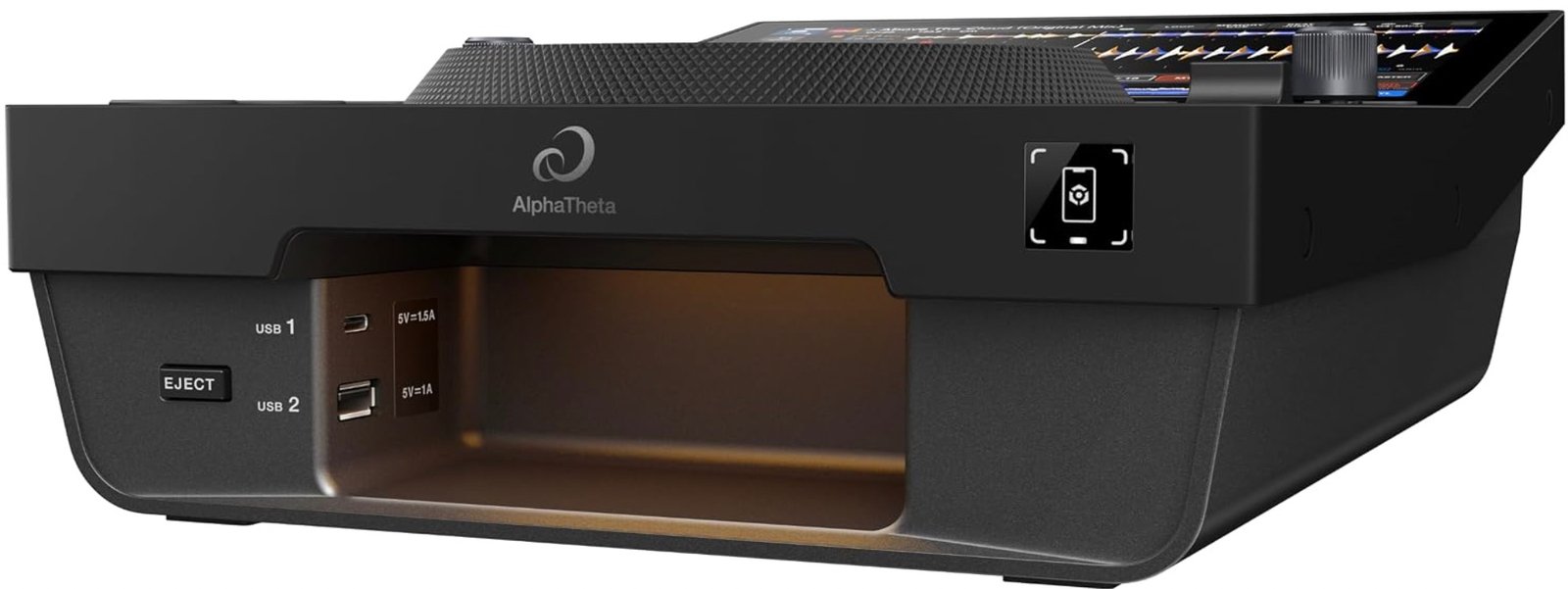
Elsewhere the connectivity is generous: an illuminated front USB bay with one USB-A and one USB-C (12 selectable LED colours), plus a rear USB-A, a second rear USB-C for computer connection, and a LAN port for Pro DJ Link. If you want to pair two of these with a compact mixer, our mixer buying guide covers the DJM-class options that suit this kind of rig.
Cloud, streaming and Serato
Connectivity is where the 1500X earns its keep. Built-in Wi-Fi means rekordbox CloudDirectPlay straight from your cloud library, plus StreamingDirectPlay from Apple Music, Beatport Streaming and Tidal (on a compatible rekordbox subscription plan). NFC on the front lets you tap a phone running rekordbox mobile to load your own playlists and settings instantly — turn up with nothing but a phone and play. Whether you’ll trust a bar’s Wi-Fi over a USB stick you know works is your call, but the option is there.
It also runs as an official Serato DJ Pro accessory over USB-C: the touchscreen browses your Serato library and shows waveforms, and the eight Hot Cue buttons map into Serato’s deck engine, including Serato Stems control. Note there’s no onboard rekordbox stems engine — stems here are a Serato-side feature. One catch to flag: rekordbox mobile needs no license, but Serato DJ Pro and djay Pro both require an active paid subscription to use with the unit. Most buyers will be on rekordbox anyway, so it’s a minor asterisk rather than a dealbreaker. If you’re weighing ecosystems, our DJ software comparison breaks down where each platform pulls ahead.
CoBeat: the crowd in your browse screen
The 1500X is the first AlphaTheta player to support CoBeat, a new audience-interaction service. You (or the venue) set up a QR code in advance; the crowd scans it to browse a catalogue of tracks you’ve pre-selected, then vote for what they want or send a message. Requests land on the player’s browse screen, ready to drop into your set, and emoji reactions appear on your phone. It’s fully optional — toggle it on or off whenever you like.
Is it useful or a gimmick? Genuinely too early to say, and early commentary is split. It’s a real feature rather than marketing fluff, but its value depends on the room. CoBeat and the rekordbox for Mac/Windows update that adds full 1500X support both go live on 9 July 2026 — so if you buy in the first week, budget for a short wait before the desktop rekordbox workflow is fully in place.
Key specs
Who it’s for — and who should skip it
Buy it if you run a bar or small venue and want a modern, low-footprint player; if you’re a producer or home DJ who wants a real CDJ workflow to practise on without spending flagship money; or if cloud libraries, streaming and crowd interaction genuinely fit how you play. As a compact “mini-3000X” for separates at home, it’s an easy recommendation.
Skip it if key sync and key shift are core to your mixing, if you need a digital output or a full-size jog, or if you’re kitting out a serious club system — in which case the CDJ-3000X still earns its price, and it’s worth reading up on the wider controllers and decks landscape before committing either way.
We’ll be putting the 1500X through a proper hands-on and updating this review with a final score. For now: a smart, overdue release that will almost certainly sell in volume — as long as you can live without the tools AlphaTheta chose to leave out.
Check prices →★ Some links on this page are affiliate links. If you buy through them, we earn a small commission at no extra cost to you — it helps fund independent testing and writing, and never changes our verdict. We only recommend gear we’d use ourselves. Read our full disclosure →