Last updated: November 2026
Has DJ gear ever been open before? Yes, several times. Final Scratch, an early digital vinyl system, was announced in 1998 for BeOS, a little-used operating system, and its first release ran on a modified version of Linux. Mixxx, free DJ software under the GPL licence, grew out of a PhD project at the University of Copenhagen and reached version 1.0 in 2003. Since then hobbyists have built Arduino controllers, DJ TechTools has published MIDI Fighter Twister firmware, and coders have worked out how to read Pioneer’s Pro DJ Link network and rekordbox USB sticks.
In October 2026 the thread reached a club booth: TriMixxx, a homemade Raspberry Pi deck, played a nine-hour night, and Behringer showed a prototype standalone it says has “no proprietary lock-in”. Cheap computers and readable USB formats are new. Closed formats, and the work of decoding them, are not.
Quick takeaways
- Final Scratch was built by N2IT, a small Amsterdam company, announced for BeOS in November 1998 and launched by Stanton in January 2002 for BeOS and Linux.
- Mixxx started as Tue Haste Andersen’s research tool for new DJ interfaces. His paper on it was presented at the NIME conference in Montreal in May 2003, and Mixxx 1.0 followed that August.
- Pioneer’s Pro DJ Link (2009) and the rekordbox USB format are proprietary. Deep Symmetry’s open source projects decoded them, and Mixxx 2.3 used that work to read rekordbox sticks.
- DIY controllers went from Traktorino (an Arduino Uno shield, 2017) to DJC-DIY (an Arduino Pro Micro build for Mixxx, 2026).
- TriMixxx and Behringer’s ANIMA prototype are the 2026 chapter. Only TriMixxx has been used in a club so far.
- None of these projects has replaced the CDJ, and the open ones still rely on small teams or single developers.
What this history adds: most coverage treats each project as a one-off. Put them on one timeline and a pattern shows up. Open DJ gear returns every few years, each time on cheaper hardware, and each time it runs into the same closed formats. We’ve built that timeline from the original papers, mailing-list announcements and code repositories.
Why does open DJ gear keep coming back?
Open DJ gear keeps coming back because DJs keep hitting the same three problems: software that only works with one brand’s hardware, gear that stops being supported, and music libraries locked into one format. Open source is the usual answer offered. Open source means the code, and sometimes the hardware designs, are published so anyone can study, change, build and even sell them, as the Open Source Hardware Association’s definition puts it for hardware.
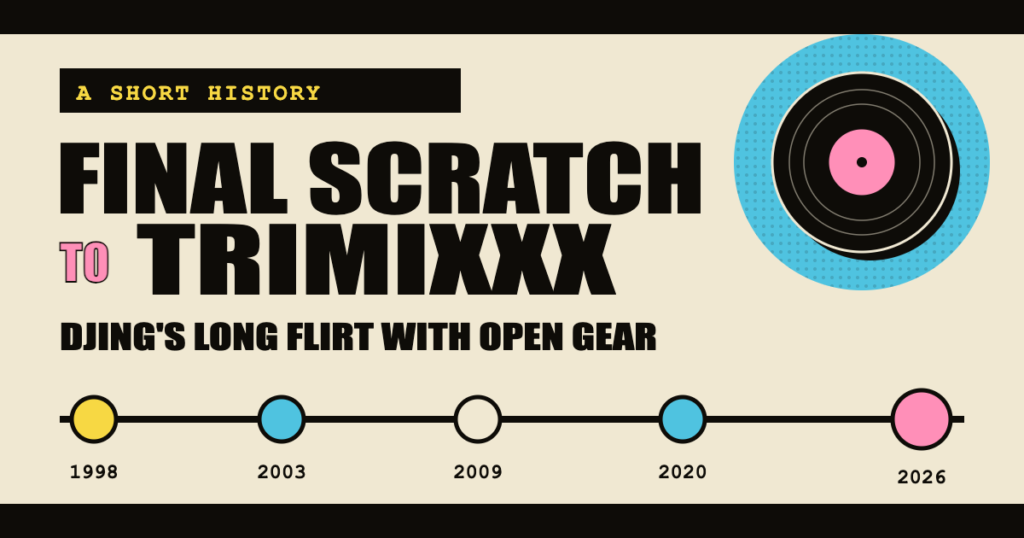
The timeline below is the backbone of this story. Each dot is a dated, sourced moment when part of DJing became open or hackable.
Chart: The DJ Mixtape, from the NIME 2003 proceedings, the linux-audio-dev mailing list archive, CDM, DJWORX, DJ TechTools, Hackaday.io, GitHub, mixxx.org, PCBWay and the TriMixxx blog, November 2026.
How did Final Scratch start on BeOS and Linux?
Final Scratch started as a two-person project in Amsterdam: according to CDM’s history of the system, the company N2IT built it in 1997 and 1998 and announced it for BeOS on 19 November 1998. Richie Hawtin and John Acquaviva gave input on the design and were among its first users.
Final Scratch was a digital vinyl system, or DVS: special timecode records on ordinary turntables control music files on a computer, so you can scratch and cue an MP3 as if it were vinyl. The odd part was the operating system. DJWORX describes BeOS as potentially great but staggeringly unpopular. Version 1.0 ran on a specially modified build of Debian Linux, per CDM and Wikipedia’s Final Scratch entry.
Stanton launched the first complete commercial version at Winter NAMM in January 2002, for BeOS and Linux. In March 2003 Stanton and N2IT released the Linux source code for the ScratchAmp driver, the software that runs the system’s audio interface. That was the only part made open, and CDM notes it covered the interface alone.
Then Final Scratch went the other way. Version 1.1 added Mac support, version 1.5 added Windows XP and dropped Linux, and Native Instruments built the software side as Traktor Final Scratch. After Stanton and NI split, NI launched its own Traktor Scratch. In April 2008 NI settled a court case with N2IT, accepted the validity of N2IT’s patents and licensed them for Traktor Scratch, DJWORX reports. The Linux-friendly experiment became the basis of a closed, patented product category. Digital vinyl has kept moving since: the Phase Essential, for example, replaces the timecode record with motion sensors that sit on your own records.
Final Scratch has a place next to the other odd turns in DJ history in our cult flops of DJ gear piece: the right idea on the wrong operating system.
Where did Mixxx come from?
Mixxx came from a university, not a gear company. Tue Haste Andersen, at the Department of Computer Science of the University of Copenhagen, built it as a research tool for testing new ways to DJ. His paper “Mixxx: Towards Novel DJ Interfaces” was presented at the NIME conference in Montreal in May 2003.
The paper itself is a good read for any DJ who likes gear. Andersen interviewed two working DJs and musicians at their own places, for up to two hours each, filmed them, and used what he saw to design prototype interfaces. He admits two people can’t speak for the whole field. The paper says Mixxx was released under the General Public License and ran on Mac OS X, Windows and Linux, and that on Linux the total latency could be under 5 ms with the right setup.
Andersen announced Mixxx 0.9.1 on the linux-audio-dev mailing list in September 2002, noting it was being developed on Linux, then Mixxx 1.0 on 24 August 2003. Sources differ slightly on the start date: mixxx.org says 2002, Wikipedia says early 2001. Either way, the project outlived its founder’s thesis. The current stable release is Mixxx 2.5.6, free with no paid version, and mixxx.org describes it as the only free cross-platform vinyl control software. Final Scratch’s timecode idea lives on there too.
When did DJs start building their own controllers?
DJs building their own controllers took off once cheap Arduino boards made it simple to turn buttons and knobs into MIDI, the standard language DJ software listens to. Three projects show how that changed.
Traktorino (2017)
Traktorino is a controller shield that plugs onto an Arduino Uno, made by Gustavo Silveira of the Brazilian company Músico Nerd. DJ TechTools covered it in August 2017 and compared it to a Traktor Kontrol Z1, quoting a kit price of about R$170, roughly $54 at the time. Silveira’s Hackaday.io page calls it open-source hardware and software and offers the code, enclosure, PCB, firmware and Traktor mapping as downloads. That page doesn’t name a licence.
Open MIDI Fighter firmware
Firmware is the small program built into a controller that decides what each button and knob sends. The firmware for the original kit-built Midi Fighter has an open source home on SourceForge under GPLv2 and MIT licences. By March 2018 DJ TechTools’ GitHub account was hosting the MIDI Fighter Twister firmware, described there as the official firmware. That was a gear company publishing the code for one of its own controllers, which was rare in DJing.
DJC-DIY (2026)
DJC-DIY is a two-deck controller you print and wire at home, by Vuk Mandić of Mandiclab, shared on PCBWay in January 2026. The GitHub repository lists an Arduino Pro Micro, eight buttons, four knobs, three slide faders and two encoders, with 3D-printed jogs, pads and case. The software is GPL-3.0 and the hardware files are CERN-OHL-S-2.0 (the PCBWay page lists a different CERN licence, so check the repository). It works with Mixxx out of the box, and the repository says the device and kits aren’t for sale.
None of these is a beginner’s route into DJing. If you just want something to mix on, our best budget DJ controllers guide covers ready-made options under $350.
How did coders crack Pro DJ Link and rekordbox USBs?
Coders cracked Pro DJ Link and the rekordbox USB format by reverse engineering, which means working out how a closed system works by watching what it does, without the maker’s documentation. Pro DJ Link is the Ethernet network Pioneer players use to share tracks and timing, introduced in 2009 according to DJ TechTools.
The best-known work comes from Deep Symmetry, James Elliott’s project. DJ TechTools reported in July 2017 that his Beat Link Trigger program makes a computer appear as a CDJ on the network, so it can follow what the players are doing and fire MIDI or lighting cues. Deep Symmetry’s Crate Digger library reads the export.pdb database and the analysis files that rekordbox writes to a USB stick, including beat grids, waveforms, memory cues and loops. The Beat Link Trigger repository is blunt that it is “in no way a sanctioned implementation of the protocols”.
That library mattered beyond lighting rigs. In July 2020 the Mixxx team announced that Mixxx 2.3 would read rekordbox-prepared USB drives, credited to “the hard work already completed by Deep Symmetry”. It imports playlists, beat grids, hot cues, memory cues and loops from the stick. It doesn’t read a computer’s own rekordbox collection, which uses a different database.
What are TriMixxx and ANIMA?
TriMixxx and ANIMA are the 2026 chapter, and they are very different things. TriMixxx is a working homemade deck. ANIMA is a prototype photographed in a factory.
TriMixxx is a CDJ-style deck built by developer Samuel Prevost. Per its GitHub repository, it runs a fork of Mixxx 2.5.6 on a Raspberry Pi 4B, reads rekordbox-formatted USB sticks without a laptop, and reverse-engineers Pro DJ Link to swap tracks with real CDJs. The repository states it has no affiliation with, or endorsement from, AlphaTheta, the company behind Pioneer DJ. On 4 October 2026 one TriMixxx deck ran for about nine hours at a club night called Technobase. The developer’s own write-up describes an 18-second freeze while loading a 52 MB AIFF from a slow stick, and a fix four days later that started the same file in 0.46 seconds on his emulated test deck.
ANIMA is a standalone DJ system prototype that Behringer posted photos of in late October 2026, with a Klark Teknik badge on the back. DJ TechTools reports a target price of $300 to $400, edited down from $400 to $500 within an hour, and quotes the pitch: “no proprietary lock-in” and “Create your own software”. Digital DJ Tips describes four channels, eight pads per deck and a fold-flat touchscreen, with jogs and pads not yet fitted. The software, processor, final name and release date haven’t been announced. Music Tribe, Behringer’s parent company, runs a MusicTribeOpenSource GitHub organisation with the tagline “Open hardware that runs any firmware, any software”, but on 3 November 2026 it held no DJ or ANIMA code.
If you need a deck for gigs now, standard club players are still the safe bet, and our best DJ media players guide compares them.
| Project | Year | Who | What was open | Reads rekordbox or Pro DJ Link? | Status in Nov 2026 |
|---|---|---|---|---|---|
| Final Scratch | 1998 (announced) | N2IT, then Stanton | Linux ScratchAmp driver source only (2003) | No | N2IT’s patents licensed to NI for Traktor Scratch (2008) |
| Mixxx | 2002–2003 | Tue Haste Andersen, now a volunteer team | All code, GPL v2 or later | Reads rekordbox USB exports since 2.3 | Version 2.5.6, free |
| Traktorino | 2017 | Gustavo Silveira, Músico Nerd | Code, PCB, enclosure, mapping (no licence named) | No | Files online |
| MIDI Fighter Twister firmware | by 2018 | DJ TechTools | Firmware code | No | On GitHub |
| Beat Link Trigger and Crate Digger | 2016 onwards | Deep Symmetry (James Elliott) | All code, EPL-2.0 | Yes, unofficially | Still updated (Beat Link Trigger 8.0) |
| DJC-DIY | 2026 | Vuk Mandić, Mandiclab | Code (GPL-3.0) and hardware (CERN-OHL-S-2.0) | No (Mixxx controller) | Build it yourself; not sold |
| TriMixxx | 2026 | Samuel Prevost | Code (GPL-3.0) and build files | Yes, unofficially | One-off; played a club night |
| ANIMA | 2026 (prototype) | Behringer / Music Tribe | Not yet known | Not yet known | Prototype; no specs or date |
Built from each project’s own pages and the sources linked above, checked on 3 November 2026. Beat Link Trigger’s copyright runs from 2016.
What’s different this time?
Three things are different in 2026: the computer is cheap and tiny, the pro USB format can be read, and a large gear company says it wants in.
Diagram: The DJ Mixtape, from CDM, Wikipedia’s Final Scratch entry and the TriMixxx GitHub repository, November 2026.
- Small single-board computers do the work. Final Scratch needed a PC and a dedicated audio box. TriMixxx puts a Raspberry Pi 4B, a credit-card-sized computer, inside the deck.
- A manufacturer is talking openness. In 2003 Stanton opened one driver. In 2026 Behringer is pitching a whole standalone with “no proprietary lock-in”, and its parent company already publishes the code for a music production centre under the AGPL-3.0 licence. Until ANIMA’s software is out, that remains a promise.
- Open projects can read the stick in your pocket. Thanks to Crate Digger, Mixxx can load a rekordbox USB export and TriMixxx can share tracks with CDJs. An open deck no longer means building a separate music library.
What hasn’t changed?
What hasn’t changed is that the formats DJs rely on are still closed, and open projects still depend on a few people working them out from outside.
- Nobody has been given the key. Deep Symmetry calls its work unsanctioned. TriMixxx’s link testing has been against CDJ-2000NXS players, a 2012 model, and newer CDJs haven’t been shown working with it.
- The physical parts are still the hard bit. TriMixxx’s jog wheels came from donor CDJ-1000MK3s, according to DJ TechTools, and DJC-DIY needs a 3D printer and a soldering iron.
- Open ideas get folded back into closed products. Final Scratch began on Linux and ended up as a patent licence. Whether ANIMA stays open will depend on what ships.
- Support is up to you. Mixxx has a volunteer team, and TriMixxx has one developer and a blog. There’s no warranty desk for either.
What does this mean for your next gear purchase?
For most working DJs, open gear is something to follow, not something to gig with yet. Picture a Saturday at a bar with a pair of CDJs: you still need a rekordbox USB, and the club’s players decide what works. Where openness does help today is in the software. Mixxx costs nothing, runs on Windows, macOS and Linux, and reads your rekordbox sticks, so it’s a free backup if your main software or licence lets you down. If you’re choosing paid software, our DJ software comparison compares Serato, rekordbox, Traktor and VirtualDJ. Check which hardware each one supports before you buy, because that tie-in is the problem open gear keeps trying to solve.
Open DJ gear FAQ
What was Final Scratch?
Final Scratch was an early digital vinyl system made by the Dutch company N2IT and sold by Stanton. Timecode records on normal turntables controlled music files on a computer. It was announced for BeOS in 1998, and its first release ran on a modified Debian Linux.
Did Final Scratch become Traktor Scratch?
Partly. Native Instruments developed the software side as Traktor Final Scratch, then launched its own Traktor Scratch after splitting with Stanton. In 2008 NI licensed N2IT’s patents for Traktor Scratch after a court case.
Who created Mixxx and when?
Tue Haste Andersen created Mixxx as a PhD research project at the University of Copenhagen. Early versions appeared in 2002, his NIME paper on it was presented in May 2003, and Mixxx 1.0 came out in August 2003.
Can free DJ software read my rekordbox USB?
Yes, Mixxx can. Since version 2.3 it reads rekordbox-prepared USB drives, including playlists, beat grids, hot cues, memory cues and loops. It doesn’t read the rekordbox collection on your computer.
Is there an open source CDJ I can buy?
Not yet. TriMixxx is a one-off homemade deck that isn’t for sale, and Behringer’s ANIMA is a prototype with no release date or confirmed software.
Is reverse engineering Pro DJ Link legal?
We can’t give legal advice. The projects themselves describe the work as interoperability research and say it isn’t sanctioned or endorsed by Pioneer DJ or AlphaTheta.
Verdict: the same flirt, on better terms
- What’s real now: free Mixxx that reads rekordbox sticks, and a homemade deck that has played a full club night.
- What’s still a promise: an open standalone from a big brand. Wait for ANIMA’s software and specs before you plan around it.
- Who should follow it: DJs worried about lock-in, anyone with an older controller they want to keep alive, and anyone who enjoys DJ history.
- Who can ignore it for now: anyone gigging on house CDJs every weekend. Nothing here changes what you need on a Saturday night yet.
How we research: every date and claim was checked on 3 November 2026 against primary sources where they exist (the NIME 2003 paper, the linux-audio-dev mailing-list archive, the projects’ GitHub repositories and websites, mixxx.org) and against named trade press (CDM, DJWORX, DJ TechTools, Digital DJ Tips) where they don’t. ANIMA details are Behringer’s statements as reported by that press. Where sources disagree, we say so. The timeline and diagram are our own, built from those sources. By Dan, DJing since 1994.