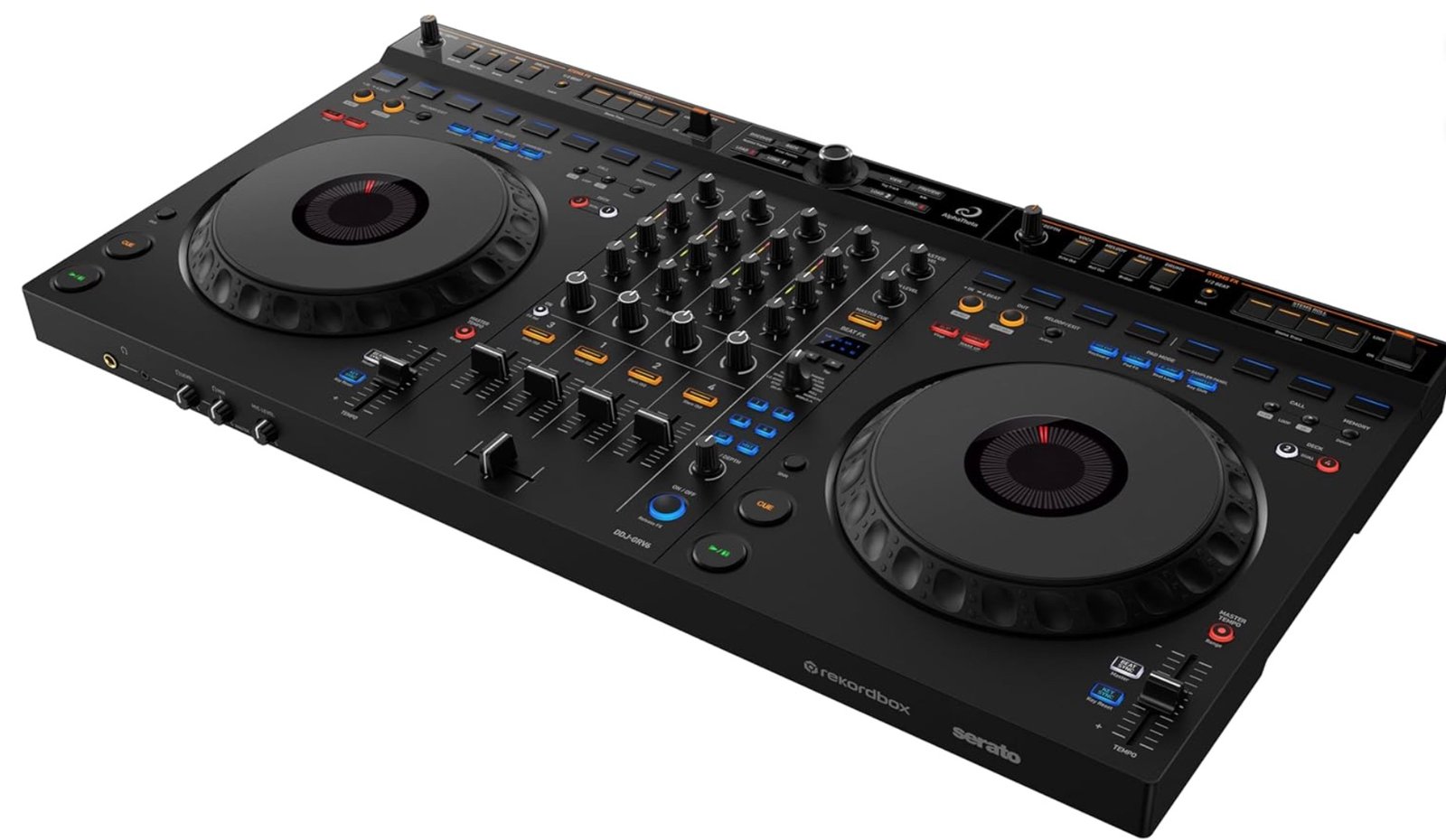
The DDJ-GRV6 is the best mid-range 4-channel controller AlphaTheta currently makes — and a genuine step forward from the FLX6 it effectively replaces. The club-standard layout, Groove Circuit, and Serato Stems FX give it a creative edge that no other controller at this price offers.
The build is consumer-grade plastic beneath the professional styling, and the lack of external inputs beyond a mic will frustrate some. But for hobby and intermediate DJs who want a serious layout and real remix tools without flagship pricing, the GRV6 makes a strong case at around $899.
What Is the DDJ-GRV6?
The AlphaTheta DDJ-GRV6 is a 4-channel performance DJ controller aimed at hobby and intermediate DJs who want a more serious layout and creative remix tools without stepping into flagship pricing. It sits in the mid-range of AlphaTheta’s controller lineup — above the entry-level DDJ-FLX4, below the more advanced DDJ-FLX10, and effectively replacing the older DDJ-FLX6 with a more convincing package.
The headline features are Groove Circuit (a rekordbox-exclusive live drum remixing tool) and Stems FX (available in Serato DJ Pro, letting you apply effects to individual stems). Both are genuinely modern, 2026-era creative tools rather than spec-sheet filler, and they’re what separate the GRV6 from a standard 4-channel controller at a similar price.
It ships with rekordbox and Serato DJ Pro included, and also supports Virtual DJ and Algoriddim Djay — a broader software net than most controllers in this bracket.
Design and Layout
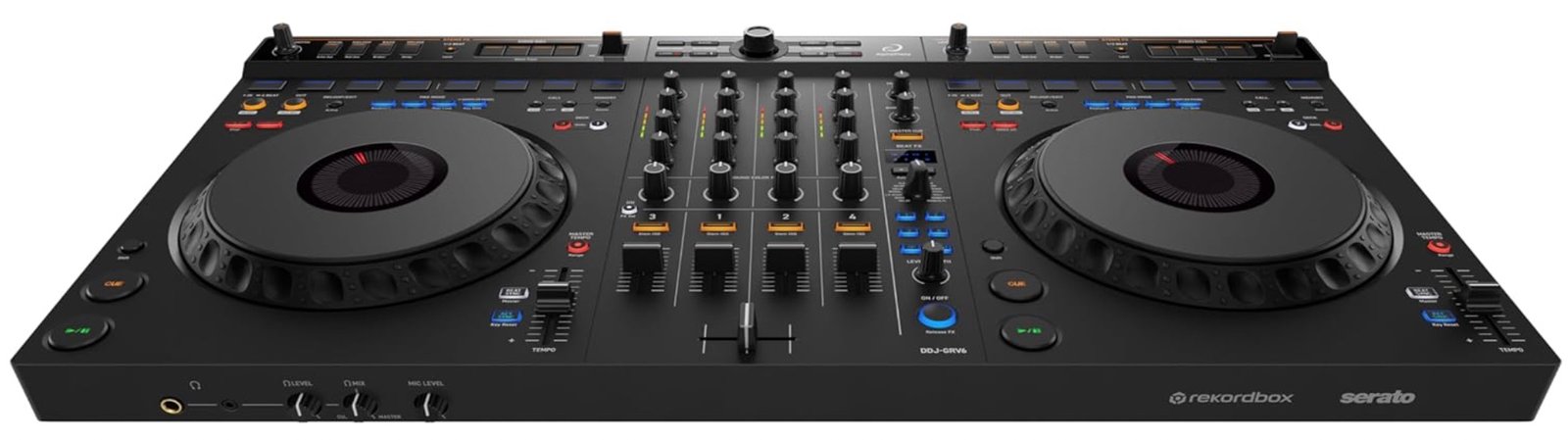
The GRV6’s layout is its most immediately striking quality. The 8 performance pads sit above the jog wheels — exactly as they do on the CDJ-3000 — and the Beat FX section is modelled on the DJM-A9 mixer. For DJs who want to build familiarity with club booth gear, this is a meaningful design choice rather than a cosmetic one. The muscle memory you build on the GRV6 transfers more directly to a CDJ/DJM setup than a controller with a conventional layout would.
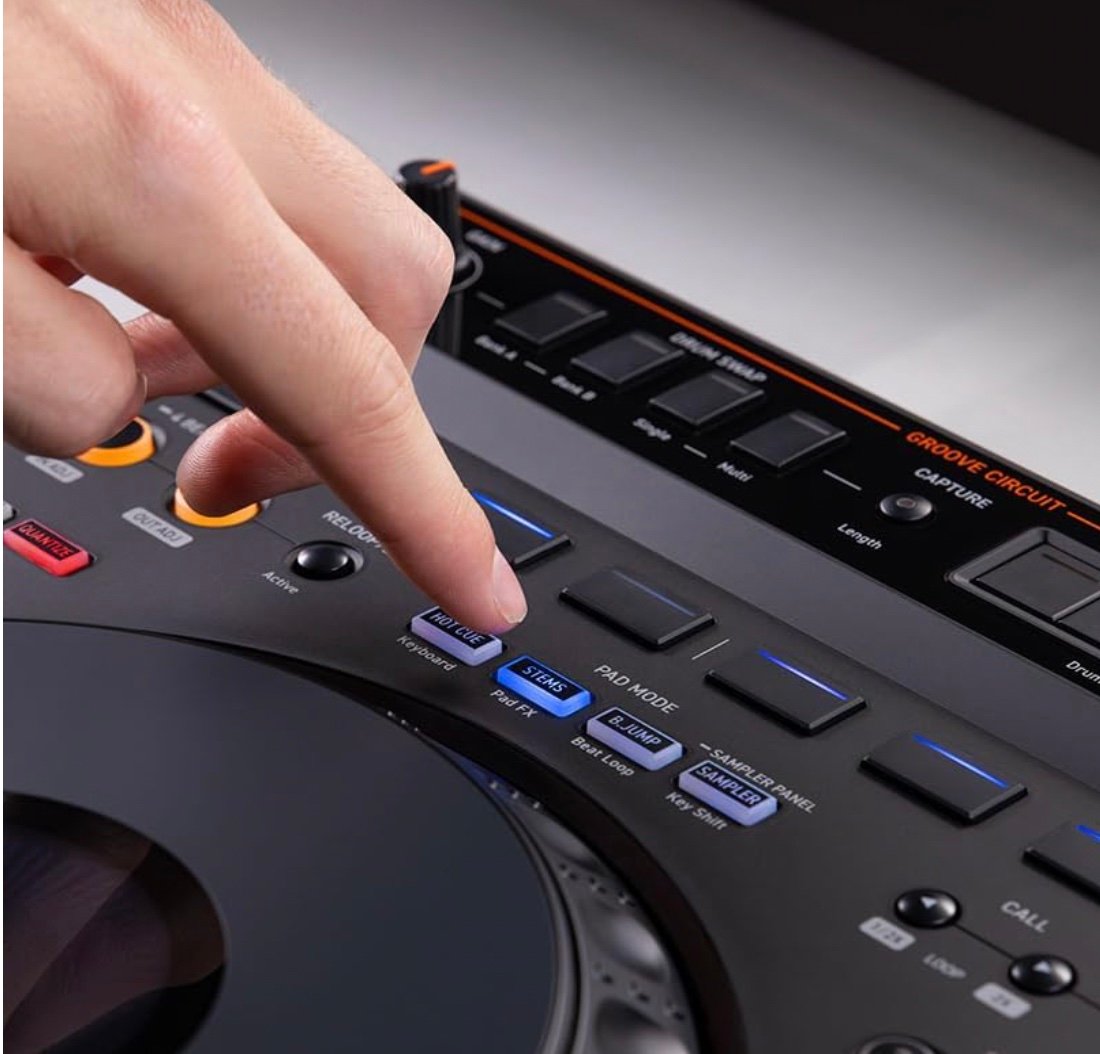
The jog wheels are CDJ-3000X sized — large, and good for scratching. They’re not motorised and don’t have the premium feel of a Rane Performer platter, but they’re solid for the price tier. The Groove Circuit controls sit cleanly above the pads with a deliberate step-up between them and the jog wheels, so you won’t accidentally nudge a jog while triggering drum loops.
Be honest about the build: this is consumer-grade construction. The matte black finish looks professional in photos and on a desk, but up close the plastic chassis and lighter-feeling faders tell the real story. At $899 that’s a fair trade-off — the FLX10 costs roughly twice as much partly because it’s built to a higher physical standard. The crossfader is decent but nowhere near a Magvel or MAG FOUR in feel.
Groove Circuit Explained
Groove Circuit is the GRV6’s standout feature and the one worth understanding before you buy. It’s a rekordbox-only function that lets you replace the drum parts of a playing track with different drum loops in real time, simply by pressing the dedicated buttons. You can swap drum patterns mid-track, apply effects to just the drum layer for fills and build-ups, and effectively remix the groove of a song while the rest of the track plays normally.
In practical terms this means you can take a house track and drop in a drum and bass pattern underneath it, create a breakdown by stripping out the drums entirely, or build tension by layering a different rhythm over the original. It’s a genuinely creative tool for open-format and hobby DJs who want to do something more interesting than a standard blend transition.
Note: Groove Circuit is a rekordbox-exclusive feature. If you use Serato DJ Pro as your primary software, you get Stems FX instead — a different but complementary set of tools. Make sure you know which software you’re using before factoring either feature into your buying decision.
Serato Stems FX and Software Support
When you run the GRV6 with Serato DJ Pro, Groove Circuit gives way to Stems FX — a mode that lets you apply effects (Roll, Trans, Echo Out, Delay) to individual stems of a track: drums, bass, vocal, or melody. An overlay sheet is included in the box to relabel the buttons for Serato use. It’s a slightly different creative workflow to Groove Circuit, but equally modern in its approach to live remixing.
One Serato caveat worth knowing: the included version of Serato DJ Pro doesn’t come with the Pitch ‘n Time expansion pack, which is required for key shifting. If key mixing is important to your workflow, that’s an additional purchase.
Beyond rekordbox and Serato, the GRV6 also supports Virtual DJ and Algoriddim Djay — broader compatibility than most controllers in this bracket. Rekordbox iOS and Android are also supported for mobile use, though with some limitations versus the full desktop experience.
Sound, Outputs, and Connectivity
The GRV6’s I/O is functional rather than extensive. Main outputs cover both 1/4″ TRS and RCA, a booth output runs via RCA, and there are two headphone outputs (1/4″ and 3.5mm). A single microphone input handles announcements or guest vocals. USB-C connection to the computer is a welcome modern touch.
What’s missing is external line and phono inputs — there’s no way to connect a turntable or external line source. For DJs running a purely digital setup this won’t matter, but if you want to blend vinyl into your sets or route external sources through the controller, the GRV6 isn’t the right tool. That limitation is worth flagging before you buy, particularly if you’re stepping up from a setup that includes turntables.

Workflow and Performance
Day-to-day, the GRV6 feels fast and well-organised. The Smart Rotary Selector handles library browsing cleanly, the Beat FX section from the DJM-A9 gives you a broad palette of effects with familiar controls, and the per-channel 3-band EQ is responsive. Stem Iso mode — activated by holding shift and a channel cue button — converts the EQs to stem controls, which is a useful shortcut for on-the-fly stem manipulation without switching modes.
The controller is aimed at creative mixing rather than turntablist-first performance. The jog wheels are good for scratching but this isn’t a battle-layout controller — if scratch technique is central to your style, the Rane Performer or DDJ-REV7 are more natural choices. For open-format mixing, blending genres, and live remixing with Groove Circuit or Stems FX, the workflow is strong.
DDJ-GRV6 vs DDJ-FLX6-GT
The FLX6-GT was a competent 4-channel controller but never a particularly exciting one. The GRV6 replaces it with a more professional layout, Groove Circuit, Stems FX, and a CDJ-inspired design that makes more sense for DJs who want to work toward club-standard gear. The FLX6-GT’s main advantage was price — the GRV6 costs more but delivers meaningfully more for it. If you’re deciding between them and budget allows, the GRV6 is the better long-term buy.
DDJ-GRV6 vs DDJ-FLX10
The FLX10 remains AlphaTheta’s more advanced 4-channel controller, with deeper performance and stem features, better build quality, and a higher price to match. The choice between them comes down to how much you’ll use those extra capabilities. For most hobby and intermediate DJs, the GRV6’s feature set is more than enough — paying the FLX10 premium only makes sense if you’re actively pushing into more advanced territory. The GRV6 is the smarter value pick for the majority of buyers in this category.
| Controller | Best for | Key strength | Main drawback | Price (USD) |
|---|---|---|---|---|
| DDJ-GRV6 | Hobby & intermediate DJs | Groove Circuit + club layout | No external inputs, plastic build | ~$899 |
| DDJ-FLX6-GT | Budget 4-channel buyers | Lower entry cost | Weaker layout, no Groove Circuit | ~$599 |
| DDJ-FLX10 | Advanced creative DJs | Deeper stems + performance features | Higher price | ~$1,729+ |
| DDJ-FLX4 | Beginners | Affordable entry point | 2-channel only | ~$349 |
| Rane One MKII | Serato scratch DJs | Motorised platters, MAG crossfader | 2-channel, higher price | ~$1,499 |
Full Specs
| Spec | Detail |
|---|---|
| Channels | 4-channel |
| Jog wheels | CDJ-3000X sized, full-size |
| Performance pads | 8 × per deck, positioned above jog wheels |
| Groove Circuit | Live drum remixing — rekordbox only |
| Stems FX | Roll, Trans, Echo Out, Delay per stem — Serato DJ Pro only |
| Beat FX | DJM-A9 Beat FX suite |
| EQ | 3-band per channel + Stem Iso mode |
| Main outputs | 1/4″ TRS × 1 + RCA × 1 |
| Booth output | RCA × 1 |
| Headphones | 1/4″ stereo + 3.5mm stereo mini jack |
| Mic input | 1 × (no external line/phono inputs) |
| USB | USB-C |
| Software | rekordbox + Serato DJ Pro included; also Virtual DJ, Algoriddim Djay |
| Mobile | rekordbox iOS/Android supported |
| Price | ~$899 USD — check current pricing |
Pros and Cons
- Groove Circuit is a genuinely useful creative tool, not a gimmick
- CDJ-3000-inspired layout builds transferable club skills
- Serato Stems FX adds a modern remixing dimension
- Full-size CDJ-3000X jog wheels
- DJM-A9 Beat FX suite included
- rekordbox + Serato DJ Pro + Virtual DJ + Djay all supported
- USB-C connection
- Strong value in the mid-range bracket
- Consumer-grade plastic build — not the premium feel the styling suggests
- No external line or phono inputs — digital-only setup
- Groove Circuit is rekordbox-only; Serato users get Stems FX instead
- Serato DJ Pro doesn’t include Pitch ‘n Time (key shifting costs extra)
- Crossfader not top-tier — not suited to serious scratch use
- Not an Ableton-native controller
The Verdict
The DDJ-GRV6 is the right controller for hobby and intermediate DJs who want a club-style 4-channel layout, real creative remix tools, and software compatibility that covers rekordbox, Serato, and beyond — all without paying flagship prices. Groove Circuit and Stems FX are the features that make it worth choosing over cheaper alternatives, but only if you’ll actually use them. If your workflow is purely mixing and blending, you can get there for less with the FLX6-GT.
Who should skip it: DJs who need external inputs for vinyl or hardware, anyone who wants a scratch-first battle layout (look at the Rane Performer or DDJ-REV7), and buyers who want the most advanced performance controller AlphaTheta makes (that’s the FLX10). For everyone else in the mid-range market, the GRV6 is a strong, modern choice.
Frequently Asked Questions
Is the DDJ-GRV6 good for beginners?
It’s better positioned as a step-up controller for hobby and intermediate DJs rather than an entry-level choice. If you’re just starting out, the DDJ-FLX4 is a more affordable and simpler entry point. The GRV6 makes more sense once you’ve outgrown a 2-channel setup and want more creative tools and a club-style layout.
Does the DDJ-GRV6 work with Serato DJ Pro?
Yes — Serato DJ Pro is included in the box. When using Serato, the Groove Circuit buttons become Stems FX controls, letting you apply effects to individual track stems. Note that Serato Pitch ‘n Time (for key shifting) is not included and costs extra.
Does the DDJ-GRV6 work with rekordbox?
Yes — rekordbox is included and is the primary software for Groove Circuit. It also supports rekordbox for iOS and Android for mobile DJing, though with some limitations versus desktop.
Is the DDJ-GRV6 better than the FLX6?
Yes, meaningfully so. The GRV6 has a more professional club-inspired layout, Groove Circuit, Stems FX support, and a generally more polished package. It costs more, but it delivers more. If budget isn’t a barrier, the GRV6 is the stronger long-term buy.
Is the DDJ-GRV6 worth the money?
At around $899 it’s good value if you’ll use Groove Circuit or Serato Stems FX. If those features don’t match your workflow, you might get better value elsewhere. The build is consumer-grade, so don’t expect flagship physical quality — but the creative feature set and club-standard layout are genuinely strong for the price.
Some links in this post are affiliate links. If you buy through them we earn a small commission at no extra cost to you — it helps fund the site. See our full disclosure.