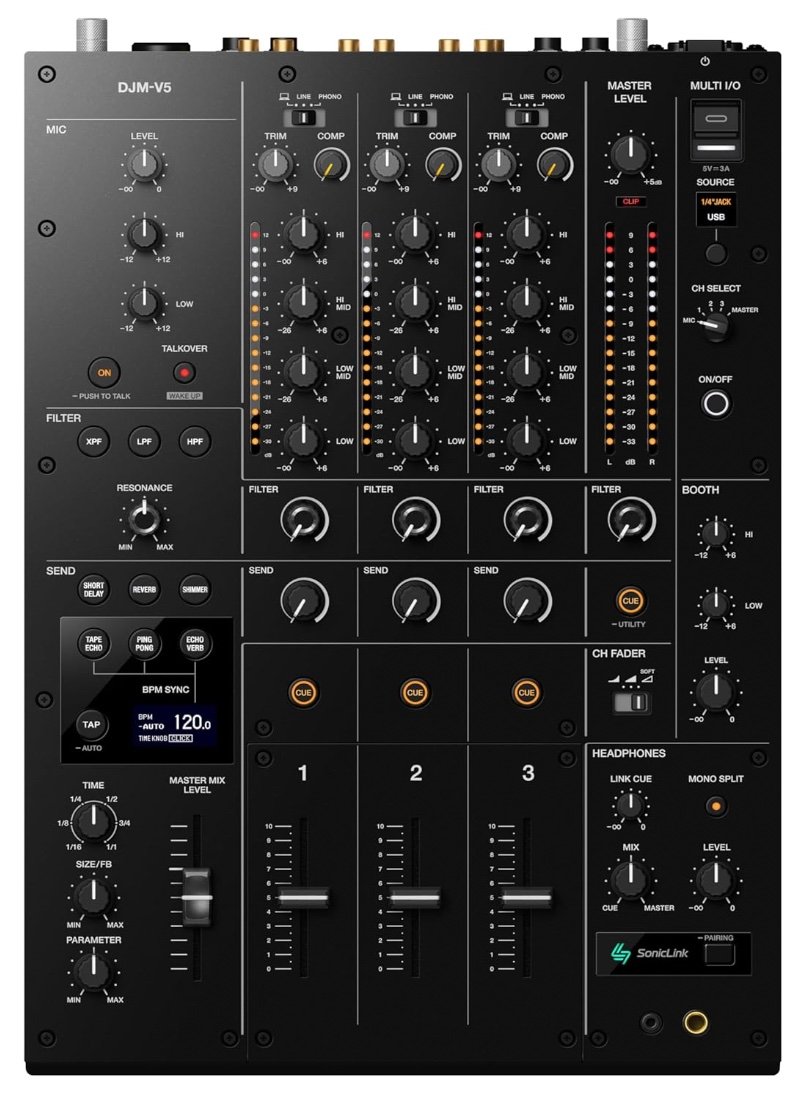
The DJM-V5 is a compact, premium club mixer that delivers V10-level sound quality and workflow in a smaller, more focused package. The 4-band EQ, send FX section, SonicLink wireless monitoring, and PRO DJ LINK make it one of the most feature-complete 3-channel mixers available at any price.
At $2,199 it demands a clear use case. But for club DJs who want AlphaTheta’s best sound engineering in a booth-friendly format — and who will actually use the creative tools on offer — there’s very little that competes directly with it.
What Is the DJM-V5?
The AlphaTheta DJM-V5 is a 3-channel compact club mixer positioned as a smaller, more focused alternative to the DJM-V10. It’s not a budget mixer and it’s not a beginner’s tool — it’s built for experienced club DJs who want the audio quality and workflow depth of AlphaTheta’s flagship range without the physical footprint of a full-size 6-channel desk.
The case for it is straightforward: premium 96kHz / 32-bit conversion, a 4-band EQ on every channel, six send effects, three filter types including cross-pass, SonicLink wireless headphone monitoring built in, and full PRO DJ LINK connectivity for CDJ-based setups. That’s a serious feature set for a mixer of this size, and it explains why the price sits where it does.
Software support covers rekordbox and Serato DJ Pro officially, with Traktor Pro 3.3.0 and ShowKontrol also referenced by retailers. For most club DJs running rekordbox or Serato, this covers everything they need.
Design and Layout
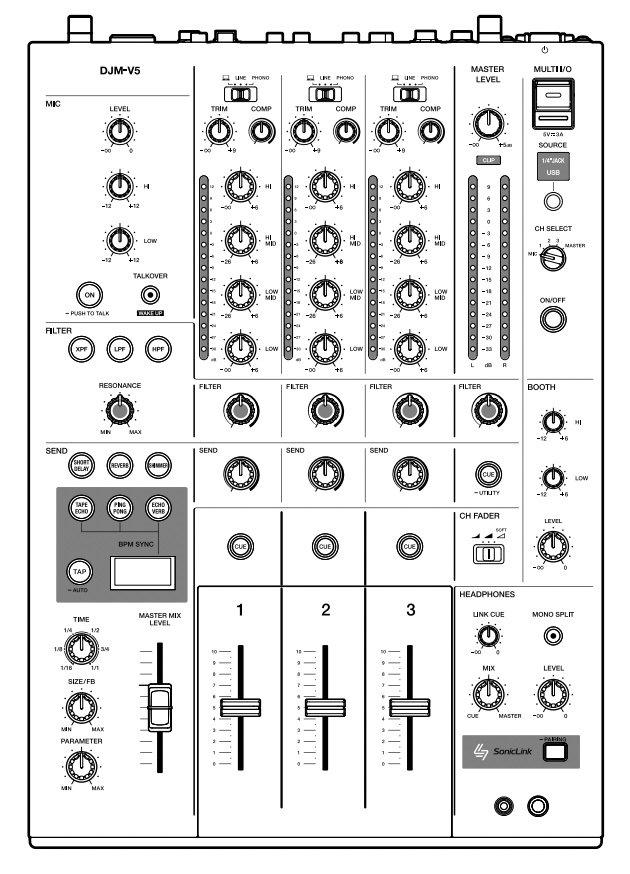
The V5’s compact chassis is the first thing you notice. Compared to the DJM-V10’s wider footprint, the V5 is designed to fit comfortably in smaller booths, home studio setups, and touring rigs where space matters. Three channels rather than six is the obvious trade-off, but for the majority of DJ workflows — two decks plus a sampler or third source — 3 channels is all you need.
The layout follows AlphaTheta’s established design language: channel faders run vertically, the 4-band EQ sits above each fader, and the send FX section occupies a dedicated zone across the top of the mixer. The crossfader is at the bottom, and the filter knob sits centrally per channel. Everything is where you’d expect it to be if you’ve spent time on a DJM-A9 or DJM-V10, which makes the transition to the V5 fast for experienced users.
Build quality is solid throughout. The faders have a premium feel, the knobs are weighted and precise, and the overall construction sits well above consumer-grade. This is a mixer built to take regular use in professional environments.
Sound Quality
Sound quality is consistently the most praised aspect of the DJM-V5 across professional reviews and user reports, and the specs explain why. The 96kHz sampling rate and 32-bit A/D and D/A conversion put it at the top end of what’s available in DJ mixers at any price. In practice this translates to a noticeably clean, warm, and detailed sound — the kind of transparency where individual elements of a mix stay distinct even when multiple channels are stacked.
The 4-band EQ is central to this. Having a dedicated mid-low band in addition to the standard high, mid, and low gives you substantially more control over the frequency stack — particularly useful for layered mixing where low-mid buildup is the most common problem. Users coming from 3-band EQ mixers consistently report that the extra band changes the way they approach mixing, opening up more surgical control without requiring aggressive cutting on adjacent bands.
Club DJs and professional reviewers who have spent time with the V5 consistently describe the sound as the standout quality — clean, warm, and detailed in a way that holds up at high volumes. The 4-band EQ draws particular praise for enabling more precise mixing without the heavy-handed cuts that a 3-band setup sometimes requires. A recurring note is that the mixer rewards careful listening: the more attention you pay to your mix, the more the V5 gives back.
The most common gripe is the price. At $2,199 it sits in a bracket where buyers expect perfection, and some users feel the 3-channel limitation is a meaningful constraint for the money. A small number of users have noted that the send FX routing takes some learning time before it becomes intuitive, though the consensus is that it’s worth that investment.
Effects and Filters
The send FX section is one of the V5’s most expressive features and one that sets it apart from straightforward club mixers in the same bracket. Six send effects are on board: Tape Echo, Ping Pong, Echo Verb, Delay, Reverb, and Shimmer. These are send effects rather than insert effects — meaning the dry signal stays clean while the effect runs in parallel, which gives you precise control over the wet/dry balance without colouring the original track.
For club mixing, this matters because you can build and release tension with reverb tails and echo throws without committing to them. The Shimmer effect — a pitch-shifted reverb — is particularly effective for extended outro transitions and ambient drops. Tape Echo and Ping Pong are the workhorses for classic delay-based transitions.
The three filter types cover low-pass, high-pass, and cross-pass. The cross-pass filter is the differentiator: it simultaneously rolls off the lows and highs while boosting the mids, creating a focused telephonic sweep that’s distinct from a standard low or high pass. It’s a creative tool as much as a mixing tool, and it’s genuinely unusual at this price point.
SonicLink Wireless Monitoring
SonicLink is the V5’s most distinctive feature — a built-in wireless transmitter that sends the headphone mix to compatible SonicLink receivers at low latency. In practical terms this means cable-free headphone monitoring: no jack dangling from the mixer, no cable management issues in a tight booth, no risk of the cable catching on faders or knobs mid-set.
The significance of this varies by setup. In a home or studio context the benefit is modest. In a live club environment with multiple DJs and cables running everywhere, wireless headphone monitoring is a meaningful quality-of-life improvement. SonicLink operates at a latency low enough that it doesn’t interfere with beat matching — the critical requirement for any wireless monitoring system to be useful in a DJ context.
Note: SonicLink requires a compatible receiver to use wirelessly. The DJM-V5 includes the transmitter built in but the receiver is sold separately. Confirm compatibility with your headphones before factoring this into your buying decision.
Connectivity and Software
The V5’s input and output configuration covers the standard club mixer requirements cleanly. Three phono inputs and three line inputs handle a full three-deck setup with turntables or CDJs on every channel. The microphone input covers announcements or guest vocals. On the output side, master out runs via XLR, booth out via TRS, and a record out via RCA covers recording or external feed requirements.
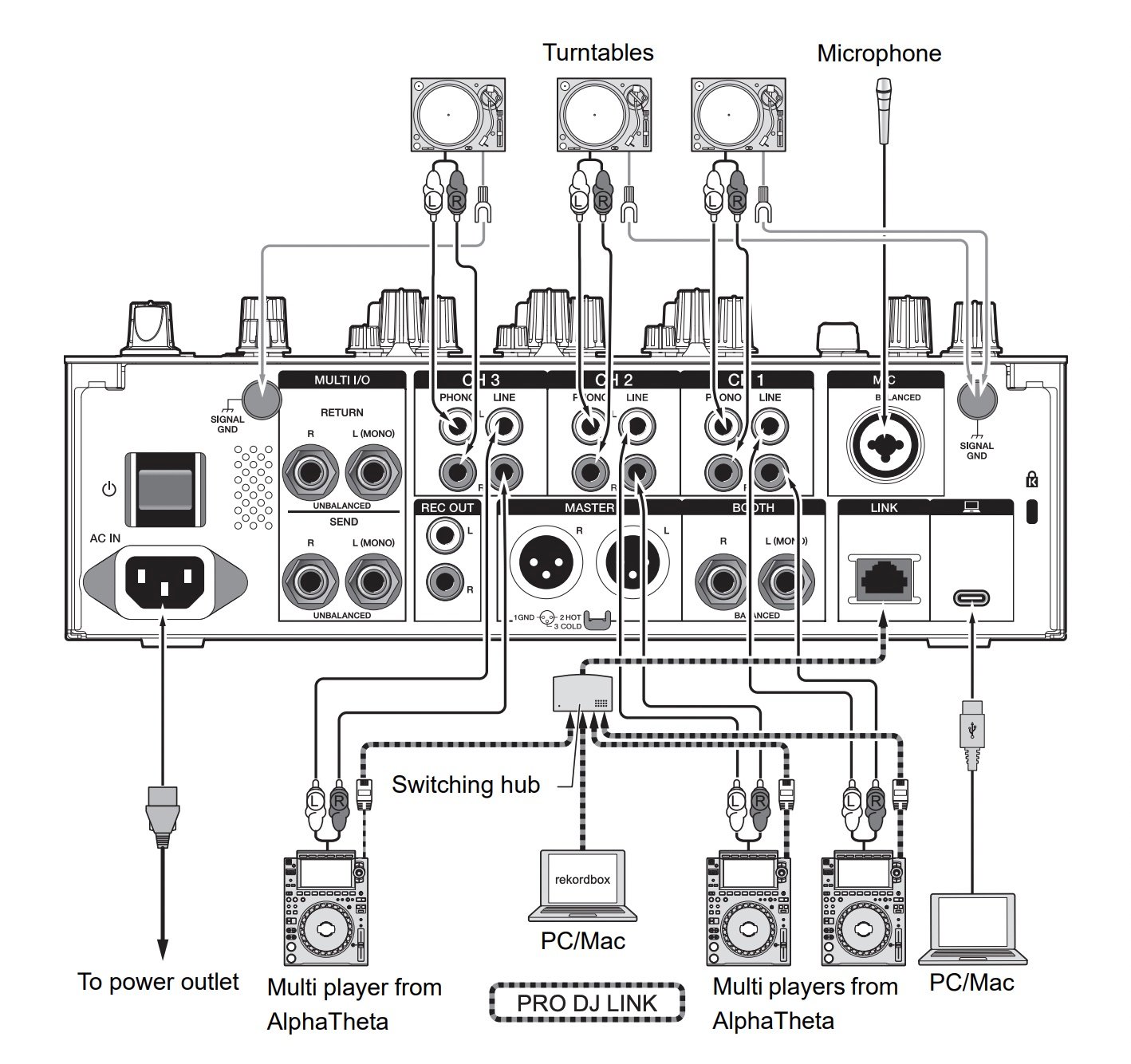
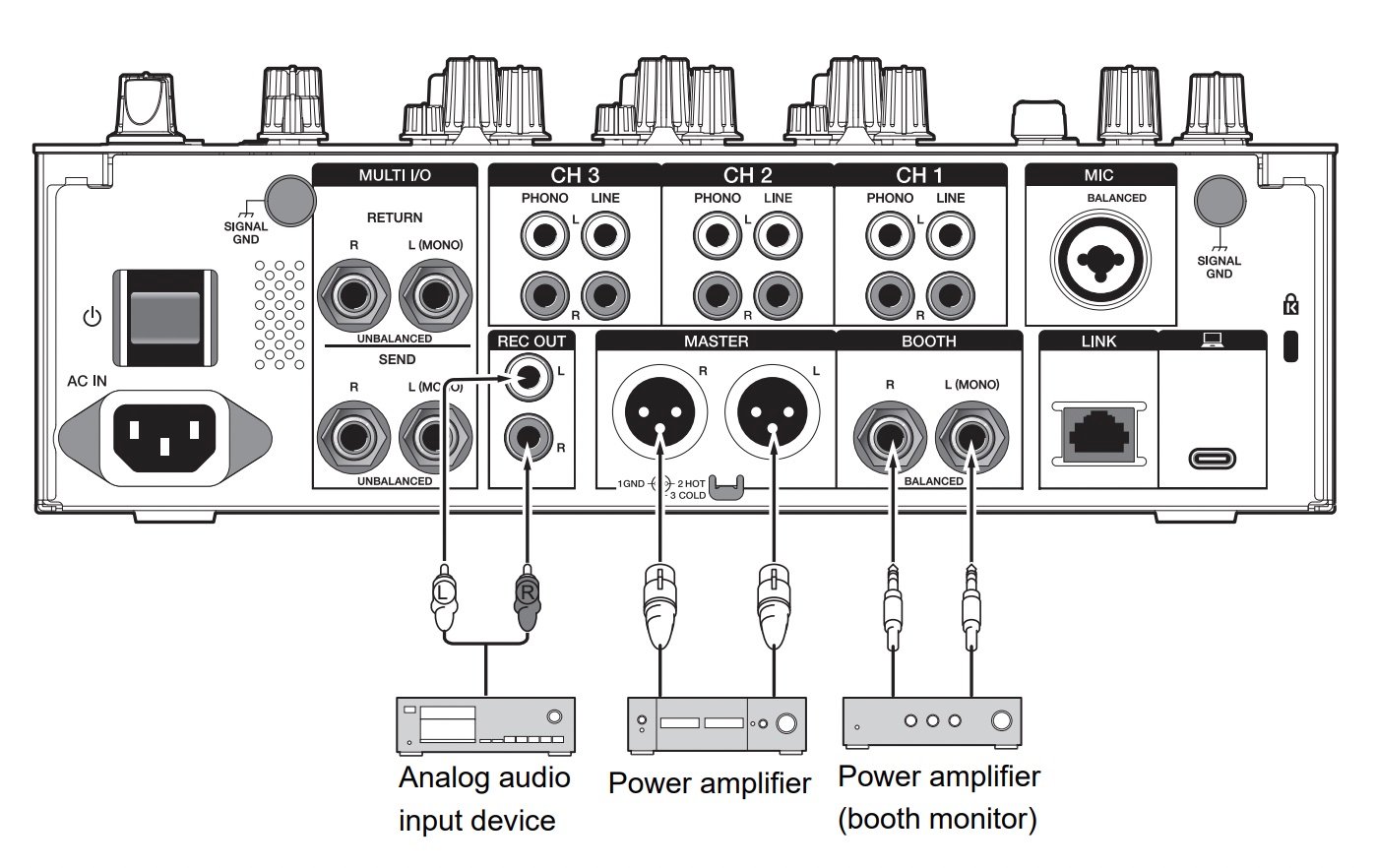
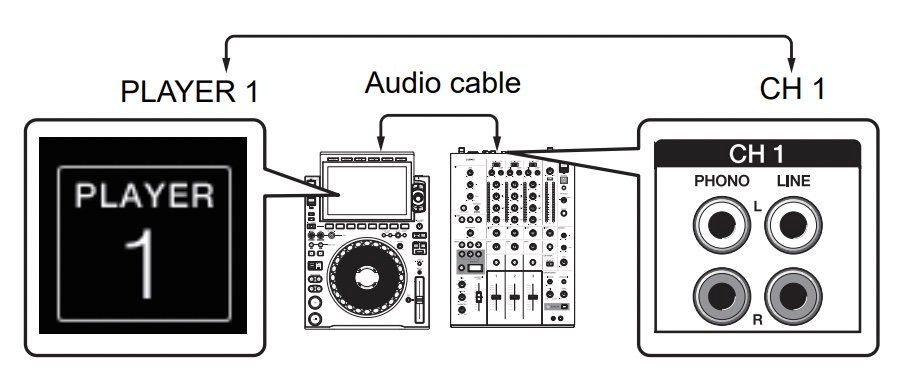
PRO DJ LINK is the connectivity feature that matters most for CDJ-based setups. It allows the mixer to share track data, waveform information, and BPM across connected CDJ-3000s or CDJ-2000NXS2s — the same networked workflow found on the DJM-A9 and DJM-V10. Link Cue extends this by letting you cue tracks in your headphones directly from linked players without routing them through a channel. USB-C handles the computer connection for rekordbox and Serato.
DJM-V5 vs Allen & Heath Xone:96
The Xone:96 is the most direct rival to the DJM-V5 in the premium club mixer bracket, and the comparison is genuinely interesting because the two mixers represent different design philosophies rather than different quality levels.
Digital-first, feature-dense, PRO DJ LINK ecosystem. Best for rekordbox/Serato club workflows, send FX creativity, and wireless monitoring. Strong choice if you’re already in the CDJ/rekordbox world.
Check Prices →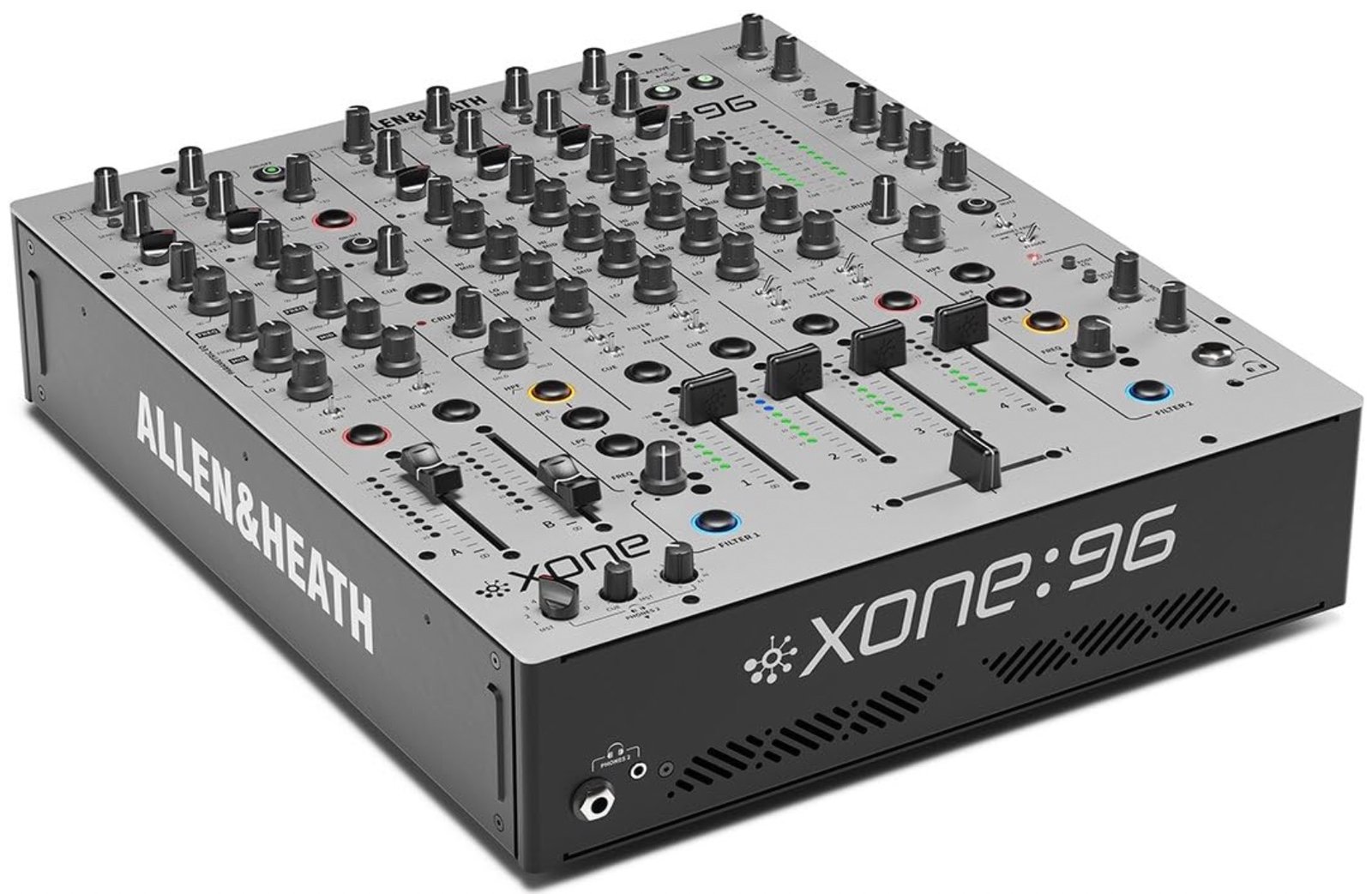
Analogue signal path, 4-band filter per channel, two dedicated FX sends, beloved by house and techno DJs. Best for DJs who prioritise analogue warmth, a distinctive filter character, and a more stripped-back workflow.
Check Prices →The Xone:96 runs a fully analogue signal path — the sound passes through analogue circuitry all the way from input to output, which gives it a particular warmth and character that a section of the DJ community actively seeks out. Its 4-band filters (not EQs — filters with resonance) per channel are distinctive and have become something of a signature tool for house and techno DJs who use filter sweeps as a central mixing technique. Two separate FX sends offer routing flexibility that the V5 doesn’t match directly.
The DJM-V5 counters with higher headline audio specs, more modern connectivity (PRO DJ LINK, SonicLink, USB-C), software integration, and a send FX suite that covers different creative ground. It’s also the more natural choice if your setup centres on CDJ-3000s and rekordbox.
Which one is right comes down to workflow and sound philosophy. If you value analogue signal path, filter character, and a Xone pedigree that’s been proven in club booths for decades, the Xone:96 is the stronger pick. If you want cutting-edge digital audio quality, modern connectivity, and deep integration with the CDJ/rekordbox ecosystem, the DJM-V5 wins. An Allen & Heath vs AlphaTheta deep dive is on the list for a future post.
DJM-V5 vs DJM-V10
The DJM-V10 is AlphaTheta’s flagship mixer — 6 channels, more expansive effects architecture, and a larger physical footprint to match. The V5 is explicitly positioned as a compact alternative rather than a direct replacement, and the differences are real rather than cosmetic.
The V10’s extra channels matter for DJs who run complex multi-source setups: hardware samplers, additional CDJs, drum machines, or live instruments routed into the mix. For a standard two or three deck setup the V5’s 3 channels cover everything. The V10 also has a more advanced effects section with Beat FX in addition to the send FX, and a dedicated EQ and filter per channel that goes further than the V5’s already strong 4-band setup.
The choice is straightforward: if you need more than 3 channels or want the absolute ceiling of what AlphaTheta makes, the V10 is the answer. If 3 channels covers your workflow and you want V10-class sound quality in a more compact and more affordable package, the V5 is the smarter buy.
Alternatives at a Glance
| Mixer | Best for | Key strength | Main trade-off |
|---|---|---|---|
| AlphaTheta DJM-V5 | Club DJs wanting compact premium sound | 96kHz/32-bit, SonicLink, send FX, PRO DJ LINK | High price, 3 channels only |
| Allen & Heath Xone:96 | Analogue-first house and techno DJs | Analogue signal path, filter character, dual FX sends | Less modern connectivity |
| Rane DJ Seventy | Scratch and battle DJs | MAG FOUR crossfader, Serato-native, battle layout | 2-channel only, narrower use case |
| AlphaTheta DJM-V10 | Advanced DJs needing flagship format | 6 channels, Beat FX + send FX, full flagship spec | Larger, more expensive |
The Rane DJ Seventy sits in a different category — a 2-channel battle mixer with a MAG FOUR crossfader built for scratch and Serato-native performance. It’s not a direct rival to the V5 but worth knowing about if your style runs more towards scratching and battle technique than layered club mixing.
Full Specs
| Spec | Detail |
|---|---|
| Channels | 3-channel |
| EQ | 4-band per channel (high, mid-high, mid-low, low) |
| Filters | Low-pass, high-pass, cross-pass per channel |
| Send FX | 6 — Tape Echo, Ping Pong, Echo Verb, Delay, Reverb, Shimmer |
| Sampling rate | 96kHz |
| A/D & D/A conversion | 32-bit |
| Wireless monitoring | SonicLink transmitter built in (receiver sold separately) |
| Network | PRO DJ LINK + Link Cue |
| Inputs | 3 × phono, 3 × line, 1 × mic |
| Master output | XLR stereo |
| Booth output | TRS stereo |
| Rec output | RCA stereo |
| Headphone outputs | 2 × (1/4″ + 3.5mm) |
| USB | USB-C |
| Software | rekordbox + Serato DJ Pro; Traktor Pro 3.3.0 + ShowKontrol also referenced |
| Price | $2,199 USD / £1,739 / €1,999 |
Pros and Cons
- 96kHz / 32-bit conversion — top-tier audio quality
- 4-band EQ gives genuine frequency control advantage over 3-band mixers
- Six send FX including Shimmer — expressive and well-chosen
- Cross-pass filter is a genuine differentiator
- SonicLink wireless monitoring built in
- PRO DJ LINK + Link Cue for full CDJ network integration
- Compact footprint — fits booths and setups where V10 doesn’t
- Premium build quality throughout
- $2,199 — high price demands a clear use case
- 3 channels only — limiting for complex multi-source setups
- SonicLink receiver sold separately
- Send FX routing has a learning curve
- Less analogue character than the Xone:96 for filter-forward styles
The Verdict
The DJM-V5 makes a compelling case as the best compact premium club mixer AlphaTheta currently produces. The audio quality is genuinely exceptional, the 4-band EQ changes how you mix for the better, and the send FX section gives you creative range that most mixers in this bracket don’t come close to. SonicLink and PRO DJ LINK round out a feature set that feels modern rather than merely premium.
The price is high and the 3-channel limit is real — these are the two reasons to look elsewhere. If you need more channels, the DJM-V10 is the answer. If you want analogue signal path and filter character above all else, the Xone:96 is the stronger pick. But for club DJs who want the best sound quality available in a compact format, who are deep in the CDJ/rekordbox ecosystem, and who will use the creative tools on offer — the DJM-V5 justifies every penny of its price tag.
Frequently Asked Questions
Is the DJM-V5 good for club DJs?
Yes — it’s designed specifically for club DJs who want premium sound quality, deep CDJ integration via PRO DJ LINK, and creative tools like send FX and cross-pass filtering. It’s less suited to beginners or DJs who only need basic mixing functionality.
Does the DJM-V5 work with rekordbox?
Yes. rekordbox is the primary supported software and the natural pairing for DJs using CDJ-3000s or CDJ-2000NXS2s. PRO DJ LINK and Link Cue are both rekordbox-native features that make the V5 a powerful hub for a full CDJ network setup.
Does the DJM-V5 work with Serato DJ Pro?
Yes — Serato DJ Pro is officially supported. Traktor Pro 3.3.0 and ShowKontrol are also referenced by retailers, though rekordbox and Serato are the primary workflows AlphaTheta has optimised for.
What is SonicLink on the DJM-V5?
SonicLink is a built-in low-latency wireless transmitter that sends the headphone cue mix to a compatible SonicLink receiver, allowing cable-free headphone monitoring. The transmitter is built into the mixer; the receiver is sold separately. Latency is low enough for beat matching in a live context.
How many channels does the DJM-V5 have?
Three. It supports 3 phono and 3 line inputs, plus a mic input. For standard two or three-deck setups this is more than enough; DJs who need more channels should look at the DJM-V10.
How does the DJM-V5 compare to the Xone:96?
The Xone:96 runs a fully analogue signal path and is beloved for its filter character — a strong choice for house and techno DJs who use filter sweeps as a core technique. The DJM-V5 offers higher headline audio specs, more modern connectivity, and deeper software integration. The right choice depends on whether you prioritise analogue signal path or modern digital workflow. A full comparison post is planned — watch this space.
Is the DJM-V5 worth the price?
At $2,199 it’s only worth it if you’ll use what makes it special: the 4-band EQ, send FX, SonicLink, and PRO DJ LINK. For DJs who want those features and are serious about sound quality, it delivers. For DJs who want a simpler club mixer at a lower price, the Xone:96 or a DJM-A9 are more sensible options.
Some links in this post are affiliate links. If you buy through them we earn a small commission at no extra cost to you — it helps fund the site. See our full disclosure.