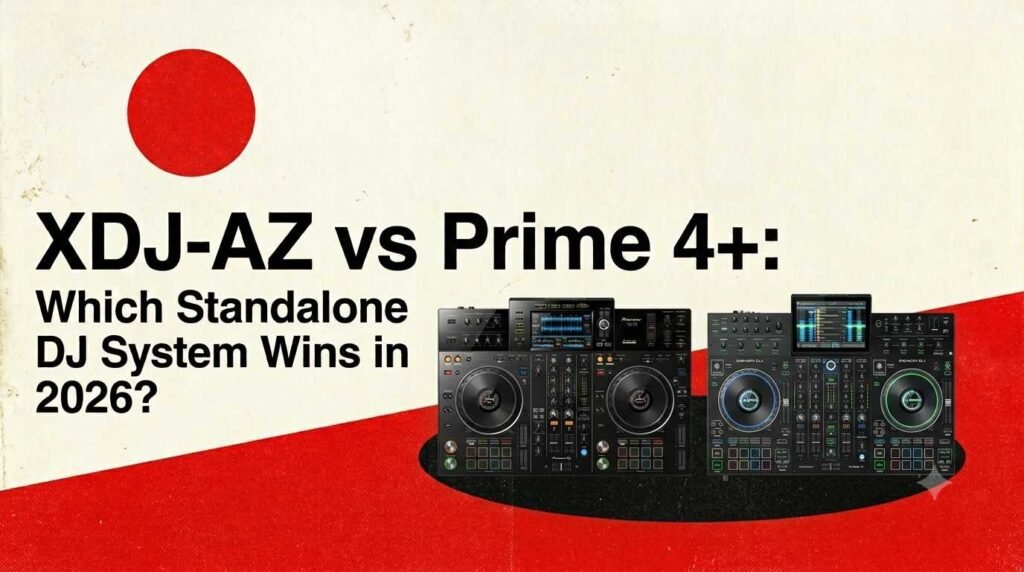
Hardware · All-in-one showdown
Two flagship four-deck systems, no laptop required — and about a thousand dollars between them. One gives you the authentic club rig in a box. The other does more for less. Here’s the honest call.
On paper these two look like the same product: a four-deck standalone DJ system, a 10.1-inch touchscreen, full-size jogs, club-style mixer, no laptop in sight. In the booth they’re aimed at completely different DJs — and the gap between them is wider than the spec sheets suggest.
The AlphaTheta XDJ-AZ is the closest thing on the market to lifting a pair of CDJ-3000s and a DJM-A9 out of a club and folding them into one chassis. The Denon DJ Prime 4+ throws the kitchen sink at you — onboard stems with no computer, a wall of streaming services, lighting control — for roughly a grand less. Neither is “better.” The right answer depends entirely on where and how you play. Let’s get into it.
The 30-second
If you don’t want to read 2,000 words, here’s the short version:
AlphaTheta XDJ-AZ
Around [CONFIRM $] · ~$1,000 more
Buy it if you play — or want to play — venues running CDJs and DJM mixers. The layout, the feel, the workflow and PRO DJ LINK all mirror a real club rig, so what you practise on is what you’ll perform on. rekordbox at its core, Serato when you want it.
Best for: club & aspiring-club DJs in the Pioneer world
Denon DJ Prime 4+
Around [CONFIRM $] · the cheaper one
Buy it if you want the most capability per dollar: free onboard stems with no laptop, the widest streaming line-up, built-in lighting control and a zone output made for mobile and event work. Engine DJ, not rekordbox — and that’s the trade.
Best for: mobile / open-format / value-led DJs
Head to head,
| XDJ-AZ | Prime 4+ | |
|---|---|---|
| Decks / channels | 4-deck standalone | 4-deck standalone |
| Onboard OS | rekordbox | Engine DJ |
| Screen | 10.1″ capacitive touch | 10.1″ multi-touch (XY FX mode) |
| Stems without a laptop | No — needs a computer | Yes — free, onboard |
| Streaming services | 2 (Apple Music, Beatport*) | 5+ (Apple, Amazon, Beatport, TIDAL, SoundCloud) |
| Club integration | PRO DJ LINK — slots into CDJ rigs | Standalone only |
| Software (with laptop) | rekordbox + Serato DJ Pro | Serato DJ Pro + VirtualDJ |
| Wireless monitoring | SonicLink (HDJ-F10) | No |
| Lighting control | No | Engine Lighting (Hue / DMX) |
| Zone output | No dedicated zone out | Yes |
| Internal storage bay | 2.5″ SATA slot | 2.5″ SATA bay |
| Feel / pedigree | CDJ-3000 + DJM-A9 layout | X-1850-style mixer section |
| Price | ~$1,000 higher | ~$1,000 lower |
*Beatport StreamingDirectPlay on the XDJ-AZ requires a Beatport Streaming Professional or Advanced plan.
The case for the

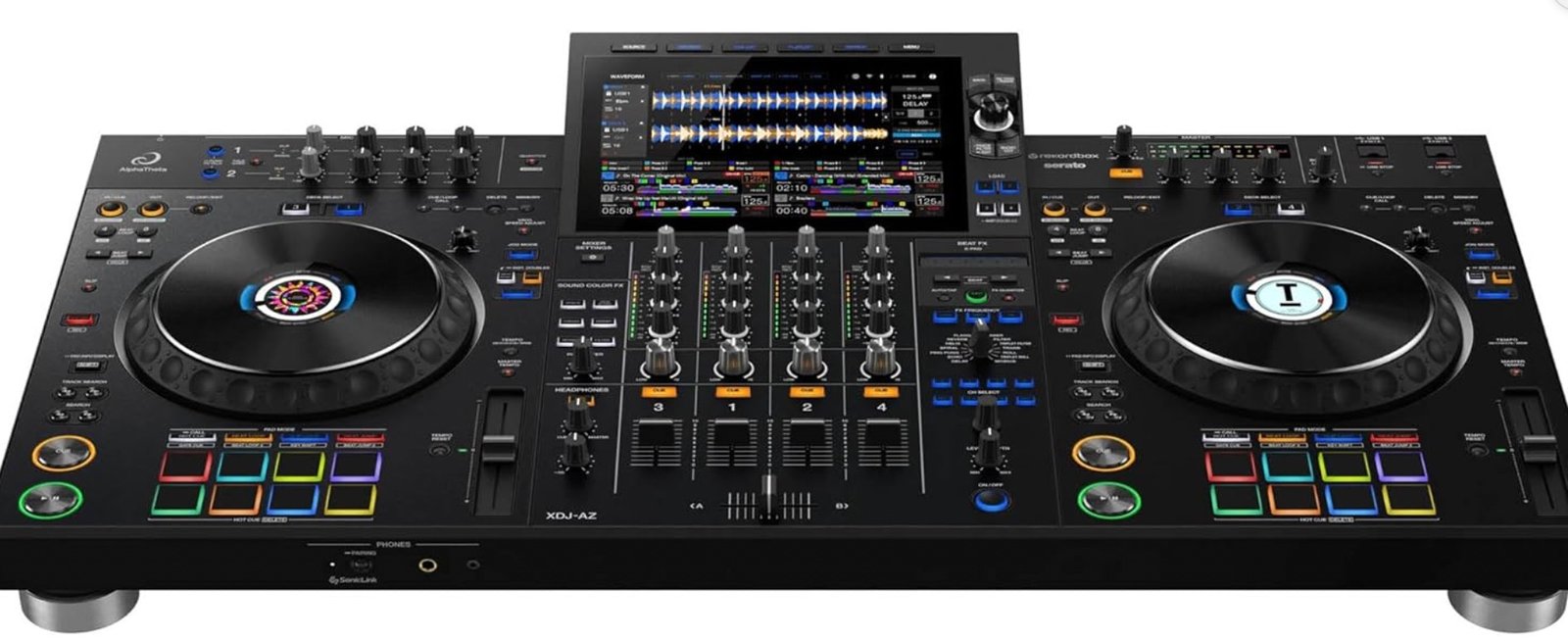

The XDJ-AZ’s entire pitch is familiarity. AlphaTheta built it to feel like the CDJ-3000 and DJM-A9 club standard — full-size 206mm jogs that behave exactly like a 3000’s, a mixer section laid out like an A9, and dedicated Beat FX buttons in the places your hands already expect them. If you’ve spent any time on Pioneer club gear, you’re up and running in minutes. More importantly, the muscle memory you build at home transfers straight to the booth.
That club-rig logic runs deep. PRO DJ LINK means you can drop the AZ into a setup with CDJs and share beat and on-air info across the players — so it doubles as a practice rig and a gig-ready unit you can extend. Sound is handled by a 32-bit ESS Technology D/A converter with a 115 dB signal-to-noise ratio, and the recent firmware (v1.30) unlocked true four-deck playback. There’s a genuinely clever party trick too: SonicLink, a built-in transmitter that pairs with AlphaTheta’s HDJ-F10 wireless headphones for ultra-low-latency cue monitoring — nobody else offers that.
Software-wise you get rekordbox and Serato DJ Pro unlocked with no subscription when you connect a laptop, plus built-in Wi-Fi for rekordbox CloudDirectPlay so you can pull your library — hot cues and all — straight from the cloud.
★ Where it wins
- The most authentic CDJ-3000 / DJM-A9 feel of any standalone
- PRO DJ LINK — integrates with real club rigs
- SonicLink wireless cue monitoring (unique)
- rekordbox + Serato, no subscription
- 32-bit D/A, club-grade audio
✕ Where it stings
- No onboard stems — you need a laptop for that
- Only two streaming services
- Around $1,000 more than the Prime 4+
- No built-in lighting control or zone output
- Early launch units had QC wrinkles (since addressed)
The case for the
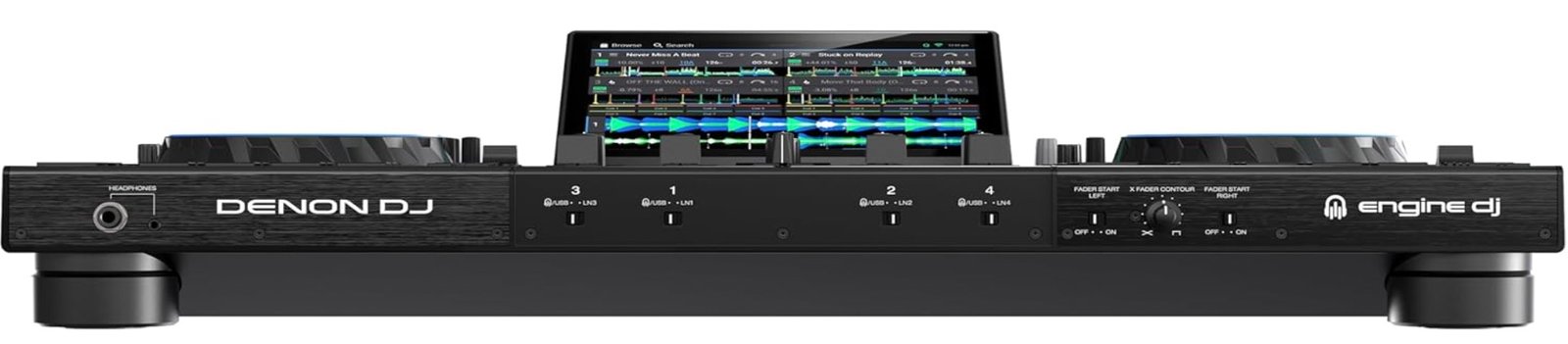
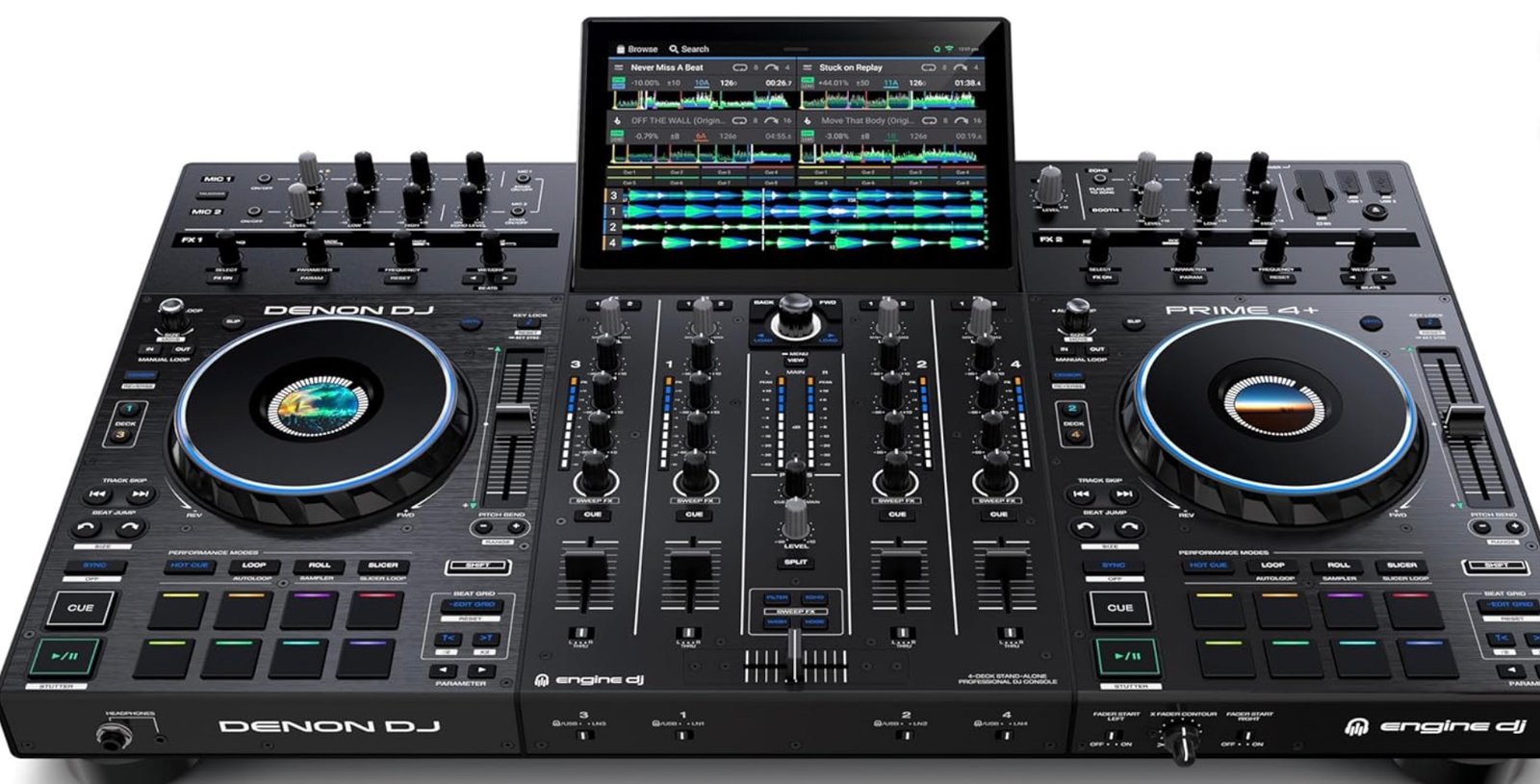
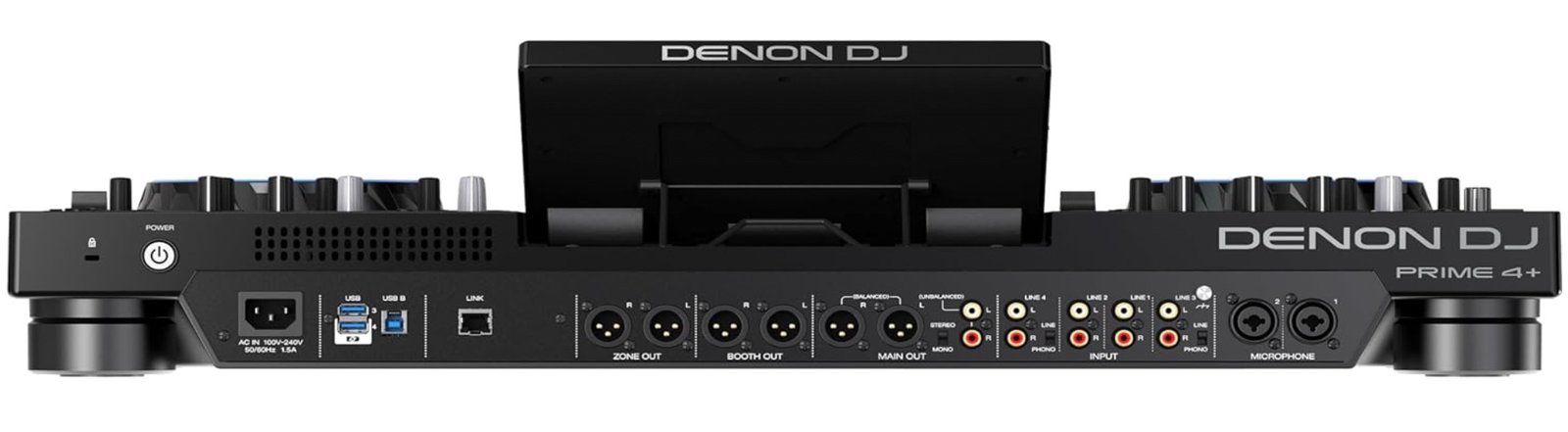
If the XDJ-AZ is about replicating the club, the Prime 4+ is about doing more in one box than anything at its price. The headline is stems: the Prime 4+ was the first standalone system that could isolate and remove vocals, melody, bass and drums with no laptop attached — and Denon hands you that feature for free. You analyse the stems in Engine DJ Desktop first, then drop acapellas and instrumentals in and out live on the unit itself. For mashup and remix-style sets, that’s a different way of working entirely, and the XDJ-AZ simply can’t do it standalone.
It’s just as generous everywhere else. Streaming runs deep — Apple Music, Amazon Music, Beatport, TIDAL and SoundCloud Go+ all connect over Wi-Fi (or Ethernet), plus Dropbox for your own library. The 10.1-inch screen flips into an XY pad for Touch FX, there’s a full Engine Lighting system for Philips Hue and DMX rigs, and a proper zone output lets you feed a second room a completely different playlist — exactly what a wedding or corporate DJ needs. The mixer section borrows from Denon’s X-1850 club mixer, and four analogue inputs mean you can hang turntables or CD players off it.
The catch is the ecosystem. This is Engine DJ, not rekordbox — and if your local clubs run Pioneer CDJs, your prep workflow lives in a different world than the gear you’ll perform on. Engine DJ also has a slightly steeper, less polished learning curve than rekordbox. None of that matters if you bring your own system to every gig. It matters a lot if you’re trying to slot into established booths.
★ Where it wins
- Free onboard stems, no laptop needed
- Five-plus streaming services built in
- Engine Lighting + dedicated zone output
- Around $1,000 cheaper than the XDJ-AZ
- Serato DJ Pro + VirtualDJ when you add a laptop
✕ Where it stings
- Engine DJ, not the club-standard rekordbox
- No PRO DJ LINK — won’t slot into CDJ rigs
- Engine OS is less intuitive than rekordbox
- No wireless cue monitoring
- Stems must be pre-analysed on the desktop app
The differences that
1. Stems without a laptop
This is the single biggest functional gap between them, and it splits along ecosystem lines. Engine DJ systems like the Prime 4+ render stems on the unit; rekordbox standalones — the XDJ-AZ included — still can’t, so you’d need to connect a laptop running rekordbox or Serato to get real-time track separation. If pulling acapellas and building live mashups is core to your sets, the Prime 4+ does it out of the box and the AZ asks you to bring a computer. If you never touch stems, this line doesn’t matter to you at all.
2. Streaming breadth
The Prime 4+ connects to five-plus services; the XDJ-AZ connects to two (and gates Beatport behind a paid Streaming plan). For a DJ who leans on streaming for last-minute requests, that’s a real day-to-day difference. For a DJ who plays exclusively from analysed files on a drive, it’s noise.
3. The ecosystem you’re buying into
This is the one that should drive the decision more than any single feature. Buying the XDJ-AZ is buying into rekordbox and the Pioneer club world — the same library, layout and link protocol you’ll find in most professional booths. Buying the Prime 4+ is buying into Engine DJ, which is brilliant and self-contained but doesn’t talk to CDJ rigs. Pick the ecosystem first; the hardware follows.
4. The ~$1,000 question
At current US pricing the XDJ-AZ sits around [CONFIRM $] and the Prime 4+ around [CONFIRM $] — roughly a thousand dollars apart. You’re not paying that premium for more features; on raw capability the Prime 4+ arguably gives you more. You’re paying it for club-standard pedigree, the CDJ/DJM feel and PRO DJ LINK. Whether that’s worth a grand depends entirely on whether you’ll ever stand behind a club’s Pioneer rig.
So — which one
Buy the XDJ-AZ if you’re a club DJ or working toward it, you already live in rekordbox, you want the gear you practise on to be the gear you’ll find in the booth, and PRO DJ LINK or SonicLink monitoring genuinely matter to you. You’re paying extra for a workflow that transfers straight to professional environments — and for that buyer, it’s worth it.
Buy the Prime 4+ if you bring your own system to every gig — mobile, weddings, events, open-format — and you want the most you can get for the money. Onboard stems, deep streaming, lighting control and a zone output make it a complete one-box solution, and you pocket about $1,000. As long as you’re happy in the Engine DJ world, it’s the better-value buy by a clear margin.
And if neither feels right: a Rane System One is the standalone to look at for scratch and turntablism (it’s the first with motorised platters and onboard stems), while the rest of the field is covered in our wider hardware coverage below.
Keep reading: our controllers & decks hub rounds up every standalone and controller we rate · the Rane System One review covers the motorised-platter standalone · the CDJ-3000X review digs into the club gear the XDJ-AZ is built to mirror · and if AlphaTheta’s own DDJ-GRV6 is more your budget, that’s worth a look too.