Published August 2026 · Specifications verified against manufacturer sources
A drum machine running alongside two decks is no longer an unusual sight. But almost everything written about these boxes assumes a studio desk, not a booth shelf at 1am.
Search for a groovebox review and you’ll find plenty. Sound On Sound, MusicTech, CDM and half a dozen others cover every one of these machines in forensic detail, usually within days of launch. What none of them cover is the question a DJ actually has: what happens when you plug this thing into a mixer channel and try to use it in front of people?
That’s a different set of concerns entirely. Not synthesis depth or sample memory, but whether it takes clock, whether it has enough outputs, whether it’ll be quieter than the record, whether it fits on the shelf, and — the one nobody writes about — how fast you can kill it when the pattern goes wrong.
This guide covers that. It’s a routing and workflow guide, not a synthesis guide — written from the perspective of someone who has been putting hardware next to a pair of decks since long before any of these machines existed. If you want to know how good the granular engine sounds, the synth press has you covered.
What a groovebox adds — and what it costs you
The honest case for adding one: it gives you percussion layers that aren’t locked to a record, transitions that aren’t beatmatched blends, a way to stretch a moment when the floor is with you, and — not a small thing — something for people to watch. A DJ pressing play looks like a DJ pressing play. A DJ building a pattern live reads differently in a room.
The honest case against: it adds a failure point to a rig that previously had none. Turntables and a mixer fail slowly and audibly. A groovebox fails instantly and in public. It also adds a thing to carry, a thing to power, a thing to soundcheck, and a thing to think about while you’re also thinking about the next record.
- You play house, techno, minimal or anything loop-led
- You already mix long and patiently
- You have a spare mixer channel — genuinely spare
- You want to play out material you’ve made yourself
- You’re comfortable practising something for months before using it
- You play open format, weddings or events
- Your sets are request-driven
- You’re still building core mixing confidence
- Your mixer is a two-channel with both channels in use
- You’re buying it because it looks good on a shelf
Be honest about that last one. The most common outcome for these machines is that they get used enthusiastically for three weeks and then live on a desk. That’s a $300–900 ornament. There’s no shame in deciding you don’t need one.
The three ways DJs actually run one
Almost every practical question about grooveboxes in a DJ set resolves to which of these three models you’re using. They ask completely different things of your gear and they fail in completely different ways.
Model one
As a channel
Audio out of the box, into a spare line channel, and that’s the whole rig. No clock, no sync, no settings menu. You beatmatch the pattern to the record by ear and by tempo knob, exactly as you’d ride in a third deck.
It sounds primitive and it’s by far the most robust thing you can do. It works with every mixer ever made, needs no adapters, and if the box misbehaves you pull the channel fader down and the record is still playing. Most DJs who use a groovebox successfully in public are doing this.
Fails as: drift. The pattern slowly walks away from the record and you nudge the tempo back. Recoverable, inaudible if you’re paying attention.
Model two
Clocked to the mix
Your player or software sends MIDI clock to the box, so the pattern locks to the record’s tempo automatically. More powerful, more musical, and considerably more to go wrong.
The practical obstacles are all physical. Most of these boxes take MIDI on 3.5mm minijack, not five-pin DIN, and several ship without the adapter. Your player or laptop needs to actually be sending clock, and you need to have set the box to receive rather than transmit. None of that is difficult; all of it is the sort of thing that goes wrong once and then never again.
Fails as: the box jumps to a wrong tempo, or stops dead when clock drops. Audible immediately. Practise the recovery before you do this in public.
Model three
As the set
The box is the primary source and records become texture layered over it — acapellas, loops, stabs, whole tracks dropped in and pulled out. This is closer to live performance than to DJing, and it’s a genuinely different discipline.
It’s also where the interesting work is happening. If you want to record the results, our guide to recording a DJ mix applies directly — this kind of set benefits enormously from being captured, because it’s never the same twice.
Fails as: total silence. There’s no record underneath to carry you. Only do this once you’re very comfortable with the machine.
The five things that matter in a booth
1. What it does with clock
The single most important spec for our purposes, and the one review sites bury. Two questions: can the box receive clock and follow, and on what connector? Minijack MIDI is now the norm on portable machines — the Teenage Engineering and Polyend boxes both use it, and both need an adapter for five-pin DIN. Check whether that adapter is in the box or an extra purchase, because discovering it isn’t at 11pm is a specific kind of misery.
If you’re running model one, none of this matters. The tempo knob is your sync.
2. Outputs, and the channel you don’t have
Nearly all of these machines give you one stereo pair. That’s fine — it’s one mixer channel. The constraint is usually at the other end: a two-channel mixer with two decks connected has nowhere for the box to go. Individual outputs sound appealing but multiply the problem, since every extra output needs another channel.
If a groovebox is genuinely part of your plan, it changes what mixer you should be buying. Our mixer guide covers the four-channel options worth considering.
3. Gain staging
Expect the box to be quieter than the record. Mastered music is loud; a groovebox output is not mastered, and a battery-powered one is often quieter still. You’ll be running the channel gain considerably higher than you’re used to, which also means any hiss in the box’s output gets amplified.
Set this at soundcheck, not mid-set. Get a pattern running, match it by ear against a record on another channel, and leave the gain there.
4. Power and footprint
Battery power is the difference between a machine that goes in the bag and a machine that needs a socket you may not get. Most booths have fewer free sockets than you’d hope and the ones that exist are behind something. Machines that run on AA or AAA cells sidestep the problem entirely.
Footprint matters just as much. Booth shelf space is scarce and often already holding a laptop. If you’re building a rig you carry to gigs, our paid-gig gear guide covers the rest of what has to fit alongside it.
5. Recovery — the one nobody writes about
At some point a pattern will be wrong. Wrong key, wrong tempo, wrong energy, or just wrong for that moment. The question is how many seconds it takes to make it stop.
What you want: a physical volume control you can find without looking, per-track mute on a dedicated button rather than buried in a menu, and a play/stop that’s unambiguous. What you don’t want is a beautiful minimalist interface where stopping playback requires a shift-key combination you’ve forgotten under pressure.
This is worth more than any synthesis feature, and it’s the thing you can only assess by handling the machine.
Everything else on a spec sheet is about what the box can make. These five are about whether you can use it in front of people. They’re not the same question, and the second one is the one that decides whether the machine gets played or shelved.
Sound sources and brains
Here’s the distinction that most buying guides blur, and it matters enormously for our purposes: some of these machines produce audio, and some produce nothing at all.
A sound source has an audio output. Plug it into a mixer channel and you hear it. A brain is a sequencer — it sends MIDI or CV to other equipment and makes no sound of its own. Plug a brain into your mixer and you get silence, because there is nothing to hear.
Both are legitimate purchases. But if you buy a sequencer expecting to plug it into your mixer, you have bought the wrong thing, and the marketing for these machines does not always make the difference obvious.
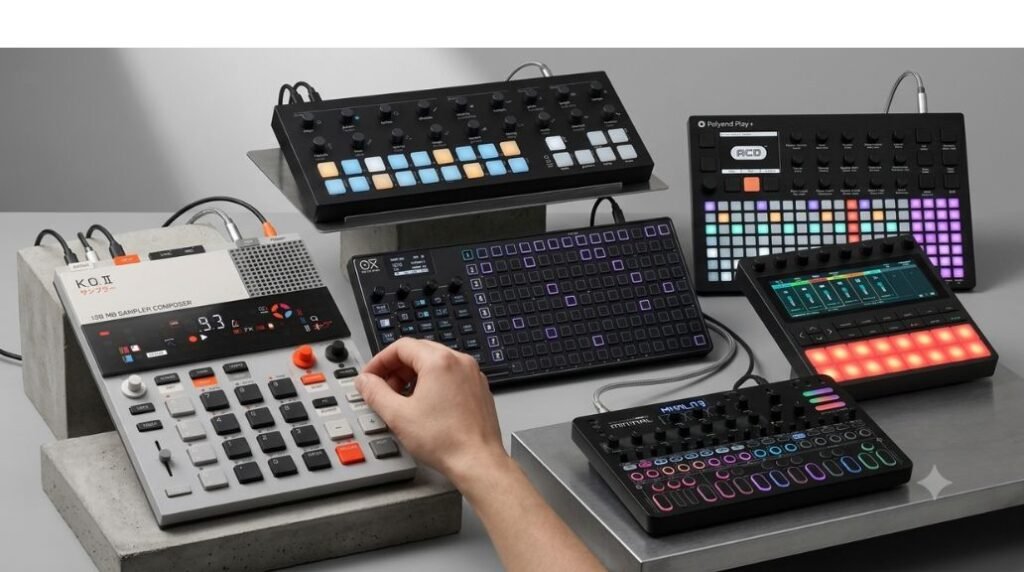
| Machine | Maker | Type | Audio out | Price |
|---|---|---|---|---|
| EP-133 K.O. II | Teenage Engineering | Sound source | Stereo minijack | ~$299 |
| Deconstruct MINIMAL | Sonicware | Sound source | Line out, 3.5mm stereo | $399 |
| T-1 | Torso Electronics | Brain | None | ~$555 |
| Play+ | Polyend | Sound source | Stereo minijack | ~$800 |
| One MkII | OXI Instruments | Brain | None | ~$880 |
| Bento | 1010music | Sound source | 3× stereo out | ~$899 |
Sound sources — boxes that plug into a channel
Teenage Engineering · Sweden
EP-133 K.O. II
The cheapest way into all of this, and the one most likely to actually get carried to a gig. Roughly the footprint of an iPad and about 16mm thick, so it genuinely fits alongside a laptop on a cramped shelf.
Runs about 20 hours on four AAA cells and switches automatically to USB power when connected, which removes the socket problem entirely. Stereo in and out, sync in and out, and MIDI on TRS minijack — the adapters are not included, so budget for them.
The punch-in effects are the part that translates directly to booth use: pressure-sensitive, immediate, and genuinely performable. The limitation is arrangement depth, which matters far less live than it does in a studio.
Battery: 4× AAA, ~20h
MIDI: TRS minijack in/out (adapters extra)
Out: 1× stereo minijack
Built-in speaker and mic
Sonicware · Japan
Deconstruct MINIMAL
The closest thing on this list to a machine built for our readership. Sonicware aimed it explicitly at minimal techno and house: eleven sequencer tracks in total — nine drum tracks, a dedicated stereo loop player, and an analogue-modelling bass synth — and very little else.
The genuinely novel feature is per-track timing drift, modelled on the 808, the 909, or a third “minimal” character. Rather than a single swing percentage, each track can carry the small irregularities characteristic of those machines. Whether that survives a club PA is a fair question, but the intent is sound.
Runs on six AA cells with a built-in speaker, and the 9V supply is a separate purchase. Currently sold out with pre-orders open — early runs were reported sold out ahead of launch, so availability moves.
Battery: 6× AA (PSU sold separately)
MIDI: in/out on 3.5mm
Out: line out 3.5mm + headphones
297 × 176 × 48mm · 840g
Polyend · Poland
Play+
Eight audio tracks and eight MIDI tracks, four synth engines alongside stereo sample playback, and a big illuminated grid that makes pattern building genuinely legible at a glance — which matters more in a dark booth than it does at a desk.
The generative and randomisation tools are the draw. Track-specific swing, length and speed, per-step parameter control, and a performance mode built for exactly the kind of live variation a DJ set wants.
The catch for mobile use is power: it runs from USB-C at 5V and has no internal battery. A power bank solves it, but that’s another thing in the bag. MIDI is on minijack with a DIN adapter included in the box.
Power: USB-C 5V (no internal battery)
MIDI: minijack in/out, DIN adapter included
Out: stereo, TRS-to-dual-jack cable included
Doubles as a USB audio interface
1010music · United States
Bento
The one on this list explicitly designed to be the centre of a rig rather than a box within it. 1010music position it as a laptop replacement, and the I/O backs that up: three stereo inputs, three stereo outputs, dual TRS MIDI in and out, and USB-C as both host and device.
Three stereo outputs is unusual and genuinely useful — you can send drums to one mixer channel and everything else to another, and treat them separately with the mixer’s EQ. That’s a real performance capability, not a spec-sheet flourish.
Eight tracks covering sample banks, loops, granular, multisample, slicing or external MIDI, driven from a seven-inch touchscreen and sixteen velocity- and pressure-sensitive pads. Around three hours on the internal battery.
Battery: internal, ~3h
MIDI: dual TRS in/out
Out: 3× stereo, 3× stereo in
204 × 218 × 51mm · just under 1kg
Brains — boxes that make no sound at all
Both of these are excellent machines and neither will make a noise on its own. They sequence other equipment. If your rig is decks, a mixer and nothing else, a sequencer has nothing to control and there is no point buying one.
Where they earn their place is a rig that already has hardware in it — a drum machine, a synth, a modular case. Then a good sequencer is what turns three separate boxes into one instrument you can actually perform.
Torso Electronics · Denmark
T-1
An algorithmic sequencer built around controlled randomness — the panel is two rows of knobs covering shape, groove and tonal parameters, and you sculpt patterns by turning them rather than by drawing steps.
That’s exactly the right interaction model for live use. You’re not editing a grid mid-set, you’re twisting a knob labelled “repeats” and hearing the pattern mutate. Surgeon has been vocal about using it precisely this way — as a starting point to warp and improvise around.
Founded in 2018, Torso are a small Danish outfit, and the T-1 was their debut. It makes no sound of its own: it needs a drum machine, synth or modular rig to control.
Type: MIDI / CV sequencer
Audio out: none — controls other gear
Interaction: knob-per-parameter, generative
Pairs with: the S-4 sampler, or any MIDI sound source
OXI Instruments · Spain
One MkII
Eight independent sequencers expandable to sixty-four tracks, six sequencing modes including chord, polyphonic, generative and a parameter-decoupling mode, and a 16×8 illuminated grid to drive it all.
For live use the standout is the dedicated performance layer and an eight-hour battery — this is a sequencer you can genuinely take out rather than one tethered to a studio desk. MIDI travels over USB, TRS and Bluetooth, plus eight CV and eight gate outputs if there’s a modular case in your setup.
OXI are explicit that the One generates no audio. It’s the brain for a rig that already has voices in it. If that describes your setup it’s one of the most capable machines here; if it doesn’t, it’s the wrong purchase.
Type: MIDI / CV sequencer
Audio out: none — controls other gear
Battery: internal, up to 8h
Connectivity: USB, TRS MIDI, Bluetooth, 8× CV, 8× gate
Which one, for which kind of DJ
You want to find out whether this is for you at all. EP-133 K.O. II. It’s the cheapest, the most portable, and if it turns out you never use it live you’ve lost $299 rather than $900.
You play minimal, techno or house and want drums that sit right. Deconstruct MINIMAL. Built for that music specifically, and the timing-drift models are the most interesting idea on this list. We’ve gone through it in depth in our full Deconstruct MINIMAL review, including the tempo setting you need to change before your first gig.
You want to play out your own material. Polyend Play+. Eight audio tracks and real generative depth, if you can live with feeding it from a power bank.
You want the box to be the centre of the rig. 1010music Bento. Three stereo outputs and the I/O to hub everything else you own.
You already own hardware and want to perform it. Torso T-1 or OXI One MkII. The T-1 for knob-driven mutation, the One for scale and connectivity. Neither makes a sound on its own.
Your rig is two decks and a two-channel mixer. None of these. Fix the channel count first — you have nowhere to plug any of them in.
What else you’ll need
The unglamorous list, because it’s what actually stops people using these machines in public.
A free mixer channel. Not one you can free up by unplugging something. A genuinely spare one, with its own gain control.
The right cable. Most of these boxes output on 3.5mm stereo minijack. Your mixer wants RCA or 1/4″ jack. That’s a minijack-to-dual-RCA or minijack-to-dual-jack lead, and buying a decent one is worth it because this cable will be pulled in and out constantly.
A MIDI adapter, if you’re clocking. Minijack TRS to five-pin DIN. Polyend include one. Teenage Engineering don’t.
Power that doesn’t depend on the venue. Batteries where the machine takes them, a power bank where it doesn’t. If you’re building a rig that travels, our standalone systems guide covers the laptop-free setup this sits inside.
Somewhere to put it. Measure your booth shelf. Seriously.
The question isn’t which of these is the best machine. It’s whether you’re the kind of DJ who will actually plug one in on a Friday night — and that’s a question about how you like to play, not about which box has the deepest sequencer.