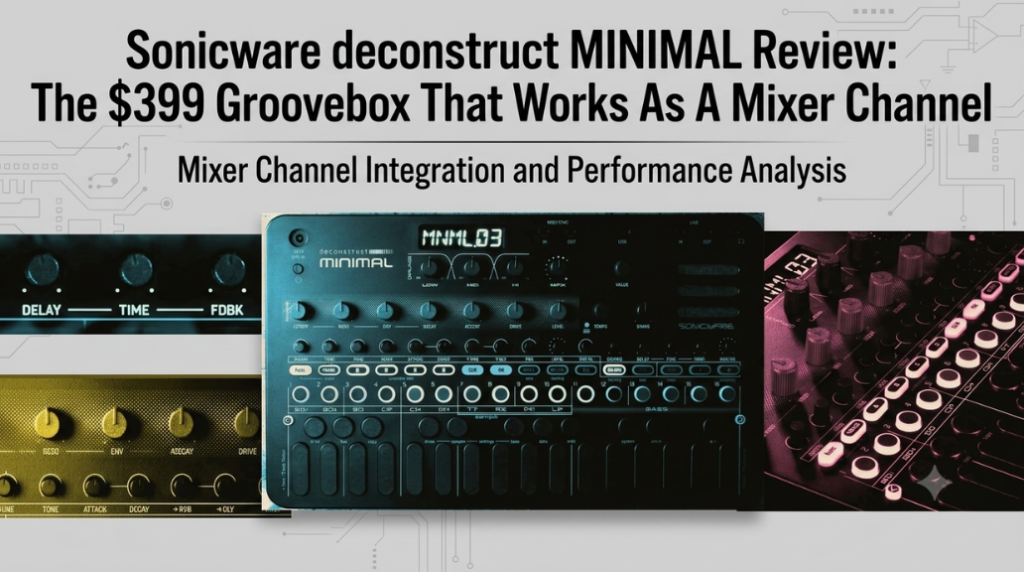
Grooveboxes · Hands on the mixer
Eleven tracks, one stereo mini-jack, and a groove engine built by measuring what the 808 and the 909 got wrong. Here’s what it means for the person standing behind a mixer.
Specifications verified against Sonicware’s official product documentation, August 2026. This is not a hands-on test — we have not had a unit in the booth. Where we describe behaviour, it is behaviour Sonicware documents.
Most reviews of the deconstruct MINIMAL will be written by producers, and they will be good reviews. Sound on Sound will take the bass engine apart. MusicTech will run the sequencer through its paces. None of them will tell you what happens when you plug this thing into channel four of a club mixer at 1am and the pattern you’ve loaded is the wrong one.
That’s the gap this site exists to fill. We covered the general case in our guide to using a groovebox in a DJ set — the three routing models, and the five things that actually matter once the box is on a mixer channel rather than a desk. The MINIMAL is the cheapest machine in that guide and, on paper, the one built closest to the way a DJ works. This is the longer look.
What it actually is
Sonicware calls it an 11-track groovebox, and the track count is worth unpicking because the marketing and the spec sheet describe the same thing two different ways.
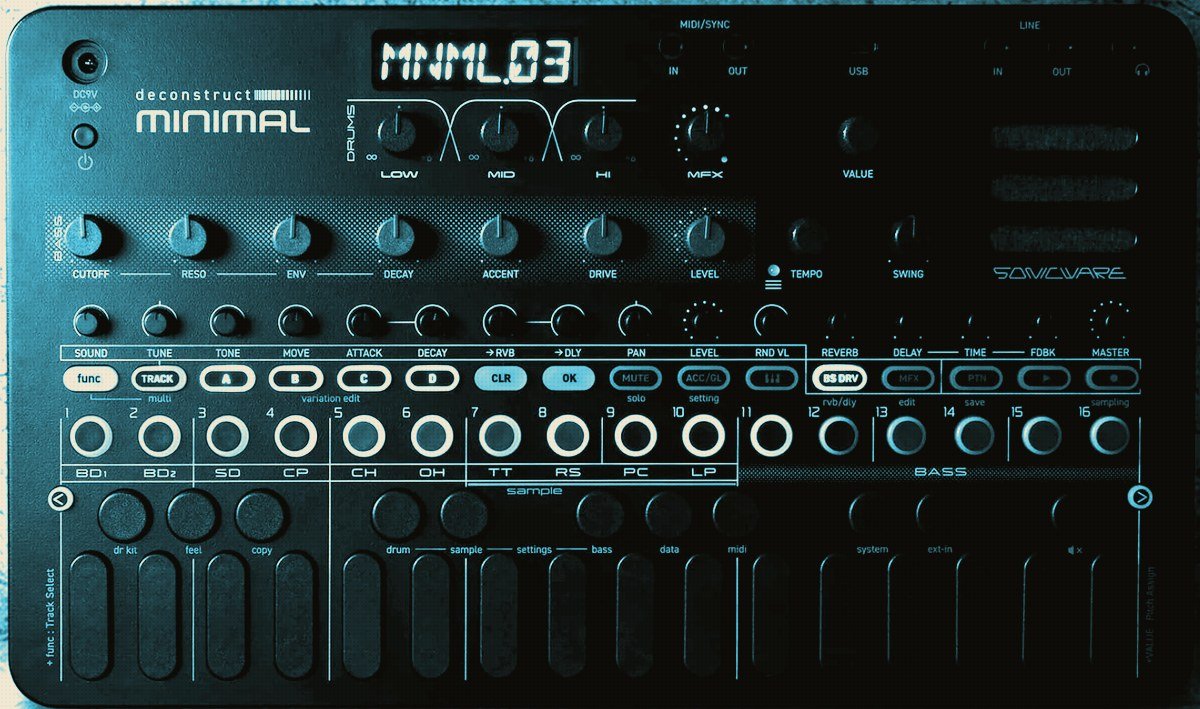
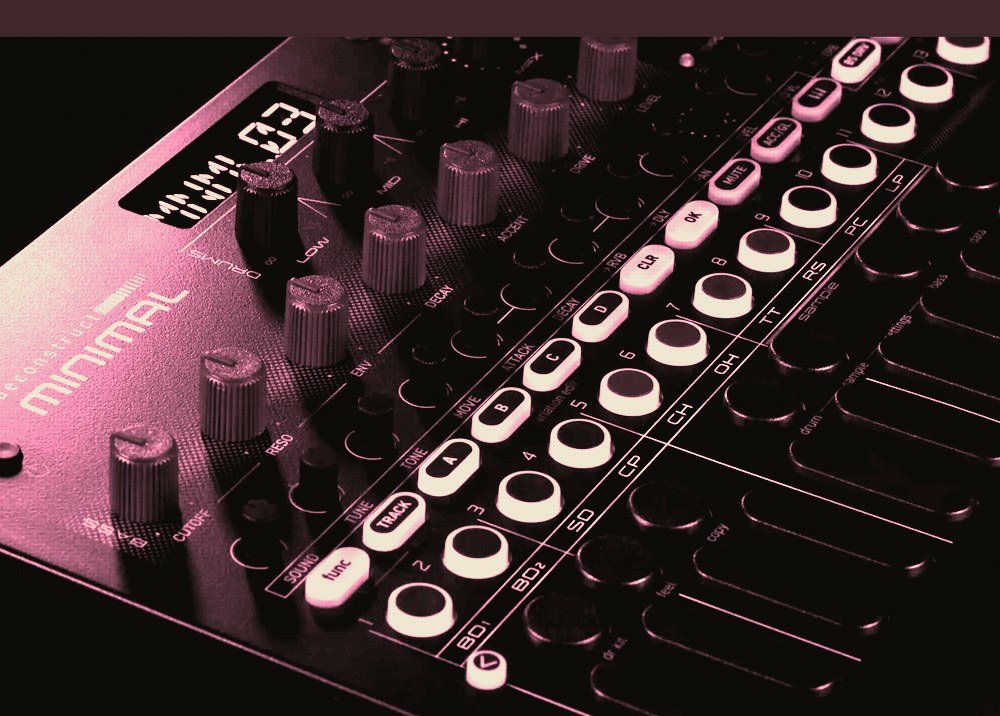
There are nine drum tracks — labelled BD1, BD2, SD, CP, CH, OH, TT, RS and PC on the panel. BD1 and SD have dedicated synthesis engines rather than playing samples; the hi-hats model the sound variation of analogue drum machines; the rest run from a sample-based engine with 16 kits and ten banks totalling 130 sounds. Tracks 7, 8 and 9 can load your own samples instead of drums.
Then there’s track 10, a dedicated stereo loop player with time-stretch, which Sonicware counts inside the drum machine — hence the “10-track drum machine” in the copy. And track 11 is the bass synth. Nine plus loop plus bass: eleven tracks in the sequencer.
The whole thing is 297 × 176 × 48 mm and weighs 840 g. It runs on six AA batteries or a 9V adapter, and there’s a small speaker built in. That matters less than it sounds — you will never use the speaker in a booth — but it means the box is genuinely a thing you can work on during a train journey and then carry into a venue without a case change.
Getting it into the mixer
This is the section nobody writes, and it’s the one that decides whether the box is usable to you.
The MINIMAL’s line output is a 3.5 mm stereo mini jack. Not a pair of quarter-inch TRS. Not balanced. One stereo mini jack, exactly like a headphone socket, and it is the only audio output on the machine other than USB and the headphone out.
So the cable you need is a 3.5 mm stereo mini jack to dual RCA, or to dual quarter-inch, depending on what your mixer’s line inputs take. It costs about eight dollars and it is not in the box. Buy two, because it’s a cable you can stand on.
There are no individual track outputs. The entire box — all eleven tracks, both send effects, the master effect — arrives at your mixer as one stereo pair on one channel. That’s a limitation if you were hoping to run kick and bass to separate channels, and it’s completely fine if you accept the premise: this is a channel, and you treat it the way you’d treat a deck.
Audio is one cable. Clock is the second, and it’s optional — see below.
The clock, and the setting that will bite you
MIDI in and out are 3.5 mm jacks on the top edge, sharing duty as sync jacks. The MINIMAL will send or receive MIDI clock, so it can be the master that everything else follows, or the slave that follows your player or software. Clock source is set in the system menu — internal, external, MIDI or sync.
If you need five-pin DIN, Sonicware sells a 3.5 mm TRS-to-MIDI adapter as an add-on. Buy it at the same time as the unit; chasing the right TRS MIDI adapter afterwards is a miserable afternoon.
But here is the setting that actually matters, and it is buried three levels down a menu where no DJ will find it by accident.
Set this before your first gig
By default, tempo is stored inside each pattern. Load a new pattern mid-set and the machine jumps to whatever BPM that pattern was saved at — which, if you built it on the sofa at 118 and the room is at 126, is a train wreck in front of people.
The fix is in the system menu: change tempo from pattern to global. Tempo then stays put across pattern changes. There is an equivalent setting for mutes, so your muted tracks stay muted when you switch patterns too.
Neither of those is a flaw. Both are the correct default for a producer sketching ideas, and the wrong one for anybody performing. It’s a two-minute change and it converts the box from a studio tool into a performance tool.
FEEL: the thing they actually built
Every groovebox claims a groove engine. Most of them mean swing. This one means something more specific, and it’s the reason the machine exists.
Sonicware’s stated approach was to measure how the 808 and the 909 misbehave — the timing fluctuations and pitch variation in the 808’s analogue circuitry, the tighter timing but variable velocity response of the 909 — and rebuild those as modulations running through both the sequencer and the sound engine. Not a swing percentage. Per-track randomisation of timing, pitch and level, modelled on specific machines.
Three settings, selected with the FEEL button:
- FEEL08 — an open feel with pronounced hi-hat pitch movement and small transient offsets on clap and snare.
- FEEL09 — tighter timing, subtler offsets, velocity randomisation spread across the instruments.
- FEEL.MN — Sonicware’s own, combining the 08 pitch movement with the 09 offsets into something more aggressive.
Whether it works is a listening question and we haven’t heard it in a room. But the intent is sound, and it is the same instinct that made those machines matter in the first place — we’ve written about that lineage at length in our history of the odd drum machines that built modern music. A groovebox that sits alongside a record needs to breathe the way the record does. Grid-perfect sits on top of a mix and never joins it.
Recovery: how fast can you undo it?
In the pillar we argued that the single most under-discussed criterion for a groovebox in a set is recovery — how quickly you can kill a bad pattern when the room is watching. A box you can’t back out of is a box you won’t risk using.
The MINIMAL is unusually good here, and none of it is marketed as a performance feature:
- Reload the saved pattern instantly. Press pattern, then OK. Whatever you’ve mangled reverts to the last save, live, without stopping playback. This is the panic button.
- Clear one track. Hold clear, press track. Removes that track’s steps and its recorded knob movements, leaving everything else running.
- Wipe the whole pattern. Hold clear, press pattern. Everything back to default.
- Reset every mute at once. Hold clear, press mute. Useful when you’ve muted your way into a corner.
- Fire a fill without committing. Hold OK and press a variation — it plays once, then drops you back where you were. The four variations chain into a 64-step pattern if you want length, or act as verse, breakdown and fill if you’d rather perform them.
Every one of those is a two-button move you can do without looking. That’s the test. If a recovery gesture needs a menu, it isn’t a recovery gesture.
The bass synth
Track 11 is an analogue-modelling monosynth built in the acid lineage, and Sonicware gives it seven dedicated knobs across the top of the panel rather than burying it in the shared context-sensitive row. That decision tells you what they think you’ll spend your time on.
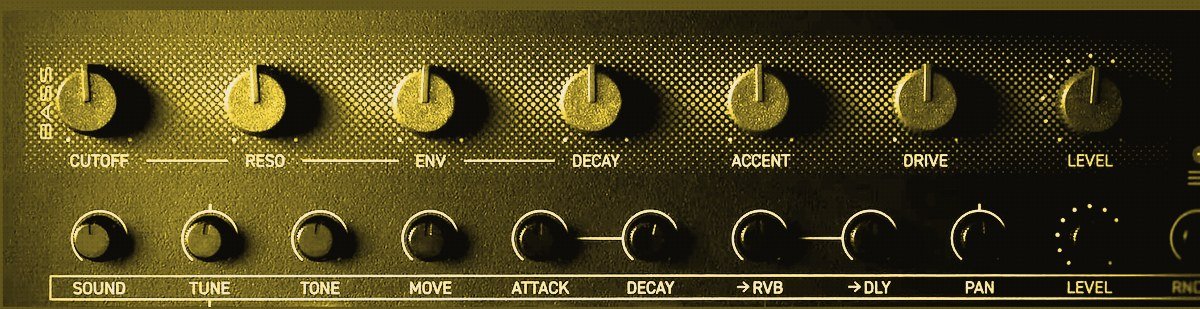
Four waveforms — saw, square, triangle, rectangle — plus an alternate S01 mode that blends between saw and square. There’s a sine sub oscillator at unison, one octave down or two, which can bypass the filter and sends entirely. Filter is a four-pole low-pass with resonance and an envelope amount. Glide time and curve are adjustable, as is gate time, and there’s a built-in overdrive on its own knob.
For a DJ, the practical note is that this is monophonic and it has a tune control. If you’re laying bass under a record rather than replacing it, you need to be in the same key, and there’s a transpose function for shifting the whole sequence when the next track isn’t. If key relationships aren’t something you already think about, our guide to harmonic mixing covers what you need — it applies just as much to a bassline you’re playing as to a record you’re bringing in.
Sampling, and what fits
Sampling is generous for the size, but the slot structure is fixed and worth knowing before you plan around it:
- 32 slots of two-second mono and 16 slots of four-second mono, loaded onto tracks 7, 8 and 9. Both have a repitch-to-tempo option so a break follows the sequencer.
- 12 slots of eight-second stereo on the dedicated loop track, with real-time time-stretch that holds pitch. Switchable between looped and one-shot playback, with a crossfade for pads and atmospheres and a retrigger position you can program per step.
- Everything is 48 kHz, 16-bit. You can sample through the line input, through USB, or import files over USB-C.
Note the mono limit on tracks 7 to 9 — stereo lives only on the loop track. That’s the right allocation for the money, but if you were planning to fly in stereo stabs across three tracks, you can’t.
The USB-C port also works as an audio interface, which means the box can go straight into a laptop for recording without a separate box in the chain. If you’re capturing sets, our guide to recording a DJ mix covers where that fits in a signal chain — the short version is that recording the groovebox separately from the mixer output gives you options you don’t get from a single stereo capture.
Effects, and the delay

Two sends, both with per-track amounts: a reverb offering room, hall and plate, and a tape-echo-style delay with BPM sync and a ping-pong mode. Delay output can be fed back into the reverb. Turning sync off decouples delay time from tempo, which at short settings is where the classic dub smearing lives.
Above those sits a three-band isolator for the drum tracks — low, mid and high, with full kill. On a machine going into a mixer channel this is genuinely useful: you can pull the MINIMAL’s own low end out before the mixer’s EQ ever sees it, which is how you stop two kicks fighting without touching the channel fader.
And there’s a single master effect knob with five modes: sweep filter, phaser, distortion, snip loop and a ducking compressor. Sonicware describes the filter as DJ-style, which is fair — it’s the same gesture as a mixer’s filter knob, just applied to this channel only. If you already work an isolator or filter as part of your mixing, this is the control you’ll reach for most.
What it isn’t
Being clear about the ceiling matters more than listing features:
- One stereo output. No individual outs, no way to split kick from bass at the mixer.
- Unbalanced mini-jack. Fine over short cable runs; not what you want stretched across a stage.
- Monophonic bass, one track. No chords, no second synth voice.
- Sixteen steps as the base pattern. Chaining the four variations gets you to 64, but this is not a long-form arrangement machine and doesn’t pretend to be.
- No adapter or batteries included. The pre-order bonus currently bundles a PSU and case; that offer will not last forever.
- Genre-shaped. The whole instrument is built around minimal techno and stripped-back house. If that isn’t the music you play, the specificity that makes it good stops being an advantage.
Availability, honestly
Sonicware’s own store lists the MINIMAL at $399, sold out, with pre-orders shipping late August 2026. Launch coverage reported an introductory $299 on the earliest units — that pricing is no longer offered. Sonicware ships direct, with free shipping and no import duties to the US, UK, Australia and Canada.
Early production runs were reported sold out ahead of launch, and the store has not come back into stock since. If you want one, the pre-order is the mechanism — this is not a machine that will be sitting on a shelf.
The verdict for DJs
The deconstruct MINIMAL is the cheapest way into the groovebox-as-a-channel approach, and it is not cheap because it’s compromised — it’s cheap because it refuses to be general-purpose. Nine drum tracks, a loop player and one acid bassline is the exact instrument list behind a great deal of the music you’d play it alongside.
What makes it interesting from behind a mixer isn’t the sound engine. It’s that the recovery gestures are two-button moves, the variations are laid out as performance controls, and the isolator lets you carve your own low end before the mixer ever sees it. Those are booth decisions, made by people who apparently thought about the booth.
Set tempo to global before you ever take it out. Buy the mini-jack cable and the MIDI adapter with the unit. And accept the genre: if you play minimal, techno or deep house, this is the one to start with. If you don’t, the thing that makes it good is the thing that will frustrate you.
Sonicware sells direct. We have no affiliate arrangement with them and earn nothing if you buy — this link exists because it’s where the machine comes from.
Read next
Grooveboxes for DJs: how to actually use one in a set — the three routing models, the five booth criteria, and how the MINIMAL compares to the Polyend Play+, the 1010music Bento, the EP-133 and the two sequencers that make no sound at all.