A 20-year fixture switched off the lights overnight, and a whole catalogue went dark with it. It’s worth asking what we’ve quietly traded away — and whether buying music still means anything in 2026.
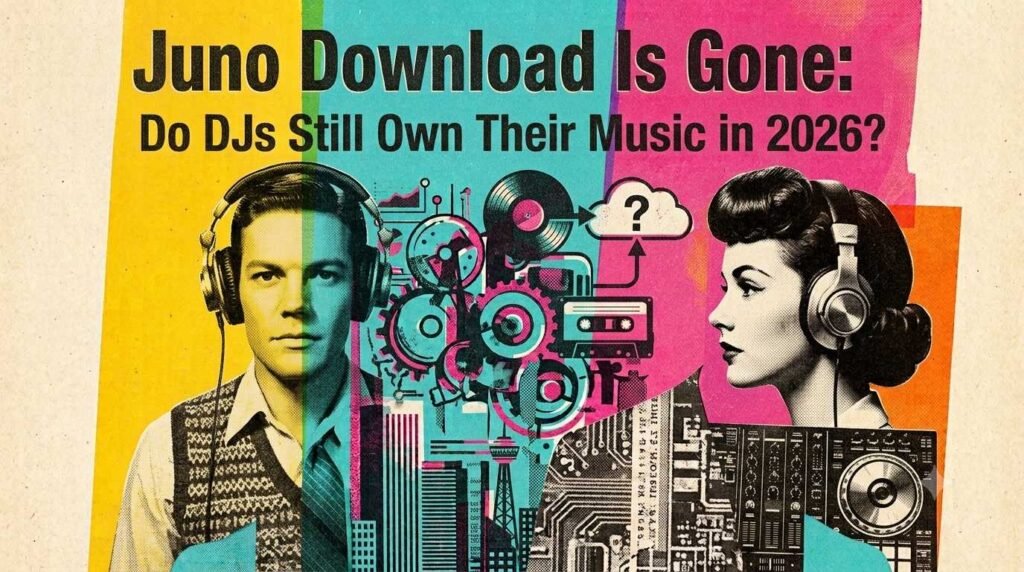
On Monday 1 June 2026, DJs who opened Juno Download to grab a track found a goodbye message where the store used to be. No countdown, no closing-down sale, no warning. Some people had been buying music from it hours earlier with no idea it was the last time. After twenty years, one of the original DJ download stores was simply gone — its social accounts wiped the same day.
If you never used Juno, this might read like a small thing. It wasn’t a giant, and plenty of working DJs never touched it. But for the diggers who did, it stings — because Juno was the place you went when Beatport didn’t have the track, or wanted too much for it. Old UK hardcore, hard trance, jungle, dancehall, pre-2015 oddities and bootlegs that never made it onto vinyl or anywhere else: if a record was obscure enough, there was a fair chance Juno had it when nobody else did.
And that’s the real loss. A lot of that catalogue didn’t migrate anywhere. When trackitdown folded a few years back, a chunk of UK hard dance went with it — releases that were never on Discogs and now survive only on someone’s old hard drive. Juno going dark does the same thing again, at a bigger scale. The scene lost a piece of its own memory overnight.
The bigger picture
Juno’s own explanation was the one you’d expect: streaming is now how most people consume music, artists reach fans directly through Bandcamp and social, and the standalone download store has become less relevant. The trend is real. The download model has been shrinking for years while streaming and direct-to-fan sales have taken over.
It’s also part of a wider squeeze. The DJ-music market is narrowing toward a handful of players big enough to carry streaming integrations and API deals. Beatport absorbed Beatsource entirely in March 2026, folding millions more tracks under one roof — and Beatport, Beatsource and DJcity already share the same parent. A mid-size independent stuck in the middle, like Juno, is simply a hard business to keep alive. Juno pushed its prices up over its final year; clearly it wasn’t enough.
There’s a counter-current worth noting, though: while downloads decline, vinyl sales topped $1 billion in 2025 and are still climbing. People aren’t done with owning music. They’re just done with owning it in a format that can vanish from a server without notice.
Own it, or rent it?
This is the question Juno’s closure forces, and it’s bigger than one store. More and more, DJs play from streaming services piped straight into their software or standalone gear. It’s miraculous when it works — tens of millions of tracks for less than the price of two singles a month. But it’s renting, not owning, and the difference matters more in a booth than almost anywhere.
A streamed track can disappear the day a licence lapses or a catalogue gets sold. Your curated streaming crate is only ever as reliable as the venue’s Wi-Fi and the platform’s contracts. Every DJ who’s had a track vanish mid-prep, or stood in a basement with one bar of signal, knows the feeling. A file on your own drive doesn’t do that. It’s there, it’s yours, and it plays whether the internet does or not.
Buying a track is a small bet that you’ll still be able to play it next year. Streaming is a bet that someone else will let you.
Why buying still matters
It’s not only about reliability. Two things keep purchasing meaningful even as it shrinks.
It pays the people who made the record. Streaming pays artists notoriously badly; buying a track — especially somewhere like Bandcamp, where the artist keeps a bigger cut — actually puts money in their pocket. For the independent labels and producers who supply the music we play, that’s not a romantic point. It’s the difference between a release breaking even or not.
And in electronic music, sales still carry weight that streams don’t. The Beatport-style charts that promoters, agencies and labels actually watch are built on purchases, not plays. A strong chart placement is a genuine calling card for a producer chasing gigs or label attention — and streaming simply doesn’t count toward it. When you buy a track instead of streaming it, you’re casting a vote that’s visible to the people who book and sign artists.
Where to buy DJ music now
If Juno was your shop, here’s the honest lay of the land in 2026 — and one urgent housekeeping job first.
Back up your Juno purchases today. You can still log into your account and re-download what you already bought, and if an old order won’t pull, a message to them usually sorts it. Don’t sit on this — grab everything and get it onto a physical drive while the gateway’s still up.
The bottom line
Streaming isn’t going away, and there’s no point pretending it doesn’t earn its place — for discovery, for breadth, for the gig where you genuinely need a track you don’t own. But Juno’s quiet death is a reminder not to let it become the only way you hold your music. Keep buying the records that matter to you. Keep local copies. Back up the things you can’t replace, because the next archive to vanish won’t warn you either.
Owning your music was never just about having the file. It’s a small act of preservation — of the scene’s memory, of the artists who made it, and of your own ability to play what you love on a night when nothing else is working. That’s worth holding onto, even as the shops switch off the lights one by one.