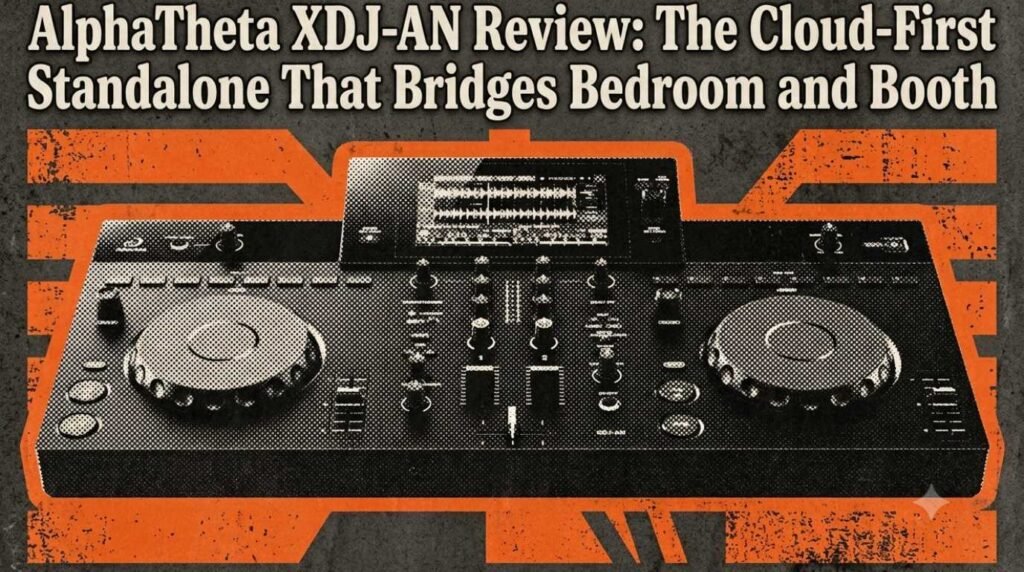
First look / All-in-one systems
AlphaTheta XDJ-AN review
A cloud-first, two-channel standalone built to walk you from the bedroom to the booth — streaming, cloud libraries and a club-style layout in one compact box.
AlphaTheta has a habit of quietly reshaping the middle of its range, and the XDJ-AN is the latest move: a two-channel, two-deck all-in-one system aimed squarely at the DJ who learned the ropes on a controller and now wants something that behaves like club gear — without the club-gear footprint or the club-gear price. It plays from a USB stick, from your phone or laptop, from the cloud, and directly from streaming services, all without a computer attached. The pitch is transition. The layout borrows from the units you’ll meet in a real booth, so the muscle memory you build at home carries over.
We haven’t had one on the bench yet — it was announced on 9 July 2026 and hasn’t shipped widely — so treat this as a specs-and-positioning first look. A scored, hands-on verdict follows once we’ve spent real time behind it. Everything below is verified against AlphaTheta’s own documentation.
What it actually is
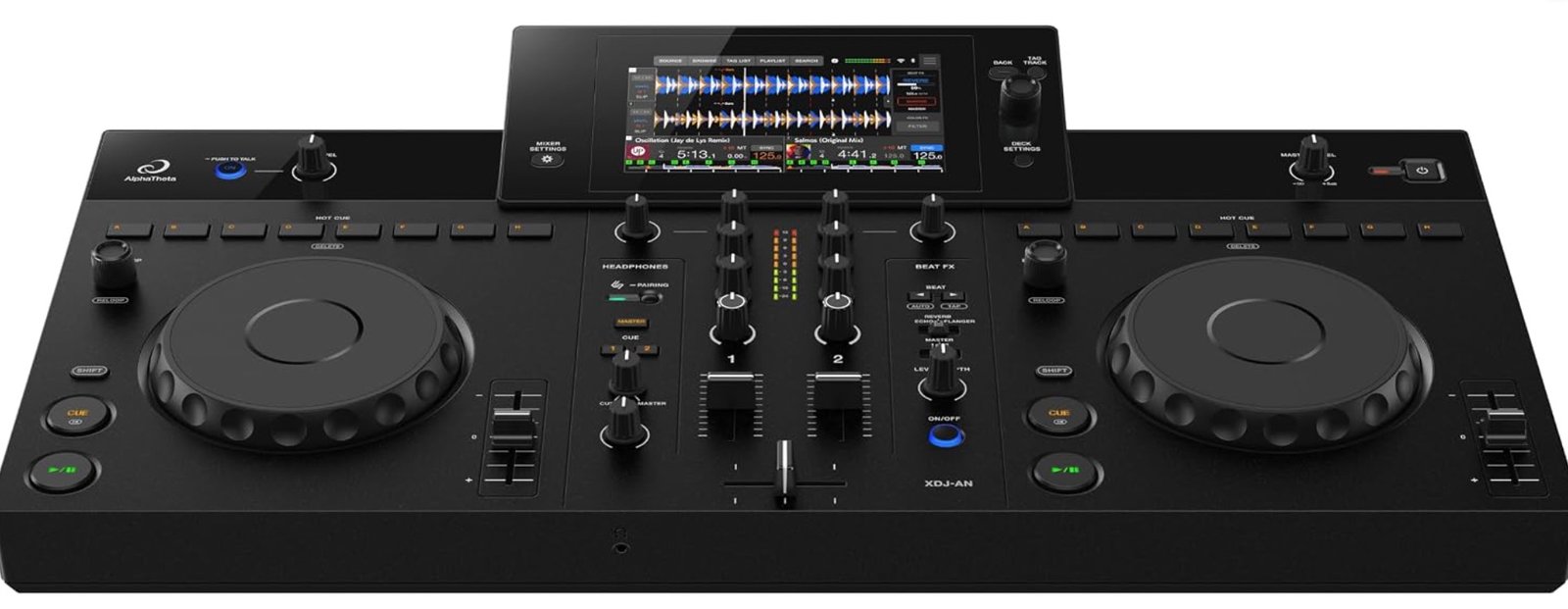
Standalone is the headline. The XDJ-AN is a self-contained system — you can perform straight from USB-C storage, from supported streaming services, or from a rekordbox cloud library, with no laptop in the chain. Plug a computer or mobile in over USB-C and it flips into a controller and audio interface for rekordbox, Serato DJ Lite or Pro, and Algoriddim’s djay. So it works both ways: a complete instrument on its own, or a familiar surface for the software you already run.
The screen is a 7-inch WSVGA (1024×600) touchscreen — the browsing and performance hub, showing your track list, waveforms, cues, loops, BPM and key. The jog wheels measure 132 mm, smaller than the platter on a flagship club CDJ like the 3000X but generous for a unit this size. If you’re stepping up from something like the controllers in our budget controller guide, this is the natural next rung: the same broad workflow, but standalone and built around a booth-standard control layout.
Don’t confuse it with the XDJ-AZ
These two share a naming convention and nothing else. The XDJ-AZ is the four-channel flagship — a 10.1-inch screen, full-size 206 mm jogs, dual USB-A slots, PRO DJ LINK, booth output, two mic inputs, a deep Beat FX bank, and a price around $3,199. The XDJ-AN is the two-channel, 7-inch, $1,199 entry into standalone. If a spec sheet quotes 4 decks or a 10.1-inch display for the AN, it’s a copy-paste error — that’s AZ territory.
Streaming and cloud, front and centre
This is where the AN earns its “cloud-first” billing. StreamingDirectPlay lets you browse and play tracks directly from streaming services on the unit itself — at launch that’s Apple Music, Beatport Streaming and TIDAL, each requiring its own active subscription. Spotify is listed as coming later via a firmware update, so it isn’t available on day one; if Spotify is your library, factor that wait in. Beatport in particular is a sensible pairing here — we dig into what that subscription gets a working DJ in our Beatport Streaming review.
On the cloud side, rekordbox CloudDirectPlay and Cloud Library Sync mean you can prep playlists and hot cues on a laptop, push them to Dropbox or Google Drive, and pull them straight down onto the AN — then edit on the unit and have those changes sync back. It’s the closest a compact box like this gets to a genuinely laptop-optional prep-to-performance loop. Note it uses rekordbox’s OneLibrary export format; older Device Library USB drives need converting in rekordbox first.

Connectivity: where the compromises live
The rear panel is honest about what this unit is. You get two master outputs — one balanced XLR pair and one RCA pair — plus a single ¼-inch TRS mic input. And that’s the extent of the analogue side: there’s no dedicated booth output, and no line or phono inputs for hooking up turntables or an external source. For a bedroom or a small mobile setup that’s fine; for a bar gig where you want separate booth monitoring, it’s a real limitation you’ll plan around.
Storage runs through a single USB-C slot — one drive at a time, which some DJs will miss coming from the dual-slot XDJ-RX3 when swapping media mid-set. A second USB-C handles computer and mobile connection, and a third is dedicated to power. That last point matters: the AN is not bus-powered — it ships with an AC adapter and needs mains. Headphone monitoring is via a 3.5 mm mini-jack only (no ¼-inch socket), so pro headphones with a fixed quarter-inch plug will want an adapter.
Wireless: SonicLink, Bluetooth, Wi-Fi
Wireless is genuinely a strong point. The AN has SonicLink — AlphaTheta’s proprietary low-latency monitoring — built in, delivering latency as low as 9 ms to compatible AlphaTheta headphones over a range of about 5 m, so you can monitor cable-free without the lag Bluetooth introduces. On top of that there’s Bluetooth input and output (handy for playing in a warm-up track from a phone, or sending audio out) and dual-band Wi-Fi for all the cloud and streaming features.
Mixer, pads and software
The mixer is a two-channel with three-band EQ and a per-channel Sound Color FX control (six colour effects). Beat FX are pared back to three — Reverb, Echo and Flanger — which is enough to add movement but a long way from the AZ’s much larger effects bank. If you’re an FX-led performer, that ceiling is worth knowing about upfront.
Each deck carries a row of performance pads for hot cues, loops and beat jumps, with the layout modelled on club units so the reflexes transfer. Worth being clear on stems: the AN does not run a stem-separation engine in standalone mode. Stem control is available when you connect it to a laptop running software that does the separation — Serato DJ Pro, for instance. If you’re weighing which engine to lean on, our breakdown of how the stem tools compare is the place to start, and our wider DJ software comparison covers which platform suits which style.
What works for it
- Genuine standalone play from USB, cloud and streaming — no laptop required
- StreamingDirectPlay for Apple Music, Beatport and TIDAL out of the box
- rekordbox CloudDirectPlay closes the prep-to-performance loop
- Built-in SonicLink monitoring at ~9 ms, plus Bluetooth in and out
- Club-style CDJ/DJM layout builds transferable muscle memory
- Compact and light at 5.2 kg for a standalone unit
Where it holds back
- No booth output and no line/phono inputs — limits bar and mobile use
- Single USB-C storage slot; no quick media swap mid-set
- Only three Beat FX; not built for FX-heavy performance
- Headphones are 3.5 mm only — adapter needed for ¼-inch plugs
- Spotify not supported at launch (promised in a later update)
- No onboard stem separation — software-side only
First-look verdict
A smart bridge — with a couple of catches
On paper the XDJ-AN nails its brief. It takes the standalone freedom and cloud/streaming smarts that used to live higher up the range and packages them at a price that makes sense for a DJ outgrowing a controller. The club-style layout, SonicLink monitoring and CloudDirectPlay loop are the real draws, and the compact chassis makes it easy to live with at home.
The catches are all about I/O and headroom: no booth out, no line inputs, one storage slot, three Beat FX, and a Spotify gap at launch. None are dealbreakers for the home-to-club DJ it’s built for — but if you’re a bar or mobile DJ who needs booth monitoring or external decks, look further up the range. It’s a strong step up from a controller, and a natural companion piece to the club players it imitates.
★ This review contains affiliate links. If you buy through them we earn a small commission at no extra cost to you — it helps fund independent testing and writing, and never changes our verdict. Read our full disclosure →