Last updated: November 2026 · Weird & Wonderful Gear
Which vintage samplers matter most, and can you still get their sound?
Six machines made between 1979 and 1988 took sampling from a studio luxury to something a DJ could carry: the Fairlight CMI, the E-mu Emulator II, the Ensoniq Mirage, the Casio SK-1, the E-mu SP-1200 and the Akai MPC60. Each one was limited in a different way. Low bit depths, short sample times and odd sample rates shape how records made on them sound. Today you can get most of the character for far less: Arturia sells software versions of the Fairlight and the Emulator II at $149 each, Casio has a new SK-1-inspired sampler, and Dave Rossum’s company rebuilt the SP-1200 until parts ran out.
Quick takeaways
- The Fairlight CMI (Sydney, 1979) came first, and you edited sounds on it with a light pen.
- The Casio SK-1 sampled at just 9.3 kHz for 1.4 seconds, and sold for £119 in Britain in 1986.
- The SP-1200 and MPC60 were both 12-bit drum samplers, and both came from engineers who had built drum machines first.
- Sample time was the real limit: the original SP-1200 held 10 seconds, the MPC60 13.1 seconds before expansion.
- Software emulations (Arturia CMI V, Emulator II V) are the cheapest route to the 8-bit sound.
- The Rossum SP-1200 reissue has finished: the 40th Anniversary Edition was the final run.
A sampler is an instrument that records a sound, stores it as digital data and plays it back from keys or pads, usually at different pitches. Every DJ who has fired a one-shot from a controller pad or chopped a loop in a groovebox is using an idea these six boxes made cheap enough to own. This post is part of our Weird & Wonderful series, which started with odd drum machines and moved on to Soviet synths.
What you get here that the usual “classic samplers” list doesn’t give you: the specs pulled from the original 1985 and 1986 magazine reviews, the designers’ own sites and museum records, laid side by side in one table and one chart, plus a plain map of which modern product gets you closest to each machine.
What were the first samplers, and why do they sound different?
Early samplers sound different because they stored sound with fewer bits and fewer samples per second than a CD or a modern WAV file. An 8-bit sampler has 256 possible levels for each sample, so quiet parts pick up grit and noise. A low sample rate cuts the high end. When you pitch a sample down on these machines, the dulling and the grain get stronger, which is where a lot of the “crunchy” drums and dusty pads on 1980s and early 1990s records come from.
The table below puts the six side by side. Every figure comes from the source named in the right-hand column.
| Machine | Year | Bit depth | Sample rate | Max sample time | Voices | Source |
|---|---|---|---|---|---|---|
| Fairlight CMI | 1979 | 8-bit | Not in our sources | Not in our sources | Not in our sources | NFSA, Arturia |
| E-mu Emulator II | 1984 | 8-bit (companded) | 27.7 kHz | Not in our sources | 8 | Arturia |
| Ensoniq Mirage | Reviewed July 1985 | 8-bit | 33 kHz | 2.2 s per keyboard half | 8 | E&M Maker, Jul 1985 |
| Casio SK-1 | Reviewed July 1986 | 8-bit PCM | 9.3 kHz | 1.4 s | 4 | Making Music, Jul 1986 |
| E-mu SP-1200 | 1987 (production) | 12-bit | 26.04 kHz | 10 s (original) | Not in our sources | Rossum Electro-Music |
| Akai MPC60 | 1988 | 12-bit (non-linear) | 40 kHz | 13.1 s (26.2 s expanded) | 16 | Roger Linn Design, Sound On Sound |
Table: The DJ Mixtape, from the sources listed, checked November 2026. “Not in our sources” means no official or period source we could check gave the figure, so we left it out rather than guess.
Chart: The DJ Mixtape, from Making Music (Jul 1986), Electronics & Music Maker (Jul 1985), Arturia, Rossum Electro-Music, Roger Linn Design and Casio spec pages, November 2026. Fairlight CMI left out: no sourced sample rate.
Fairlight CMI: the sampler you drew on with a pen
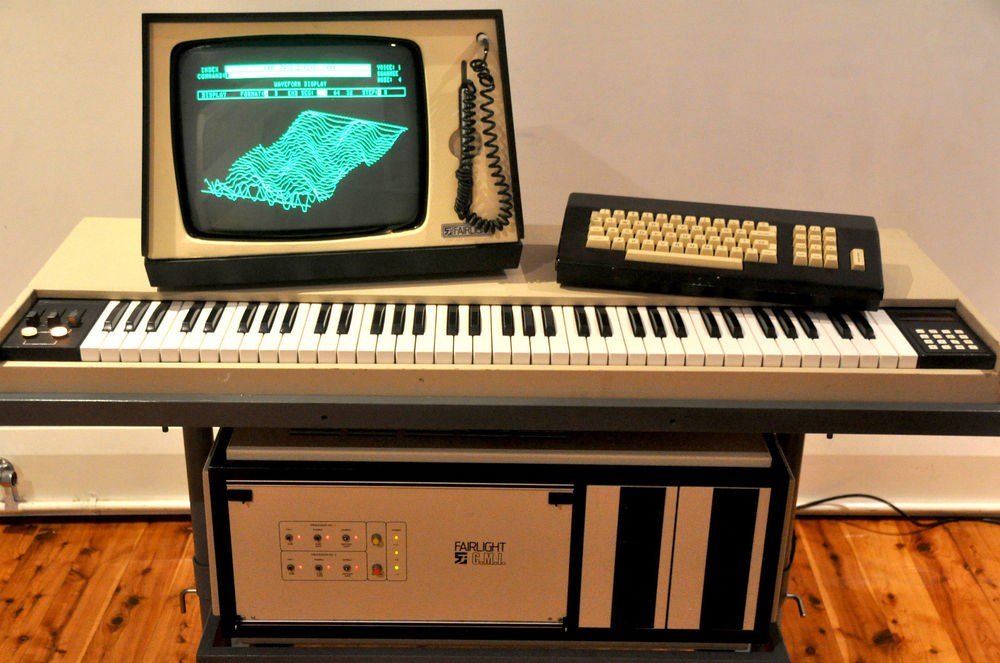
Fairlight CMI Series IIx. Photo: Peter Wielk, Wikimedia Commons, CC BY-SA 4.0.
SYDNEY · 1979 · 8-BIT · LIGHT PEN
The Fairlight CMI is the first sampler most people name, and it came from Sydney: the National Film and Sound Archive of Australia credits Peter Vogel and Kim Ryrie with inventing it in 1979, built around a dual-6800 microprocessor design by Tony Furse. CMI stands for Computer Musical Instrument, and it looked like one: a computer mainframe, a monitor and a music keyboard.
What made it odd
You edited sounds by drawing on the screen. The Science Museum Group holds a Series 3 light pen alongside the keyboards and monitor, and its Series 3 mainframe alone weighs 45 kg. The museum’s catalogue calls the system “an early digital audio workstation”, since it put a synth, a sampler and a sequencer in one unit. The sequencer screen, Page R, became famous in its own right.
Where it turned up
NFSA names Kate Bush and Brian Eno among the users and says Fairlight samples became ubiquitous in 1980s pop. The Science Museum’s Series 3 was used at Abbey Road in the late 1980s.
How to get the sound today
Arturia CMI V models a fully specified CMI Series IIx. Per Arturia, it ships with 600 samples from the original CMI library and 360 presets, a Page R-inspired 32-step sequencer, and a sampler that records up to 30 seconds at a variable rate from 2.1 kHz to 44.1 kHz, so you can choose how lo-fi to go. Arturia’s US store lists it at $149.
Video: official CMI V overview from Arturia’s YouTube channel. Loads from YouTube when you press play.
E-mu Emulator II: a sampler that behaved like a synth
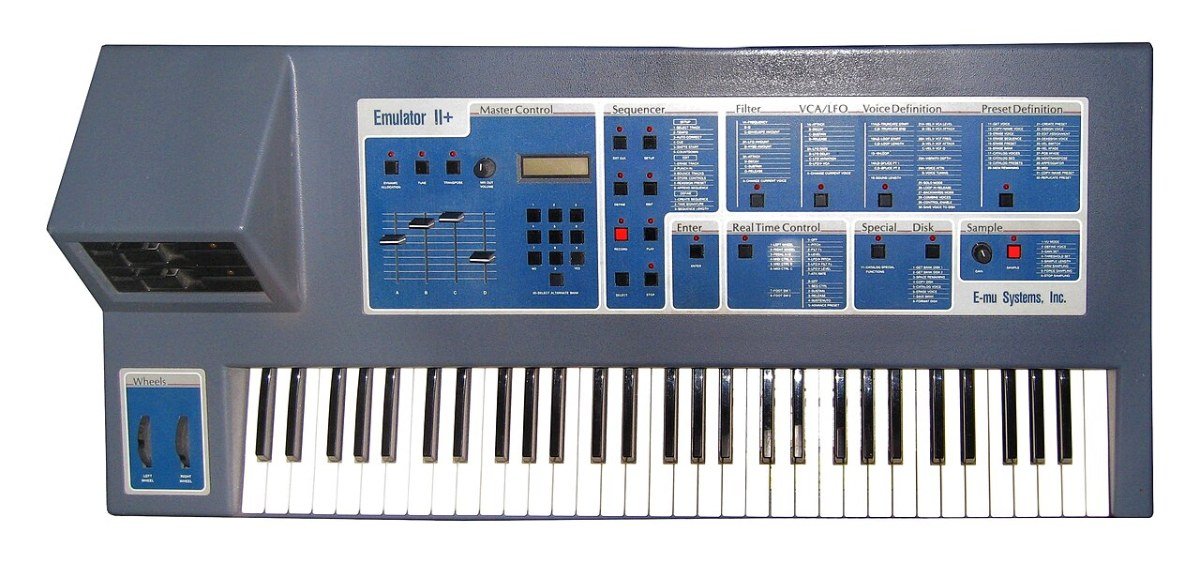
E-mu Emulator II+, the expanded version of the Emulator II. Photo: Mojosynths, Wikimedia Commons, public domain.
1984 · 8-BIT COMPANDED · 27.7 kHz · 8 VOICES
The E-mu Emulator II was the upgraded follow-up to E-mu Systems’ first Emulator, and per Arturia’s history of the instrument it reached the market in 1984 with Dave Rossum at the head of E-mu. It sampled at 27.7 kHz with 8-bit companding, a trick that squeezes more usable quality out of 8 bits by spending more of them on quiet sounds.
What made it odd
Each of its eight voices had its own analogue-style filter, LFO and envelopes, per Arturia, so a sampled sound could be shaped like a synth patch. That made it sit halfway between a tape-replay instrument and a synth, which is why its choirs and strings sound part real, part machine.
Where it turned up
Arturia lists Depeche Mode, New Order, Genesis, John Carpenter and Trent Reznor among its users.
How to get the sound today
Arturia Emulator II V costs $149 on Arturia’s site and is part of V Collection 11 Pro. Arturia says it keeps the original 8-bit companding and 27.7 kHz rate, and adds 250-plus presets, 11 master effect types, a six-mode arpeggiator and MPE support.
Video: official Emulator II V video from Arturia’s YouTube channel. Loads from YouTube when you press play.
Ensoniq Mirage: the keyboard that split itself in half
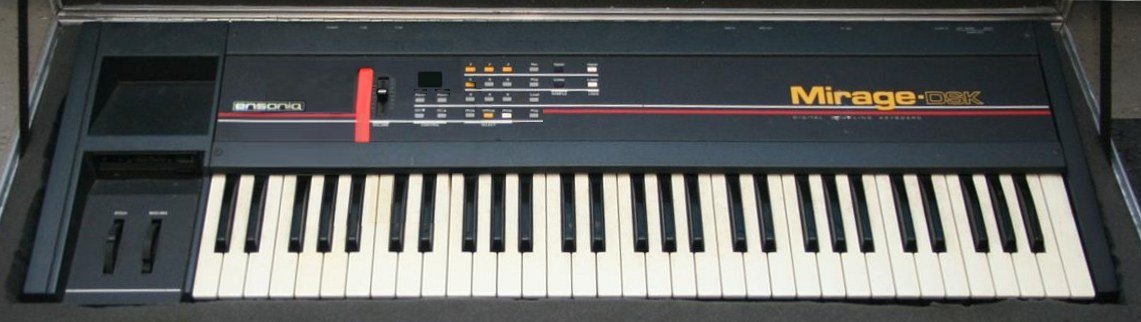
Ensoniq Mirage keyboard. Photo: emily przybylinski and Johnr (derivative work), Wikimedia Commons, CC BY 2.0.
8-BIT · 33 kHz · 64K PER HALF · 3.5″ DISKS
The Ensoniq Mirage brought keyboard sampling down to a price a gigging musician could think about. When Paul Wiffen reviewed it for Electronics & Music Maker in July 1985, it offered 2.2 seconds of 33 kHz, 8-bit sampling for each half of a five-octave keyboard, played back through an eight-voice analogue-style synth section.
What made it odd
The memory was split: 64K for the lower half of the keyboard and 64K for the upper half, so you thought in pairs of sounds. Each 3.5-inch disk held three pairs of samples plus four programs, and the operating system itself loaded from disk in about 15 seconds every time you switched on. There was even a 333-note sequencer.
The price kept falling. By the time E&M Maker reviewed the rack version in May 1986, the keyboard’s British price had dropped from £1,695 to £1,295.
How to get the sound today
We couldn’t find an official Mirage emulation from a maker with rights to the name, so the honest route is sample packs: multisampled Mirage patches turn up in libraries for any DAW sampler. Our guide to finding samples for your music covers where to look, and a subscription library such as Loopcloud is the quickest way to audition vintage-sampler packs before you pay for one.
Casio SK-1: the £119 toy that taught a generation to sample
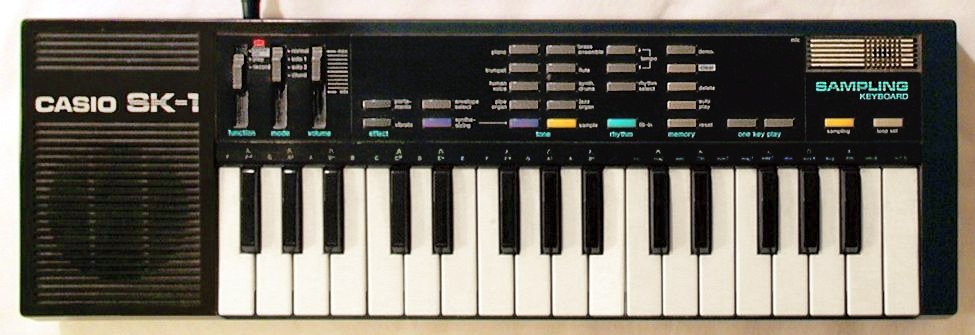
Casio SK-1. Photo: Vlad Spears (derivative work by Clustern), Wikimedia Commons, CC BY-SA 2.0.
8-BIT · 9.3 kHz · 1.4 SECONDS · BUILT-IN MIC
The Casio SK-1 is the cheapest machine here and the one most people actually owned. Making Music reviewed it in July 1986 at £119: 8-bit PCM sampling at 9.3 kHz, a maximum of 1.4 seconds, four-note polyphony, two and a half octaves of mini keys and a microphone built into the top right corner. It ran on five penlight batteries and weighed 1.1 kg.
What made it odd
It was a home keyboard that happened to sample. You held it up to a radio, a dog or your own voice, pressed record and played the result back across the keys. At 9.3 kHz almost all the top end goes, which is exactly the lo-fi colour later producers went looking for.
How to get the sound today
Casio’s own answer is the SXC-1, a 315 g pad sampler with 16 pads, a built-in mic, 16-bit/48 kHz sampling and up to 15 minutes of sample time, per Casio’s spec table. MusicRadar reports it comes loaded with preset sounds from the SK-1 and MT-40 and launched in Japan at ¥39,930 (around $250). We couldn’t find a US listing or US price at the time of writing, so check before you plan around it.
Video: official SXC-1 brand film from the CASIO Japan YouTube channel. Loads from YouTube when you press play.
E-mu SP-1200: ten seconds that defined a drum sound
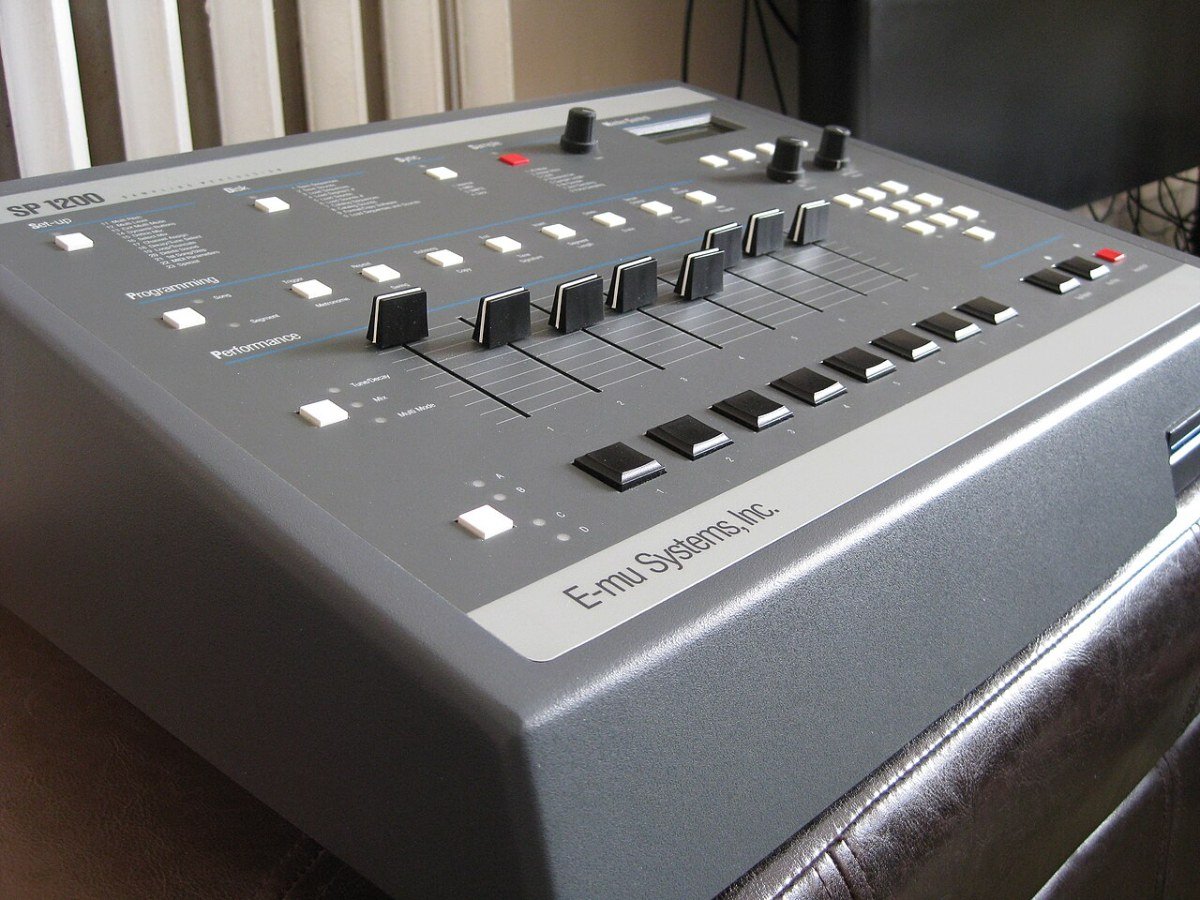
E-mu SP-1200. Photo: 2xUeL, Wikimedia Commons, public domain.
12-BIT · 26.04 kHz · 10 SECONDS · 8 SLIDERS
The E-mu SP-1200 is a 12-bit drum sampler designed by Dave Rossum, the E-mu co-founder who also designed the SP-12 that started the series in 1985, according to Rossum Electro-Music. It sampled at 26.04 kHz, and Rossum notes that in 1987 the cost of RAM held production models to 10 seconds of sample time in total.
What made it odd
Ten seconds had to cover every sound in a project, so samples were kept short. Playing a 12-bit, 26.04 kHz sample back at a lower pitch stretches it out and adds grain, which is why tuned-down SP-1200 drums sound rougher than the same break played at its original pitch. Rossum lists eight slide controls on the front panel, so it played more like a small mixer than a computer.
Where it is now
Rossum Electro-Music built a new SP-1200 from 2021 to 2025 at $3,999, with 20 seconds of sample time, an SSI2144 analogue filter and memory-card storage, per its product page. A rebuilt original, the 2020 35th Anniversary Renovation, cost $7,500. The 40th Anniversary Edition (100 units, $4,999) was the last run: Rossum says parts, especially the discontinued Z80 CPU, are no longer available. Both batches show as sold out, so used units are the only hardware route now.
Akai MPC60: Roger Linn’s pads, Akai’s badge
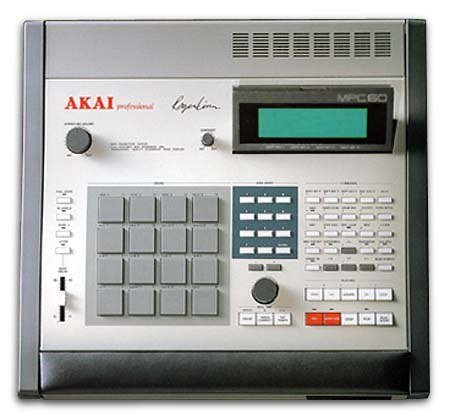
Akai MPC60. Photo: Kimi95 (Italian Wikipedia), Wikimedia Commons, CC BY 3.0.
1988 · 12-BIT · 40 kHz · 16 PADS · 16 VOICES
The Akai MPC60 put a 4×4 grid of drum pads on a sampler. Roger Linn’s own museum page dates it to 1988 and lists up to 26 seconds of 12-bit non-linear sampling at 40 kHz, 16 voices, two MIDI inputs and four MIDI outputs. Sound On Sound adds that the base memory gave 13.1 seconds of mono audio and that MPC first stood for MIDI Production Center.
What made it odd
The pads were the new part. Linn had already built the LM-1 (announced 1979, $5,000, about 500 made), which his site says introduced timing correction and swing to drum machines. The MPC60 combined that sequencing feel with sampling and pads you played with your fingers.
How to get the sound today
Akai still sells standalone MPCs. The MPC One+, which Akai describes as a standalone MPC with built-in sounds, keeps the pad-and-sequencer workflow the MPC60 started. If you want to use pads and samples inside a DJ set rather than a studio, our guide to grooveboxes for DJs covers how to fit one into a booth.
Check the Akai MPC One+ on Amazon
Which vintage sampler sound should you chase?
Pick by the part of your set you want to change. The flow below starts from what you’d actually use the sound for.
Chart: The DJ Mixtape, from Arturia, Akai Professional, Rossum Electro-Music and Casio product pages, November 2026.
When did each sampler arrive?
All six arrived in under a decade, and the price fell at every step. The Fairlight was a studio computer in 1979, while by 1986 Casio was selling a sampler for £119.
Chart: The DJ Mixtape, from NFSA, Arturia, Electronics & Music Maker (Jul 1985), Making Music (Jul 1986), Rossum Electro-Music, Roger Linn Design and Casio, November 2026. Mirage and SK-1 dated by their first UK reviews.
Buying a vintage sampler used: what to check
A used vintage sampler is a 35-to-45-year-old computer, so check the parts that fail. Floppy drives are the weak point on the Mirage, SP-1200 and MPC60: ask for a demo that loads from disk, or budget for a floppy emulator. Rossum’s own SP-1200 renovation swapped in an SD card floppy emulator for this reason. Check that every pad, key and slider responds, and listen for crackle on the faders. Ask whether the memory has been expanded, since an MPC60 with 26.2 seconds is far more usable than one with 13.1. For most DJs, the software routes above cost less than a service bill on the real thing.
FAQ
What was the first commercial sampler?
The Fairlight CMI, invented in Sydney in 1979 by Peter Vogel and Kim Ryrie, is the machine Arturia calls the first commercially available digital sampling system.
Why do old samplers sound gritty?
They stored sound at low bit depths (8 or 12 bits) and low sample rates (9.3 kHz to 40 kHz in our table). That adds noise and cuts the high end, and pitching samples down makes both effects stronger.
Can I get the SP-1200 sound without an SP-1200?
Not as new hardware any more: Rossum’s reissue has ended. A bit-crusher or sample-rate reducer set to 12 bits and about 26 kHz gets you part of the way. Tuning samples down after you reduce them adds the rest of the grain.
Is the Casio SK-1 still worth buying?
As a toy and a sound source, yes, if you accept 1.4 seconds of 9.3 kHz audio. If you want the presets with modern memory, Casio’s SXC-1 includes SK-1 sounds, though we couldn’t confirm a US release at the time of writing.
Are vintage sampler plugins good for DJs?
They’re most useful for making edits, intros and one-shots you then load into your DJ software. Arturia CMI V and Emulator II V run as VST, AU and AAX plugins or standalone, so you can build sounds without a DAW-heavy setup.
Start here
- Producer-DJs making edits who want 1980s pads and hits: Arturia Emulator II V or CMI V, $149 each.
- Hip-hop and breaks DJs who want the drum feel: a modern MPC, or a used SP-1200 if you have the budget and a technician.
- Anyone who just wants to play with sampling: a used SK-1, or Casio’s SXC-1 if it reaches your country.
- Skip original Fairlights and Emulators unless you’re a collector. The software versions do the job for a fraction of a service bill.
How we research: specs and prices checked against official and period sources in November 2026 (maker pages, designers’ own sites, museum records and the original 1985 to 1986 magazine reviews). UK prices are quoted where they are the only period price on record. Charts and diagrams are our own, drawn from those sources. Demo videos come from the makers’ official channels. By Dan, The DJ Mixtape (DJing since 1994).